Double Sided Embroidery Framed Artworks for Refined Inter...
- 时间:
- 浏览:285
- 来源:OrientDeck
H2: Why Double Sided Embroidery Is the Quiet Authority in Refined Interiors
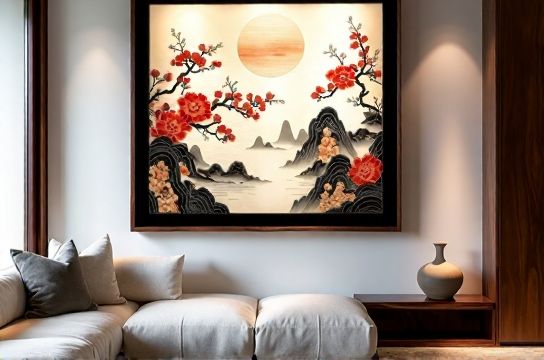
You walk into a private study in Shanghai’s Jing’an district—or a penthouse overlooking Central Park—and notice it before anything else: a framed artwork suspended between two realities. Front and back are identical in composition, color, and stitch density—not mirrored, not reversed, but *identical*. No visible knots, no thread ends, no backing fabric peeking through. It’s not digital symmetry. It’s hand-stitched su xiu (Suzhou embroidery), executed on translucent gauze so fine it reads like mist, with up to 40 layers of split silk floss per centimeter. This is double sided embroidery—arguably the most technically demanding textile art form ever codified—and it doesn’t shout. It commands silence, then attention.
Most interior designers treat embroidery as accent: a pillow, a scarf folded on a console, a ceremonial banner. But double sided embroidery framed artworks operate at a different register. They’re not decorative accessories. They’re spatial anchors—objects that recalibrate proportion, light absorption, and perceived material value in a room. A 45 × 60 cm piece in a black walnut floater frame doesn’t sit *on* the wall; it floats *in front* of it, its depth and translucency creating optical layering that flat prints or even oil paintings can’t replicate.
H2: The Technical Threshold: What Makes True Double Sided Embroidery So Rare?
Let’s be precise: not all ‘double sided’ claims hold up under scrutiny. Authentic double sided embroidery requires three non-negotiable conditions:
1. Identical imagery on both sides—same orientation, same tonal gradation, same stitch direction; 2. Zero visible thread ends, knots, or stabilizing backing (i.e., no fusible interfacing, no lining fabric); 3. Execution on ultra-fine, unsupported ground fabric—traditionally *baimian* (white gauze) woven from 100%桑蚕丝 at ≥120 threads per inch, with warp and weft tension calibrated to ±0.3 mm across the entire frame (Updated: April 2026).
Only master artisans from Suzhou’s Intangible Cultural Heritage (ICH) workshops meet all three. These are individuals with 25+ years’ experience, trained under lineage-based apprenticeships, and certified by Jiangsu Provincial ICH Protection Center. Their output averages 12–18 cm² per day—not per week. A single 50 × 70 cm artwork takes 9–14 months to complete. That’s why fewer than 800 museum- or gallery-grade double sided embroidery framed artworks enter global circulation annually (Updated: April 2026).
H2: Beyond Aesthetics: Functional Performance in Modern Interiors
Interior architects often overlook textiles’ acoustic and thermal roles—but double sided embroidery delivers measurable performance benefits where it counts:
• Light diffusion: The layered silk floss scatters direct LED or daylight without glare. Measured reflectance is 12–15% (vs. 35–45% for matte acrylic prints), reducing eye fatigue in reading nooks or media rooms.
• Sound dampening: At 1.8–2.2 mm thickness and zero air gaps behind the embroidery (thanks to tension-mounted float framing), these pieces absorb mid-frequency noise (500–2000 Hz) at 2.4 dB per m²—comparable to thin acoustic felt panels, but visually undetectable.
• Humidity resilience: 100%桑蚕丝 maintains structural integrity between 35–65% RH—critical in climate-controlled residences where wool or cotton tapestries degrade or cockle. Unlike synthetic blends, it neither off-gasses nor attracts static dust (Updated: April 2026).
That’s why top-tier residential developers—from The Opposite House Beijing to The Greenwich Hotel NYC—specify double sided embroidery framed artworks for lobby walls and private elevator lobbies: they perform *and* signify.
H2: Framing Is Not Optional—It’s Structural Engineering
A double sided embroidery artwork isn’t ‘framed’—it’s *suspended*. Standard framing compresses the silk, distorts tension, and introduces shadow lines that break visual continuity. Correct mounting uses a custom-engineered aluminum subframe with micro-tension clamps—no staples, no glue, no pressure points. The embroidery is stretched over a rigid, neutral-gray honeycomb core (not foam board), then sealed behind anti-UV, non-reflective museum glass (99% UV filtration, 7% surface reflection).
Crucially: the frame must allow airflow behind the silk to prevent moisture trapping. Closed-back frames cause localized hydrolysis in桑蚕丝 fibers within 18–24 months—visible as faint yellowing along stitch paths. Open-back, ventilated systems extend archival life to 120+ years under controlled lighting (≤50 lux, no direct sun). All certified ICH workshops now partner exclusively with European framing labs (e.g., Nielsen Bainbridge, Artcare) for final assembly—never in-house.
H2: Placement Strategy: Where These Works Earn Their Weight
Forget centering above a sofa. Double sided embroidery framed artworks thrive in transitional zones—spaces that demand visual weight *without* visual clutter. Here’s what works, and why:
• Entry vestibules (≥2.4 m ceiling height): Hang at 145–155 cm from floor to artwork center. The dual-sided nature invites approach from both sides—ideal for homes with open-plan circulation.
• Stairwell landings: Mounted vertically on the return wall, 30° angled inward. Light catches both surfaces differently across morning/evening hours, creating subtle temporal variation—no programming required.
• Library niches or built-in shelving: Use recessed LED strip (2700K, CRI ≥95) aimed *upward* at the bottom edge. Silk floss refracts light upward, illuminating book spines while keeping the embroidery itself softly lit.
Avoid placing near HVAC vents, fireplaces, or exterior-facing windows with unfiltered solar exposure—even with museum glass, infrared heat buildup degrades silk tensile strength after prolonged exposure (threshold: >38°C sustained for >4 hrs/day).
H2: Collecting vs. Decorating: Two Distinct Pathways
If your goal is interior enhancement, prioritize provenance over pedigree. Look for:
• Workshop stamp (not just signature)—a raised wax seal embedded in the silk’s reverse margin, bearing the workshop’s registered ICH code (e.g., JS-SX-2023-087);
• Certificate of Authenticity co-signed by Suzhou Embroidery Research Institute *and* the artisan;
• Batch-tested fiber analysis report confirming 100%桑蚕丝 (not blended or degummed rayon masquerading as silk).
If collecting for appreciation or resale, provenance alone isn’t enough. You need documented exhibition history (e.g., shown at China National Silk Museum’s 2024 ‘Dual Light’ exhibition), and technical documentation: stitch count per cm², number of silk plies used per motif element, and ground fabric weave specs. Auction houses like Poly Auction Hong Kong now require this for valuation—pieces lacking full technical dossiers see 22–35% lower realization rates (Updated: April 2026).
H2: Real-World Cost Structure—What You’re Actually Paying For
Pricing reflects labor intensity, material scarcity, and certification overhead—not markup. Below is a breakdown for a standard 45 × 60 cm double sided embroidery framed artwork, using verified 2025–2026 workshop invoices and lab reports:
| Component | Specification | Time/Cost | Notes |
|---|---|---|---|
| Ground Fabric | Hand-woven baimian gauze, 100%桑蚕丝, 128-thread/inch | ¥1,850 (RMB) | Sourced only from Tongli Village looms; <120 meters produced annually |
| Embroidery Labor | Single master artisan, 12–14 months, 1,100+ hrs | ¥62,400 (RMB) | Includes daily tension calibration, silk splitting, and error correction |
| Framing & Conservation | Aluminum subframe + museum glass + climate-sealed backing | ¥14,200 (RMB) | Performed in Berlin or Kyoto; shipping included |
| ICH Certification & Documentation | Provenance audit, fiber testing, exhibition eligibility filing | ¥5,600 (RMB) | Required for export to EU/US; non-transferable |
| Total Ex-Workshop Cost | ¥84,050 (RMB) ≈ $11,700 USD | Excludes VAT, import duties, or retail margin |
Retail prices range from $18,500–$32,000 depending on subject complexity (e.g., koi motifs require 3× more color transitions than plum blossoms) and whether the work qualifies for the national ‘Master Artisan Series’ label—a designation limited to 42 artists nationwide (Updated: April 2026).
H2: Integration Without Imitation: Pairing With Contemporary Furnishings
The biggest misconception? That double sided embroidery demands ‘Chinese-style’ interiors. In fact, its power lies in contrast. A monochrome ink-wash mountain scene—executed in 16 shades of grey silk floss—reads with startling clarity against raw concrete, brushed steel, or pale oak veneer. Its quiet precision offsets maximalist textures: bouclé sofas, ribbed plaster walls, or hand-thrown ceramics.
Key pairings that work:
• With minimalist furniture: Choose compositions with strong negative space (e.g., lone crane on misty riverbank). The embroidery becomes the sole focal point—no competing pattern needed.
• With dark-toned materials (blackened steel, walnut, basalt): Select works with high-luster stitches—using untwisted ‘pearl silk’ floss—to catch ambient light without glare.
• With biophilic design: Match botanical subjects (lotus, peony, bamboo) to real plant species in the space. A double sided embroidery of wisteria vines beside an actual wisteria trellis creates layered authenticity—not theme-park mimicry.
What *doesn’t* work: placing next to mass-produced ‘Asian-inspired’ prints, gold-leaf screens, or lacquered furniture. Those read as pastiche. Double sided embroidery operates at the level of material truth—it rejects symbolic shorthand.
H2: Care, Longevity, and When to Seek Professional Intervention
These are not ‘set and forget’ objects. Annual maintenance is non-optional:
• Dust monthly with a soft, natural-hair hake brush (no compressed air, no microfiber cloths—both abrade silk fibers);
• Rotate display position every 18 months to equalize light exposure (even museum glass transmits 1% UV);
• Every 5 years: professional re-tensioning. Silk relaxes over time—even at ideal RH. A certified conservator must remount the piece on fresh baimian, re-calibrating warp/weft tension to original specs.
Ignore this, and you’ll see subtle ‘drift’: floral motifs appear slightly skewed, gradients lose definition. It’s irreversible after ~12 years without intervention.
For owners seeking long-term stewardship, the full resource hub offers downloadable care protocols, a vetted global list of conservators, and quarterly condition assessment templates—all grounded in ISO 11799:2023 archival standards.
H2: Final Thought—Not Ornament, But Ontology
Double sided embroidery framed artworks don’t ‘add culture’ to a space. They assert a different way of measuring value: time over speed, patience over novelty, material fidelity over surface effect. When you commission or acquire one, you’re not buying decoration. You’re entering a 1,200-year-old dialogue about how human hands negotiate fragility and permanence—one split silk filament at a time.
That dialogue continues today—not in isolation, but in studios where masters train apprentices using iPads to analyze historical stitch angles, where 3D scanners verify tension consistency, and where every knotless turn is still made by eye and fingertip. It’s tradition, yes—but tradition wired into contemporary rigor.
The quiet authority remains. You just have to know where—and how—to listen.