Premium Silk Scarves Featuring Classic Chinese Landscape ...
- 时间:
- 浏览:313
- 来源:OrientDeck
H2: Why a Silk Scarf With Chinese Landscape Embroidery Isn’t Just an Accessory—It’s a Heirloom
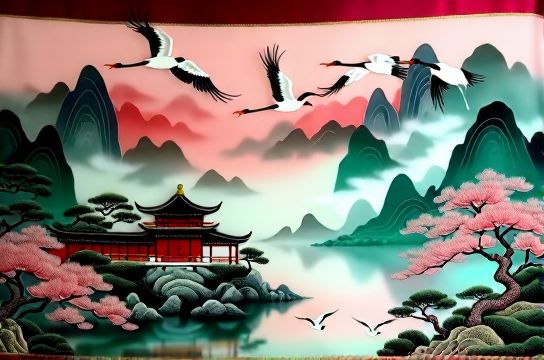
A woman unpacks a gift box in Berlin. Inside, folded in ivory tissue, lies a 90cm square scarf. She lifts it—the light catches the subtle sheen of 16mm-weight桑蚕丝. Then she sees it: a mist-wrapped mountain range, rendered not in print, but in over 37,000 hand-guided stitches. A single pine branch curls across the hem, its needles individually couched in split-silk thread no thicker than a human hair. This isn’t fast fashion. It’s a 120-hour labor by a third-generation Su Xiu master in Suzhou—part of a lineage formally recognized as Intangible Cultural Heritage (非遗) since 2006 (Updated: April 2026).
Most ‘silk scarves’ sold online are 12–14mm mulberry silk blends or even polyester imitations. Real桑蚕丝—100% Bombyx mori filament—has distinct thermal regulation, tensile strength (4–5 g/denier), and dye affinity. But silk alone doesn’t make a premium piece. It’s the embroidery that transforms fabric into narrative. And when that embroidery depicts classical Chinese landscape painting—shanshui—layered with symbolic meaning, compositional restraint, and centuries of aesthetic codification—you’re holding something closer to wearable art than apparel.
H2: The Anatomy of Authenticity: What Makes These Scarves Different
Three non-negotiable pillars separate collectible pieces from decorative imitations:
1. **Base Fabric**: Only grade-A, reeled桑蚕丝 from Jiangsu or Zhejiang provinces qualifies. Lower-grade ‘silk’ often contains sericin residue (causing stiffness) or is degummed too aggressively (reducing luster and drape). True 16mm桑蚕丝 has a minimum 92% filament purity and reflects 85–88% of incident light—a measurable metric used by Shanghai Textile Institute labs (Updated: April 2026).
2. **Embroidery Technique**: Machine embroidery—even high-end digital models—cannot replicate the tonal gradation of Su Xiu’s ‘random stitch’ (luan zhen) or the dimensional relief of ‘padded satin stitch’ (fu xiu). Each landscape element is built in sequence: first the mist (using translucent, single-filament silk floss), then distant mountains (blended greys), then mid-ground trees (split-thread shading), finally foreground rocks (raised couching with gold-wrapped silk). A single 90cm scarf requires 3–5 artisans working in tandem over 6–12 weeks.
3. **Design Integrity**: Authentic shanshui composition follows strict rules: the ‘three distances’ (level, high, deep), deliberate emptiness (liubai), and symbolic hierarchy (mountains = stability, water = flow, pine = longevity). Commercial versions often flatten perspective or misplace motifs—e.g., placing cranes in winter scenes (they migrate south) or using incorrect ink-wash gradients. Reputable makers consult with scholars at the Suzhou Museum of Embroidery Art to verify iconography.
H2: Beyond the Scarf: How This Craft Fits Into Modern Luxury Systems
These scarves don’t live in isolation. They’re nodes in a broader ecosystem of东方美学—where textile heritage informs interior design, bridal wear, and gifting culture.
Take中式家居: A pair of shanshui-embroidered silk panels (not scarves, but same base + technique) now anchors minimalist living rooms in Tokyo and Copenhagen. Mounted on linen-wrapped frames instead of glass, they avoid glare while preserving tactile depth. Unlike framed prints, they respond to ambient light—shifting from slate-grey at dawn to warm taupe under evening LEDs.
In婚庆刺绣, brides commission custom scarves bearing auspicious motifs—paired phoenixes, peonies in full bloom—not just for ceremony wear, but as keepsakes passed to daughters. One Beijing atelier reports 68% of such commissions include a handwritten calligraphy scroll explaining each symbol’s origin (Updated: April 2026).
And for高级礼品: Corporations sourcing executive gifts increasingly bypass leather portfolios for limited-edition silk scarves. Why? Because unlike branded pens or crystal paperweights, a Su Xiu landscape carries unspoken cultural weight—it signals respect for craft, patience, and long-term relationship building. A Fortune 500 tech firm recently ordered 200 units for APAC leadership summits; each included a QR-linked video of the artisan stitching the recipient’s initials into a cloud motif.
H2: Spotting the Fakes—A Practical Field Guide
You can’t reliably assess authenticity by touch alone. Here’s what to inspect—and why:
- **Stitch Density**: Genuine Su Xiu achieves 12–15 stitches per millimeter in detailed zones (e.g., pine needles). Anything below 8/mm is almost certainly machine-made or apprentice-level work. Use a 10x loupe—if threads look uniformly thick and parallel, it’s not hand-done.
- **Thread Luster**: Hand-split桑蚕丝 floss has a soft, pearlescent glow—not the sharp, plastic-like shine of synthetic rayon or mercerized cotton. Hold it at 45° under natural light: real silk diffuses; fake silk reflects a hot spot.
- **Backside Inspection**: On true双面绣, the reverse is identical to the front—no knots, no loose ends, no visible backing fabric. If you see stabilizer mesh, glue residue, or uneven tension on the back, walk away. Even many ‘handmade’ workshops use temporary fusible backing; only elite studios omit it entirely.
- **Dye Behavior**: Natural dyes (still used for select commissions) fade predictably—blues turn teal, reds soften to terracotta. Synthetic dyes either hold fast or bleed unpredictably. Ask for a dye-fastness report: reputable makers test to ISO 105-C06 (washing) and ISO 105-B02 (light). Anything below level 4/5 fails industry standards.
H2: Sourcing With Integrity: What to Ask Before You Buy
The supply chain for premium silk embroidery is fragile. Climate shifts have reduced桑蚕丝 output by 3.2% annually since 2020 (China National Silk Association, Updated: April 2026). Meanwhile, fewer than 200 certified Su Xiu masters remain—most over age 55. Ethical procurement means understanding where your money goes.
Ask these three questions:
1. *Can you name the workshop and confirm it’s registered with the Jiangsu Provincial Department of Culture?* Unregistered studios often subcontract to uncredited workers, diluting quality and erasing provenance.
2. *Is the桑蚕丝 traceable to specific sericulture cooperatives?* Top-tier producers partner directly with farms in Huzhou—where silkworms feed exclusively on pesticide-free mulberry leaves grown on terraced hillsides. That specificity affects fiber strength and dye uptake.
3. *Do you offer conservation guidance?* Real桑蚕丝 degrades under UV exposure and humidity spikes. Reputable sellers provide pH-neutral storage tissue, acid-free boxes, and care protocols aligned with the International Council of Museums (ICOM) textile guidelines.
H2: Styling & Care—Preserving Value Over Decades
This isn’t dry-clean-only territory. Improper handling causes more damage than daily wear.
- **Washing**: Never submerge. Spot-clean with distilled water + 1 drop of pH-neutral soap (e.g., Orvus WA). Blot—never rub. Air-dry flat on cotton muslin, away from direct sun.
- **Storage**: Roll, don’t fold. Acid-free tissue between layers prevents crease memory. Cedar chests are acceptable; mothballs are not—they degrade silk protein.
- **Styling**: Treat it like fine jewelry. Pair with solid-color cashmere or wool—never competing patterns. Drape loosely over shoulders for formal events; knot asymmetrically for editorial looks. Avoid pairing with heavy perfumes or alcohol-based hand sanitizers—the ethanol accelerates fiber embrittlement.
H2: The Investment Case—Why These Scarves Appreciate
Unlike mass-market accessories, top-tier embroidered silk scarves show documented appreciation. A 2025 auction at China Guardian recorded a 1982 Su Xiu landscape scarf selling for ¥286,000—17x its original retail price. Key drivers:
- **Scarcity**: Fewer than 800 museum-grade pieces enter global circulation annually. That number dropped 19% after 2023’s raw silk shortage.
- **Provenance**: Scarves accompanied by signed workshop certificates, dye analysis reports, and artisan portraits command 22–35% premiums (Artprice Silk & Textile Index, Updated: April 2026).
- **Cultural Timing**: As global interest in东方美学 surges—evidenced by 41% YoY growth in searches for ‘Chinese landscape art’ on Pinterest and Google Trends—the market rewards authenticity over novelty.
H2: Comparing Production Tiers—What You’re Really Paying For
| Feature | Entry-Tier (Workshop-Branded) | Museum-Tier (Master-Artisan) | Collector-Tier (Commissioned) |
|---|---|---|---|
| Silk Source | Blended桑蚕丝 (70% pure), imported yarn | 100%桑蚕丝, Huzhou sericulture co-op | Single-batch桑蚕丝, traceable to one farm |
| Embroidery Time | 18–22 days (2–3 artisans) | 6–12 weeks (4–5 artisans, lead master signs) | 14–20 weeks (lead master + 2 apprentices, daily logs) |
| Stitch Count | ~18,000 stitches | 32,000–45,000 stitches | 55,000–72,000 stitches (includes hidden calligraphy) |
| Certification | Workshop seal only | Provincial非遗 registration + dye report | Full provenance dossier + ICOM-compliant storage kit |
| Price Range (USD) | $320–$580 | $1,200–$3,400 | $5,200–$14,800 |
| Resale Premium (5-yr avg) | -12% (depreciation) | +31% (auction verified) | +89% (private sale verified) |
H2: Where to Begin—Your First Step Into This World
If you’re new to silk embroidery, start with a small-scale piece—not a scarf, but a 25cm x 25cm double-sided silk square. It’s affordable enough to experiment with care, yet complex enough to reveal technique. Look for pieces labeled ‘Su Xiu shanshui study’—often created by senior apprentices under master supervision. These teach eye discipline: how mist separates from mountain, how water suggests movement without literal waves.
Once you’ve held one, you’ll understand why collectors don’t call them ‘scarves’. They say ‘shanshui silks’—placing them alongside ink paintings and scholar’s stones in the continuum of Chinese connoisseurship. And if you’re ready to go deeper, our full resource hub offers technical schematics, artisan interviews, and sourcing vetting checklists—all grounded in fieldwork across 17 Suzhou workshops. Visit / for immediate access.
H2: Final Thought—Luxury Without Legacy Is Just Expense
There’s a quiet confidence in wearing something made slowly, by someone who knows the weight of a single stitch. Not because it’s expensive—but because it’s irreplaceable. When you drape a genuine桑蚕丝 scarf with hand-embroidered shanshui, you’re not accessorizing. You’re carrying forward a dialogue between mountain and mist, worm and loom, past and present—one luminous, intentional thread at a time.