Oolong Tea Explained: How Roasting Style Shapes Aroma, Bo...
- 时间:
- 浏览:305
- 来源:OrientDeck
H2: Roasting Isn’t Just Heat—It’s Oolong’s Identity Switch
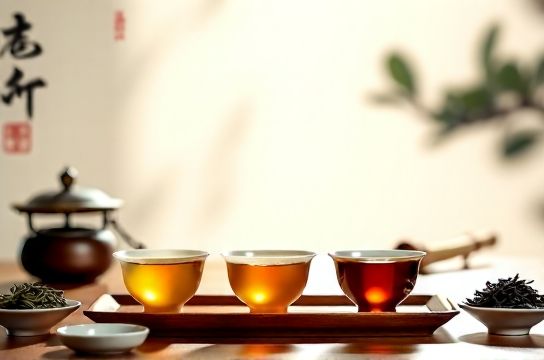
Most tea drinkers know oolong sits between green and black tea in oxidation—but few realize roasting is where its true personality crystallizes. Unlike steaming (as in Japanese sencha) or sun-drying (as in many white teas), roasting applies controlled thermal energy *after* oxidation, triggering Maillard reactions, caramelizing sugars, volatilizing grassy notes, and polymerizing polyphenols. The result? A spectrum of aromas—from orchid and honey to roasted almond and aged wood—and a body that shifts from crisp and floral to viscous, mineral-rich, and deeply resonant.
This isn’t theoretical. In Fujian’s Wuyi Mountains, a master roaster may spend 12–18 hours over charcoal, adjusting airflow and temperature every 20 minutes across three distinct phases: drying (to stabilize moisture), caramelization (to develop sweetness and depth), and finishing (to fix volatile oils and refine texture). A single batch of Da Hong Pao can be roasted five times over six months—each pass altering its aging trajectory and ideal brewing method. That’s why two identical spring-harvest Tieguanyin lots—one lightly roasted, one heavily—behave like different species at the gaiwan.
H2: The Roast Spectrum—Three Tiers, Three Realities
H3: Light Roast (100–120°C, 1–2 hours)
Light roast oolongs—think modern Anxi Tieguanyin or high-mountain Dong Ding—are minimally heated to preserve fresh, floral volatility. They retain 75–80% of their original amino acids (Updated: April 2026), giving pronounced umami and a clean, brisk finish. Aroma leans toward gardenia, lily, and ripe pear; body stays agile, almost effervescent. But there’s a trade-off: low thermal stability means these teas degrade faster. Shelf life drops from 24 months (heavily roasted) to just 9–12 months if stored above 25°C or exposed to light.
Brewing ritual reflects this fragility. Use water at 85–90°C—not boiling—to avoid scalding delicate volatiles. Steep 5–8 seconds for the first infusion, increasing by 2–3 seconds each round. Over-extract, and bitterness spikes—not from tannins, but from degraded chlorophyll compounds. This is why ceramic gaiwans (not porous zisha) are preferred: they don’t absorb or mute top notes.
H3: Medium Roast (125–145°C, 3–5 hours)
Medium roast—exemplified by traditional Phoenix Dancong or mid-tier Wuyi Yancha—strikes a balance most Western palates find intuitive. Here, the Maillard reaction fully engages without overwhelming the leaf’s terroir. Catechins partially convert to theaflavins, softening astringency while adding structure. You’ll taste baked apple, osmanthus, and wet stone, with a rounded, syrupy mouthfeel that coats the tongue evenly.
Crucially, medium roast improves shelf stability *and* aging potential. Moisture content settles at 3.2–3.8% (Updated: April 2026), low enough to inhibit microbial activity but high enough to allow slow enzymatic change. These teas often improve for 2–3 years when stored in nitrogen-flushed foil bags away from light—unlike light roasts, which peak within 6 months.
Brewing demands precision: water at 92–95°C, 1:15 leaf-to-water ratio (e.g., 6g in 90ml), and infusions starting at 10 seconds. A Yixing zisha pot—especially one seasoned with Dancong—enhances texture by absorbing minute lipids and releasing them gradually. But avoid new, unseasoned purple clay: its porosity will initially mute aroma.
H3: Heavy Roast (150–170°C, 6–12+ hours)
Heavy roast oolongs—like classic Shui Xian or aged Rou Gui—aren’t merely toasted; they’re thermally transformed. Cellulose breaks down, starches caramelize into furanones, and caffeine migrates toward the leaf surface. The result is lower perceived bitterness (despite higher actual caffeine), deeper umami, and aromas of roasted chestnut, sandalwood, and dried longan. Body becomes thick, almost chewy, with a lingering mineral finish that can last 45+ seconds.
But heavy roast sacrifices nuance for endurance. Volatile terpene content drops by ~60% versus light roast (Updated: April 2026), flattening floral complexity. What remains is structural integrity: these teas withstand boiling water, multiple infusions (15+ rounds common), and even cold-brewing—though cold extraction yields less body and more roasted nuttiness than heat-driven infusions.
For brewing, go full gongfu: use a small Yixing pot (100–120ml), 8–10g leaf, and near-boiling (98–100°C) water. Rinse twice—first to awaken the leaf, second to remove surface carbon fines. Then begin 5-second infusions, extending only after round 7. A well-roasted Shui Xian should still deliver resonance at infusion 12.
H2: Gear That Matches the Roast
Your teaware isn’t neutral—it interacts with roast level. Light roasts need thermal neutrality and aroma preservation. Heavy roasts benefit from thermal mass and subtle absorption. Here’s how common vessels perform:
| Teaware | Best For Roast Level | Why It Works | Key Limitation |
|---|---|---|---|
| Ceramic Gaiwan (Jingdezhen) | Light & Medium | Non-porous, rapid heat dissipation preserves top notes; easy temperature control | No texture enhancement; fragile for daily heavy-roast brewing |
| Yixing Zisha Pot (Zini or Zhuni) | Medium & Heavy | Pores absorb lipids and tannins over time, smoothing harshness and amplifying body | Must be dedicated to one roast type—mixing light/heavy causes flavor cross-contamination |
| Japanese Tokoname Kyusu | Light Only | Fine mesh filter retains delicate buds; low-fired clay adds subtle earthiness | Too porous for medium/heavy roasts—absorbs roasted oils irreversibly |
| Modern Glass Cold-Brew Jar | Heavy Roast Only | Allows observation of slow oil release; no thermal shock to volatile compounds | Zero aroma concentration—best for convenience, not ritual |
Note: Never use the same Yixing pot for both light and heavy roasts—even with cleaning. Residual carbonized oils embed in the clay matrix and will bleed into future light infusions, muting florals and adding unwanted smokiness. Season separate pots: one for floral Tieguanyin, another for roasted Shui Xian.
H2: Beyond Flavor—How Roast Dictates Storage & Aging
Roast level directly governs storage logic. Light roasts demand refrigeration (4°C) in opaque, airtight containers—ideally with oxygen absorbers. At room temperature, they lose 20% of their linalool (a key floral compound) in under 30 days (Updated: April 2026). Medium roasts tolerate ambient storage (18–22°C, <60% RH) for up to 18 months if vacuum-sealed. Heavy roasts? They’re the most forgiving: stable at 25°C for 36+ months in simple aluminum-lined pouches—provided humidity stays below 65%.
Aging potential diverges sharply too. Light roasts rarely improve beyond 12 months—their amino acid profile degrades faster than it transforms. Medium roasts hit peak complexity at 24–30 months, developing honeyed depth and softer edges. Heavy roasts, however, gain layered nuance over 5–10 years: roasted notes mellow into incense and dried fruit, while mineral backbone strengthens. This is why vintage Wuyi teas command premiums—not for rarity alone, but for proven thermal resilience.
H2: Practical Buying Guidance—Spotting Authentic Roast Intention
Many commercial oolongs misrepresent roast level. A bag labeled “light roast” might actually be medium—if it smells faintly of toast or leaves a dry, warming sensation on the throat. Here’s how to verify:
• Visual cue: Light roast leaves are uniform green-brown, glossy, tightly rolled. Heavy roast leaves show visible carbon flecks, matte finish, and slight crumbling at edges.
• Wet leaf inspection: After rinsing, light roast unfurls into bright green, plump leaves. Heavy roast reveals dark brown to near-black tissue, often with brittle veins.
• Liquor color: Light roast yields pale yellow-green, translucent. Heavy roast gives amber to burnt sienna—opaque, viscous, clinging to the cup wall.
• Mouthfeel test: Swirl, hold, then exhale through the nose. Light roast gives immediate floral burst and clean exit. Heavy roast delivers delayed warmth, throat-coating viscosity, and a finish that evolves over 20+ seconds.
When buying online, prioritize vendors who disclose roast date (not just harvest date) and roast temperature range. Reputable producers like Wu Yi Shan’s Yashu Tea or Anxi’s Fenghuang Tea Co. list exact roast cycles on packaging. Avoid brands using vague terms like “artisan fire” or “traditional baking”—these lack technical accountability.
H2: Integrating Roast Into Daily Ritual
You don’t need a full gongfu setup to honor roast intention. Start simple:
• For light roast: Use a 120ml porcelain gaiwan, 5g leaf, 90°C water, and a timer. Focus on aroma lift—cover the gaiwan for 5 seconds before lifting the lid to inhale.
• For medium roast: Try a 100ml Yixing pot (dedicated), 7g leaf, 95°C water. Skip the rinse—let the first infusion build texture.
• For heavy roast: Brew Western-style in a 350ml ceramic teapot—8g leaf, 100°C, 3-minute steep. The extended contact extracts body without bitterness.
And remember: roast dictates not just *how* you brew, but *when*. Light roasts shine mid-morning—clean and alerting. Medium roasts suit afternoon focus, balancing calm and clarity. Heavy roasts anchor evening rituals, their depth encouraging slower breathing and reflection. This alignment—leaf, fire, vessel, moment—is where tea transcends beverage and becomes practice.
If you're assembling your first intentional oolong toolkit—pot, kettle, scale, storage—our complete setup guide walks through material choices, vendor vetting, and seasonal rotation logic. It’s designed for real kitchens, not showrooms.
H2: Final Note—Roast as Dialogue, Not Directive
Roasting doesn’t ‘improve’ oolong—it interprets it. A lightly roasted Tieguanyin isn’t ‘lesser’ than a heavily roasted Shui Xian; it answers a different human need. One offers immediacy and vibrancy; the other, patience and resonance. Understanding roast style doesn’t make you a connoisseur—it makes you a better listener. And in tea, listening—deeply, repeatedly, without agenda—is where culture begins.