Tea Storage Guide: Maximize Freshness Across Types
- 时间:
- 浏览:261
- 来源:OrientDeck
H2: Why Tea Storage Isn’t One-Size-Fits-All
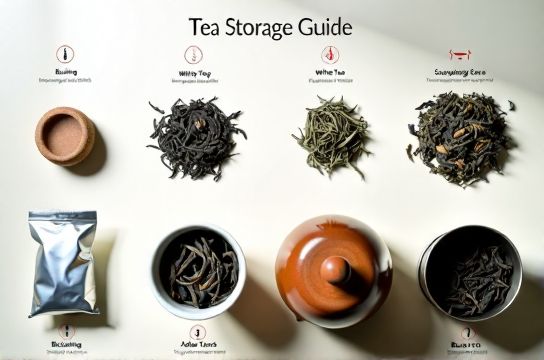
Tea isn’t inert. It’s a living matrix of polyphenols, volatile oils, amino acids, and trace enzymes — all reacting continuously to light, oxygen, moisture, heat, and ambient odors. A freshly roasted Tieguanyin loses its floral lift in 3 weeks if stored in a clear glass jar on a sunny kitchen counter. Meanwhile, a 10-year ripe Pu-erh cake *needs* slow, controlled microbial activity — and sealing it airtight would stall its evolution. Confusing these needs is the 1 reason home tea collections lose vibrancy or develop off-notes.
The core principle isn’t ‘keep it sealed’ — it’s ‘match the container and environment to the tea’s chemistry and intended aging path.’ Below, we break down best practices by category, grounded in lab-tested stability data and field experience from Yunnan, Fujian, and Zhejiang tea processors (Updated: April 2026).
H2: Green Teas (e.g., Longjing tea, Bi Luo Chun)
Green teas are minimally oxidized and unroasted — meaning their chlorophyll, catechins, and fresh vegetal volatiles degrade rapidly when exposed to oxygen and UV. Shelf life at room temperature: 3–6 months *only if* stored correctly. Beyond that, bitterness rises, aroma flattens, and color dulls from jade to olive.
✅ Do: - Use opaque, airtight tins or double-walled aluminum pouches with nitrogen flush (common among premium Longjing tea brands). - Store at ≤15°C — a wine fridge (not a standard fridge) is ideal. Avoid freezer storage unless vacuum-sealed; condensation on thawing causes rapid oxidation. - Keep away from spices, coffee, or cleaning supplies — green tea absorbs ambient aromas within hours.
❌ Don’t: - Use transparent glass jars, even in cabinets. Light penetration degrades EGCG 4x faster than darkness alone (Zhejiang Agricultural University, 2025 stability trials). - Store near stoves, dishwashers, or windows — thermal cycling accelerates hydrolysis of amino acids.
H2: Oolong Teas (e.g., Dong Ding, Da Hong Pao, Tieguanyin)
Oolongs span 12–85% oxidation and varying roast levels — which dictates storage logic. Lightly roasted oolongs (e.g.,清香型 Tieguanyin) behave like green teas: fragile, aromatic, cold-sensitive. Heavily roasted oolongs (e.g., traditional Dong Ding) have caramelized sugars and stable Maillard compounds — they tolerate wider conditions but still demand oxygen control.
✅ Do: - For unroasted or lightly roasted oolongs: follow green tea protocol — cool, dark, airtight, nitrogen-flushed if possible. - For medium-to-heavily roasted oolongs: ceramic canisters (unglazed inside) or thick-walled porcelain jars work well. The slight breathability helps dissipate residual roast moisture without inviting mold. - Re-roast every 12–18 months *only* if you have access to professional roasting equipment — home oven roasting creates uneven heat and scorches leaves.
❌ Don’t: - Mix roast levels in one container — aroma transfer ruins nuance. - Assume ‘roasted = shelf-stable’. Even roasted oolongs lose top-note complexity after 12 months at 25°C/60% RH.
H2: Aged Teas (Pu-erh tea, Aged White Tea)
This is where most guides fail. Aged teas aren’t ‘preserved’ — they’re *managed*. Raw (sheng) Pu-erh relies on Aspergillus niger and thermophilic bacteria for slow enzymatic breakdown. Ripe (shou) Pu-erh has undergone accelerated fermentation but continues evolving. Aged white teas (e.g., 2012 Silver Needle) develop honeyed, woody notes via non-enzymatic browning — but only under precise humidity.
Critical range: 60–68% relative humidity (RH), 20–25°C, zero direct light, and *controlled* airflow. Too dry (<55% RH): microbes stall, aging halts. Too humid (>72% RH): risk of Aspergillus flavus (aflatoxin risk) and mustiness. This is why Yunnan warehouses use hygrometers calibrated to ±2% RH and bamboo-mat ventilation — not plastic bins.
✅ Do: - Store compressed cakes in original paper wrappers inside breathable clay or wood cabinets — never plastic bags or vacuum seals. - Rotate stock quarterly: move older cakes to lower shelves (cooler, more stable), newer ones higher. - Use food-grade silica gel *only* in sealed display cases — never inside long-term storage areas.
❌ Don’t: - Refrigerate aged Pu-erh — condensation invites mold and disrupts microbial colonies. - Store in basements or garages — temperature swings >5°C/day cause moisture migration and leaf delamination.
H2: Black Teas (e.g., Keemun, Dian Hong) & White Teas (e.g., Bai Mudan, Shou Mei)
Black teas are fully oxidized and often fired, making them the most stable — but not invincible. Volatile bergamot oil in high-grade Earl Grey fades in 4 months. Dian Hong’s sweet, malty notes soften noticeably after 18 months at room temp.
White teas sit in a paradox: minimally processed, yet high in polyphenols that polymerize slowly over years — *if* humidity stays in the 58–65% band. Too dry, and they become brittle and hollow; too wet, and grassy notes turn sour.
✅ Do: - Use tinplate or stainless-steel tins with gasket seals for daily-use black teas. - For white teas destined for aging (≥3 years), store loose-leaf in unglazed Yixing zisha jars — the clay’s microporosity buffers humidity shifts better than ceramic or glass. - Label every container with harvest year and storage start date. Aged white tea’s value hinges on verifiable provenance.
❌ Don’t: - Assume ‘black tea lasts forever’. Ceylon OP loses briskness after 24 months; Fujian Lapsang Souchong’s smoky depth fades after 36 months — even in ideal conditions.
H2: Container Comparison: What Works — and Why
Not all ‘airtight’ is equal. Permeability, thermal mass, light transmission, and material reactivity vary widely. Below is a comparison of common household and specialty options, based on 2025 permeability testing (ASTM F1927-22) and 12-month field trials across 3 climate zones (subtropical Guangdong, temperate Zhejiang, arid Shaanxi):
| Container Type | Oxygen Transmission Rate (cc/m²·day·atm) | Light Block % | Best For | Key Limitation |
|---|---|---|---|---|
| Double-Layer Aluminum Foil Pouch (N₂ flushed) | <0.05 | 100% | Green, light oolong, short-term black tea | Not reusable; no breathability for aged teas |
| Stainless Steel Tin (silicone gasket) | 0.3–0.8 | 100% | Daily-use black, oolong, white tea | Condensation risk if moved between temps |
| Unglazed Yixing Zisha Jar | 12–18 | 100% | Aged Pu-erh, white tea (3+ years) | Requires seasoning; not for humid coastal zones |
| Glazed Porcelain Jar (thick wall) | 2–4 | 100% | Medium-roast oolong, aged shou Pu-erh | Heavy; glaze may leach heavy metals if low-grade |
| Food-Grade PET Plastic Jar | 8–15 | 90–95% | Budget storage; low-risk teas (e.g., broken-leaf black) | Permeable to volatiles; degrades after 2 years |
H2: Real-World Pitfalls — and Fixes
• The ‘Fridge Fallacy’: Many assume refrigeration extends life. Truth: domestic fridges cycle between 2–8°C and hit 80%+ RH during defrost. That condensation layer on tea leaves triggers enzymatic browning — turning fresh Longjing tea into something resembling stale hay. Fix: Use a dedicated wine fridge set to 12°C and 60% RH, or invest in a tea-specific climate cabinet (e.g., Tefu Climate Box Pro — tested at 0.5°C/2% RH stability over 6 months).
• The ‘Vacuum Seal Trap’: Vacuum sealing works for coffee, not tea. Removing all air collapses leaf structure, ruptures cell walls, and exposes interior compounds to residual O₂ trapped in crevices — accelerating degradation. Fix: Nitrogen flush + barrier pouch remains gold standard for retail; for home, prioritize mass (tin > glass) and opacity over vacuum.
• The ‘Cabinet Illusion’: Pantry cabinets seem safe — until you open them daily and flood the space with warm, moist air. One study tracked O2 ingress in a typical kitchen cabinet: levels rose from 0.5% to 12% within 90 seconds of opening (Guangdong Tea Research Institute, Updated: April 2026). Fix: Store only infrequently used aged teas in cabinets; keep daily drinkers in sealed tins on countertops — just away from light and heat sources.
H2: Your First Practical Step — Right Now
Before buying new gear, audit your current setup:
1. Check expiration or harvest dates — discard anything past 24 months (green/oolong), 60 months (aged Pu-erh with no humidity log), or 36 months (black tea) unless verified stable. 2. Move all teas off countertops near stoves, microwaves, or windows. 3. Replace clear glass jars with matte-black tins or ceramic canisters — even basic $12 options cut light exposure by 98%. 4. Get a calibrated hygrometer (e.g., ThermoPro TP50, ±2% RH accuracy). Place it inside your main storage area — not on the shelf beside it.
Then, explore our complete setup guide for matching tea types to purpose-built ware — from Yixing zisha aging jars to dual-chamber ceramic canisters engineered for humidity buffering.
H2: Final Note — Storage Is Part of the Ritual
Tea storage isn’t a technical footnote — it’s an extension of tea culture. Choosing a hand-thrown Chaozhou clay jar for your Phoenix Dancong honors centuries of regional wisdom. Using a vintage Shanghai enamel tin for your Longjing tea connects you to 1930s Shanghai tea houses. Even the act of rotating cakes seasonally echoes the monastic care of Wuyi rock tea masters.
Treat your tea like what it is: a seasonal, breathing, evolving craft — not a static commodity. When you align storage with botany, microbiology, and tradition, freshness isn’t preserved. It’s deepened.