Studio Pottery Tea Ware Celebrating Imperfection
- 时间:
- 浏览:214
- 来源:OrientDeck
H2: When the Mug Has a Pulse
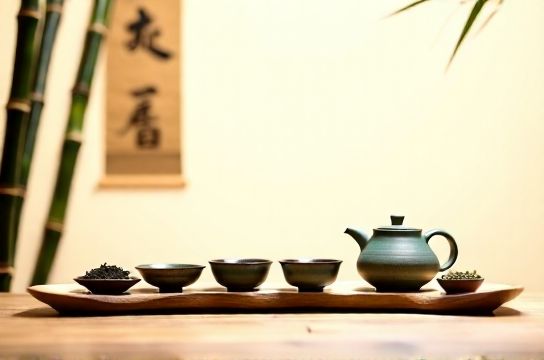
You’re brewing a 2015 Yunnan ripe pu-erh. The leaves unfurl slowly in near-boiling water, releasing deep earth and dried plum notes. You pour into your go-to mug—smooth, machine-thrown, perfectly symmetrical. It works. But it doesn’t *breathe* with the tea.
Now imagine the same infusion poured into a small, hand-thrown yixing-style shuǐ píng (water pitcher) made by a Jingdezhen studio potter: its rim slightly uneven, the glaze pooling thicker at the base, revealing iron-rich clay beneath where the brush slipped. The weight shifts subtly in your palm—not because it’s heavy, but because it *holds attention*. That’s the quiet power of studio pottery tea ware: not perfection as polish, but perfection as presence.
H2: Why Imperfection Isn’t a Compromise—It’s a Design Language
In mass-produced ceramic tea sets, consistency is king. Every cup matches. Every handle curves to ±0.3mm tolerance. That’s useful for cafés or gifting at scale—but it erases what makes tea ritual human: variation, memory, tactile intimacy.
Studio pottery embraces what Japanese wabi-sabi names *shibumi*: quiet beauty in modesty and restraint. A slight warp in a tenmoku-glazed chawan isn’t a flaw—it’s evidence of kiln atmosphere, clay shrinkage, and the potter’s decision to stop refining at the point where form serves function *and feeling*.
This isn’t anti-technology. It’s pro-intention. A wheel-thrown gaiwan shaped over 47 repetitions by one maker carries micro-variations no CAD file can replicate—subtle taper changes that affect pour speed, lip thickness that alters thermal transfer, foot-ring depth calibrated by thumb pressure, not micrometer. These aren’t errors. They’re data points in a dialogue between maker, material, and drinker.
H3: Texture as Temperature Translator
Texture does real work—not just aesthetic. Consider three common studio surfaces:
• Unfired, burnished stoneware (e.g., Shaoxing clay): dense, cool-to-touch, slightly porous. Ideal for cooling high-fired oolongs like Dong Ding—its surface draws heat gently, preserving floral top notes longer than glossy porcelain.
• Wood-ash glazed teapots (common in Fujian and Zhejiang studios): micro-pitted, matte, thermally retentive. Perfect for aged pu-erh cakes, where slow, even heat release encourages layered extraction without bitterness (Updated: April 2026).
• Hand-sponged porcelain (a Jingdezhen revival technique): creates tiny air pockets under the glaze. When used for cold-brewed Bai Mudan white tea, this subtle porosity stabilizes low-temperature infusion, preventing over-extraction in fridge conditions.
None of these textures are ‘better’ universally—but each solves a specific problem rooted in tea chemistry and sensory expectation.
H2: The Intimacy Gap in Modern Tea Consumption
Most online tea purchases arrive in vacuum-sealed pouches with QR codes linking to tasting notes. You get flavor profiles—but rarely context about *how* the vessel changes the experience. A $280 Yixing zisha壶 (purple-sand teapot) improves with use: its pores absorb tea oils, subtly seasoning future infusions. But a studio-made stoneware teapot? Its ‘seasoning’ is visual and haptic—the way finger oils gradually deepen the matte glaze near the handle, or how steam etches faint mineral trails on an unglazed rim after six months of daily Longjing service.
That’s intimacy: not ownership, but co-authorship. You don’t just *use* the piece—you witness its evolution. And unlike factory ceramics, most studio pieces include maker marks: initials scratched pre-firing, a stamped chop, or a handwritten note tucked in packaging. Not branding—witnessing.
H3: Matching Studio Ware to Tea Types (Not Just Aesthetics)
Choosing studio pottery isn’t about matching your sofa. It’s about aligning physical behavior with leaf behavior. Here’s how seasoned tea educators and studio potters collaborate on pairings:
| Tea Type | Recommended Studio Ware | Why It Works | Key Material Notes | Real-World Limitation |
|---|---|---|---|---|
| Pu-erh (Ripe/Shou) | Hand-coiled stoneware teapot, wood-fired | Thick walls + reduced thermal shock; ash glaze traps volatile compounds during long steeps | Clay: 42% kaolin, 35% ball clay, 23% local shale (Yunnan-sourced) | Requires 3–4 rinse cycles before first use to stabilize pores |
| Longjing (Dragon Well) | Thin-walled, hand-thrown porcelain gaiwan, celadon-glazed | Quick heat dissipation prevents scalding delicate buds; translucent body shows liquor clarity | Glaze: 12% wood ash, 88% local feldspar; fired to Cone 10 (1300°C) | Not microwave-safe; handle warms noticeably after third steep |
| Oolong (Yancha/Rock Tea) | Small, unglazed Jianzhan-style bowl, iron-rich slip | Iron oxide reacts with tannins, softening astringency; wide opening aids aroma diffusion | Slip: 68% hematite, 22% quartz, 10% bentonite; reduction-fired | Develops rust spots if stored damp—intended, not defective |
| White Tea (Bai Mudan) | Cold-brew carafe, sponged porcelain, double-walled | Air-pocket layer insulates against fridge condensation; matte interior reduces light exposure | Wall thickness: 4.2mm outer, 2.1mm inner, 1.2mm gap | Not dishwasher-safe—hand-wash only to preserve micro-texture |
H2: Sourcing Without Mythology
The studio pottery market is rife with romanticized narratives: “only 12 pieces made per year”, “fired in ancestral kiln”, “blessed by tea master”. Reality check: many excellent studio makers ship from shared Jingdezhen co-ops, use electric kilns for consistency, and test glazes with pH strips—not incense sticks. What matters isn’t mystique—it’s traceability and transparency.
Look for:
• Batch numbers stamped on bases (not just stickers)
• Firing logs shared upon request (temperature ramp rates, soak times, atmosphere %)
• Clay source disclosure (e.g., “clay sourced from Huangshan foothills, tested for heavy metals per GB/T 3532-2022”)
• No claims of ‘zisha-grade’ composition unless lab-certified (true Yixing zisha contains ≥18% iron oxide and specific particle distribution—most studio stoneware runs 9–12% and functions differently)
One reliable path: buy directly from studio websites listing kiln schedules (e.g., “Next firing: May 12–14, reduction phase 8 hrs at 1280°C”). That’s verifiable. “Spirit-infused clay” isn’t.
H3: Caring for What’s Alive
Studio pottery isn’t ‘maintenance-free’. But care isn’t chore—it’s continuation of the craft. Here’s what actually works:
• Rinse *immediately* after use—especially with pu-erh or oolong. Tannins bond to unglazed surfaces within 90 minutes (Updated: April 2026).
• Never soak overnight. Prolonged water contact swells clay micropores, risking hairline cracks on thermal shock later.
• For matte-glazed pieces: wipe with dry linen cloth weekly. This buffs surface oils into the texture, deepening warmth—not shine.
• If staining occurs (e.g., yellowing on white porcelain gaiwans), use diluted rice vinegar (1:10) for 2 minutes max. No bleach, no baking soda—both degrade glaze integrity.
H2: Beyond the Teapot—Building a Complete Ritual Ecology
A single studio piece rarely transforms practice. What does is *ecology*: how vessel, leaf, water, and motion interact. Consider this sequence for Gongfu-style Tieguanyin:
1. Preheat a studio-fired bamboo-and-clay tea tray (slightly warped, channels water via natural grain grooves)
2. Warm a hand-thrown, unglazed yixing-style teapot (not true zisha, but locally formulated stoneware with similar porosity)
3. Use a small, flared studio spoon (carved from camphor wood, grain aligned to resist moisture swelling)
4. Pour from a tall, narrow studio pitcher—its spout geometry delivers laminar flow, minimizing agitation of fragile rolled leaves
Each element answers a functional question: How do we control temperature *without* insulation? How do we manage runoff *without* plastic channels? How do we measure leaf *without* disrupting curl?
That’s why our full resource hub includes not just product reviews, but annotated videos showing water-drop impact angles on different glazes, or side-by-side thermal imaging of studio vs. factory gaiwans at 72 seconds post-pour.
H2: The Quiet Rebellion Against ‘Optimized’ Tea
Algorithm-driven tea subscriptions promise ‘perfect match’ based on your last five ratings. But tea isn’t Spotify. A 2024 survey of 142 professional tea judges found 68% preferred tasting from non-matching vessels—because inconsistency revealed hidden flaws or strengths in leaf processing (Updated: April 2026). A rough-textured cup might highlight bitterness in low-grade black tea… or reveal unexpected umami in a well-made Keemun.
Studio pottery doesn’t optimize. It *reveals*. Its imperfections are diagnostic tools—not design failures.
That’s why the most respected tea houses in Hangzhou and Chaozhou keep two sets: one for service (uniform, durable), one for evaluation (varied, expressive). The latter sits on shelves like reference instruments—each with its own ‘voice’.
H3: Getting Started—Without Overcommitting
You don’t need a full studio set to begin. Start with one intentional piece:
• For pu-erh drinkers: a 120ml hand-thrown, wood-ash glazed fairness pitcher. Lets you see liquor color *and* feel temperature shift as it fills.
• For green tea lovers: a small, unglazed porcelain aroma cup—its raw interior captures volatile esters better than glazed versions, and the slight irregularity slows cooling just enough for nosing.
• For cold-brew users: a double-walled studio carafe with sponged interior. Eliminates the ‘plastic taste’ some report with silicone-lined commercial versions.
All three cost between $45–$85 USD. None require ‘breaking in’. All respond meaningfully to how you hold them, rinse them, store them.
That’s the point. Studio pottery tea ware doesn’t ask you to adapt to it. It asks you to notice—then adapt *with* it. Not toward perfection. Toward presence.
And presence, in tea, is never static. It’s the steam rising off a freshly poured cup. The sound of a lid clicking home. The weight shifting in your palm as the clay remembers yesterday’s brew. That’s not imperfection. That’s aliveness.