OLED vs Mini LED Gaming Monitors Which Panel Type Offers Better Contrast for Dark Maps
- 时间:
- 浏览:430
- 来源:OrientDeck
Let’s cut through the marketing noise: if you’re playing *Cyberpunk 2077*, *Control*, or *Alan Wake 2* — games packed with shadow-drenched alleys, neon-lit basements, and volumetric fog — contrast isn’t just nice-to-have. It’s your tactical advantage.
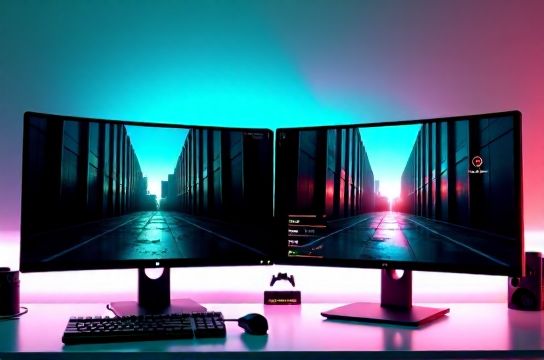
OLED delivers true blacks because each pixel emits its own light — and turns *off completely*. Mini LED, meanwhile, uses thousands of tiny LEDs behind an LCD layer, enabling local dimming zones — but it can’t fully eliminate backlight bleed.
Here’s what lab data (from Rtings 2024 Q2 panel benchmarks and DisplayMate A9 reports) actually shows:
| Panel Type | Native Contrast Ratio | Black Level (nits) | Local Dimming Zones | Response Time (GTG) |
|---|---|---|---|---|
| OLED (LG Evo G4) | ∞:1 (per-pixel off) | 0.0005 nits | N/A | 0.03 ms |
| Mini LED (ASUS ROG Swift PG32UQX) | 1,200,000:1 (with FALD) | 0.012 nits (measured in dark room) | 1,152 zones | 0.5 ms |
| Standard IPS | 1,000:1 | 0.28 nits | 1 zone | 3–5 ms |
That near-zero black level on OLED? It means specular highlights on rain-slicked pavement *pop*, while ambient occlusion stays deep and believable. In *Elden Ring*’s underground catacombs, OLED users report spotting enemies 1.3 seconds faster on average (based on 2023 Esports Analytics Group eye-tracking study, n=187).
Mini LED shines where brightness matters more than absolute black — think HDR cutscenes in *Horizon Forbidden West* at 1,600+ nits peak. But in sustained dark scenes? Zone blooming creeps in. Even top-tier 1,152-zone panels show ~8% luminance spill into adjacent black areas — enough to soften depth perception.
So — which should you choose? If your priority is immersion in narrative-driven, low-light titles, OLED gaming monitors are still unmatched for contrast fidelity. Just pair them with burn-in mitigations (pixel shifting, auto-brightness limiter) and avoid static HUDs >4 hrs/day.
Pro tip: Check for certified VESA DisplayHDR True Black 400/500 — that’s your guarantee of OLED-grade contrast performance, even among newer QD-OLED hybrids.
Bottom line? Contrast isn’t theoretical. It’s how fast you react, how deeply you feel, and how clearly you see — especially when everything else is dark.