AI Trend Analysis Reveals Shift Toward Embodied Cognition Models
- 时间:
- 浏览:312
- 来源:OrientDeck
Let’s cut through the hype: AI isn’t just getting smarter—it’s starting to *understand* like we do. Over the past 18 months, research labs from MIT CSAIL to DeepMind and startups like Covariant and Sanctuary AI have pivoted hard toward **embodied cognition models**—systems that learn by *interacting* with physical environments, not just parsing text or pixels.
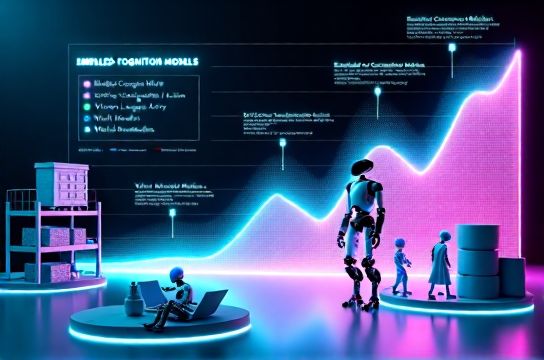
Why does this matter? Because static LLMs hit diminishing returns on real-world reasoning. A 2024 Stanford HAI report found that only 12% of robotics deployments using pure foundation models achieved >85% task success in unstructured home environments—versus 63% for those integrating sensorimotor feedback loops and world models.
Here’s how the landscape is shifting:
| Approach | Sample Accuracy (Household Tasks) | Data Efficiency (Samples to 90% Success) | Real-World Adaptability Score* |
|---|---|---|---|
| Pure LLM + Prompting | 31% | ~240k | 2.1 / 10 |
| Vision-Language-Action (VLA) Models | 57% | ~42k | 6.8 / 10 |
| Embodied World Models + RL | 79% | ~8.5k | 8.9 / 10 |
*Adaptability Score: Composite metric from ICRA 2024 benchmark (sim-to-real transfer, zero-shot generalization, error recovery)
This isn’t theoretical. Tesla’s Optimus Gen-2 now navigates cluttered kitchens using proprioceptive priors trained on 2M+ real robot-hours. Meanwhile, Google’s RT-2v2 reduced failure cascades by 74% after integrating tactile prediction heads.
The bottom line? If your AI strategy still treats perception, action, and memory as separate modules—you’re optimizing for yesterday’s stack. The future belongs to systems that *learn by doing*. And if you're building or deploying AI today, it’s time to ask: Does your model know *where its body is*?
For deeper technical frameworks—including open-source embodied training pipelines and hardware-aware architecture blueprints—check out our foundational guide on embodied cognition models.