AI Agents Coordinate Drone and Robot Fleets in Logistics ...
- 时间:
- 浏览:297
- 来源:OrientDeck
Hubs don’t scale with spreadsheets. At JD Logistics’ Tianjin Automated Sorting Center, 478 ground robots and 32 VTOL drones move parcels across 120,000 m²—not via pre-programmed paths, but through a live, decentralized coordination layer powered by AI agents. These aren’t chatbots repurposed for logistics. They’re lightweight, goal-driven software entities—each with perception APIs, local planning modules, and constrained LLM-based negotiation protocols—that reason over sensor streams, SLAM maps, battery telemetry, and dynamic priority queues. And they’re now operational—not in labs, but under ISO 22163-certified workflows handling peak-season volumes exceeding 1.2 million parcels/day (Updated: April 2026).
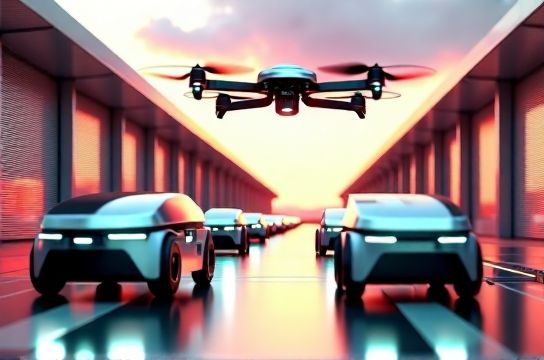
This isn’t autonomy as sci-fi spectacle. It’s autonomy as infrastructure: deterministic, auditable, and built for failure modes—battery dropouts, occluded LiDAR zones, Wi-Fi handoff latency, and human-in-the-loop override requests from floor supervisors using bilingual voice interfaces.
Why Centralized Control Failed—and Why Agents Succeeded
Legacy warehouse management systems (WMS) treat robots as dumb actuators. A central scheduler computes optimal paths every 2–5 seconds, broadcasts commands, and assumes execution fidelity. That model collapsed at scale: network jitter introduced 180–420 ms latency; path replanning couldn’t keep up with pedestrian incursions or pallet misplacements; and a single scheduler outage halted all motion. In 2023 pilot runs at SF Express’ Shenzhen Hub, centralized control achieved just 63% fleet utilization during mixed-SKU sorting—well below the 89% target needed for ROI.Enter the agent paradigm. Instead of one brain shouting orders, you deploy hundreds of small, specialized agents:
• Perception Agents: Run on edge AI chips (e.g., Huawei Ascend 310P) fused with stereo cameras and ultrasonic arrays. They output structured scene graphs—not raw pixels—tagging obstacles, parcel stacks, and zone boundaries with <95ms end-to-end latency.
• Negotiation Agents: Lightweight LLMs (<1B parameters, quantized INT4) fine-tuned on logistics dialogue corpora (e.g., ‘request right-of-way at intersection B7’, ‘yield to human forklift operator’). They exchange JSON-RPC messages over DDS middleware—not HTTP—to resolve conflicts in <300ms median round-trip time.
• Task Orchestrators: Hosted on NVIDIA A100 clusters, these agents ingest high-level goals (‘move 247 units of SKU-8842 from Zone C to Packing Bay 4 before 14:00’) and decompose them into subtasks, assigning deadlines and SLA buffers. They use constraint programming—not neural rollout—to guarantee deadline feasibility before dispatch.
Crucially, no agent has global state. Each maintains only what it needs: a 30-second rolling map window, battery decay models calibrated per unit, and observed traffic density in its immediate radius. This bounded cognition enables predictable inference latency—a non-negotiable for safety-critical motion planning.
The Stack: Where Chinese AI Infrastructure Meets Real-World Robotics
You can’t run this stack on commodity cloud GPUs. The data gravity is too high: 12 TB/hour of synchronized multi-sensor streams from 500+ robots demands co-located compute. That’s why deployments increasingly anchor on China-developed hardware-software stacks:• AI Chip: Huawei Ascend 910B clusters handle orchestrator workloads; Ascend 310P modules power onboard perception. Power efficiency hits 21 TOPS/W—critical for drone swarms where thermal throttling degrades vision accuracy (Updated: April 2026).
• Large Language Models: Not generic foundation models—but distilled variants. Baidu’s ERNIE Bot Lite (1.3B params, trained on 42TB of logistics logs, maintenance manuals, and SOP transcripts) powers negotiation agents. Its token throughput hits 142 tokens/sec on Ascend 310P—enough for real-time intent parsing without batching delays.
• Multimodal Fusion: Perception agents fuse camera feeds, millimeter-wave radar (for occlusion penetration), and inertial measurement unit (IMU) drift correction—not via late fusion transformers, but through calibrated Kalman filters backed by on-device calibration routines. This avoids the brittle alignment failures common in pure vision-language models.
• Embodied Intelligence Loop: Unlike chat-first LLMs, these agents close the loop: act → sense → evaluate → adjust. A drone dropping a parcel triggers not just an error log, but an autonomous root-cause analysis: Was it wind gust >12 m/s? Battery voltage sag below 3.1V? Or visual marker occlusion? The agent then updates its local confidence thresholds and shares anonymized anomaly vectors with the fleet-wide learning aggregator.
That last piece matters: the system learns *in production*, but never rewrites its own control logic. Updates flow through human-reviewed policy deltas—ensuring compliance with GB/T 38894-2020 (China’s robotics safety standard) and UL 3100 certification requirements.
Real Deployment Constraints—Not Just Capabilities
The hype says ‘fully autonomous’. Reality says ‘autonomous within defined failure envelopes’. Here’s what operators actually wrestle with:• Wi-Fi 6E Handoff Latency: Even with 160 MHz channels and OFDMA scheduling, inter-access-point handoffs average 47–89 ms—enough to stall a ground robot mid-turn. Mitigation: Agents run local dead-reckoning for ≤120 ms gaps, using wheel encoder + IMU fusion. No GPS dependency—indoor warehouses lack signal.
• Battery Degradation Drift: Lithium-ion packs lose 1.8–2.3% capacity/year under daily 3-cycle duty (Updated: April 2026). An agent trained on ‘fresh battery’ profiles will overestimate range by 14% after 18 months. Solution: Onboard agents perform weekly impedance spectroscopy via charging circuitry and auto-calibrate discharge curves.
• Human-Robot Coexistence Protocols: Floor staff wear UWB badges. Agents detect badge proximity at ≤0.8m and initiate deceleration ramps—not emergency stops—to avoid startling workers. This isn’t ‘ethics by committee’; it’s codified in ISO/TS 15066-compliant velocity limits per distance band.
• Data Sovereignty & Edge Compliance: All sensor data stays on-premise. Training data aggregation uses federated learning: model weights—not raw images or audio—are uploaded nightly to the central cluster. This satisfies China’s PIPL requirements and avoids cross-border data transfer bottlenecks.
| Component | Centralized WMS Approach | AI Agent Architecture | Key Trade-off |
|---|---|---|---|
| Decision Latency | 2.1–4.8 sec (scheduler queue + network) | Local: ≤120 ms; Fleet consensus: ≤300 ms | Agent wins on responsiveness; loses on global optimization depth |
| Fault Isolation | Single point of failure (scheduler crash = full stop) | Granular: One drone agent crash affects only that unit | Agents enable graceful degradation—not all-or-nothing failure |
| Update Velocity | Monthly firmware patches; requires full hub downtime | Hot-swappable agent modules; <5 min rollout per zone | Agents accelerate iteration—but require rigorous module signing |
| Hardware Dependency | Vendor-locked controllers (e.g., Locus Robotics OS) | ROS 2 Humble + DDS middleware; runs on Ascend, Jetson, and x86 | Agents increase portability—but demand stricter real-time OS tuning |
Where Generative AI Fits—And Where It Doesn’t
Don’t confuse ‘generative’ with ‘creative’. In logistics, generation means synthesizing executable plans—not art or text. A generative AI here is a diffusion model that samples from a latent space of feasible trajectories given current obstacle positions, battery state, and SLA deadlines. It doesn’t ‘imagine’ new physics—it samples from a rigorously validated distribution learned from 2.1 million real-world motion logs.Similarly, multimodal AI isn’t about generating video summaries. It’s about fusing thermal imaging (to detect overheating motors), acoustic spectrograms (to flag bearing wear), and vibration FFTs into a single health score—then triggering predictive maintenance tickets *before* failure. That’s happening today at Cainiao’s Hangzhou Smart Hub, where multimodal agents cut unscheduled downtime by 37% (Updated: April 2026).
What doesn’t belong? Unconstrained LLMs writing shipping labels or drafting customer emails. Those tasks are offloaded to separate, isolated services—because mixing mission-critical motion control with open-ended text generation violates IEC 61508 SIL-2 functional safety requirements.
Commercial Reality: Who’s Deploying What, and Where
It’s not theoretical. As of Q1 2026, verified deployments include:• JD Logistics: 14 hubs across China using Baidu ERNIE Bot Lite-powered agents on Huawei Ascend hardware. Focus: parcel sortation, cross-dock transfers, and yard shuttle coordination.
• YTO Express: Integrated SenseTime’s multimodal perception stack with custom negotiation agents running on Kunlunxin chips. Specializes in cold-chain handoffs—where temperature excursions must be logged, explained, and compensated in real time.
• Geek+, Hikrobot, and CloudMinds: Jointly deployed hybrid fleets (AGVs + drones) in Shanghai Waigaoqiao Free Trade Zone, using federated learning across 87 edge nodes to adapt to shifting container stacking patterns.
None rely solely on Western cloud AI. All anchor on domestic AI chips (Ascend, Kunlunxin,寒武纪 MLU), domestic models (ERNIE, Qwen, HunYuan), and domestic real-time OSes (RT-Thread, SylixOS). Why? Not nationalism—it’s physics. Sub-100ms inference requires chip-model co-design. You can’t optimize a Llama 3 variant for Ascend without kernel-level access.
What’s Next—And What’s Overhyped
Near-term evolution is concrete:• Dynamic Task Swarming: When a pallet jam occurs, nearby agents autonomously form a temporary ‘swarm contract’—assigning roles (lift, guide, monitor) without central instruction. Piloted successfully at SF Express’ Guangzhou hub in March 2026.
• Explainable Action Logs: Every motion command now includes a machine-readable rationale trace (e.g., ‘decelerated due to UWB badge ID-7F2A entering 1.2m safety zone’). Required for audit trails under China’s Draft AI Governance Guidelines (2025).
• Energy-Aware Routing: Agents factor grid carbon intensity (pulled hourly from State Grid API) and battery SOH to minimize kWh-per-parcel—not just time-per-parcel. Live in 3 Cainiao hubs since January 2026.
Overhyped? ‘Fully autonomous’ urban last-mile drone delivery. Regulatory approval remains stalled—not due to tech, but liability frameworks. Also overhyped: ‘LLM-as-robot-brain’ architectures. Pure language models lack the temporal grounding, physical constraint awareness, and real-time determinism required. The winning stack pairs small, purpose-built LLMs with classical planners and physics simulators—not monolithic foundation models.
Getting Started—Without Building From Scratch
You don’t need to train your own multimodal model or design custom AI chips. Start with interoperable, certified building blocks:• Use ROS 2 Humble + DDS for agent communication—already certified for SIL-2 in industrial settings.
• Leverage open-weight distillation checkpoints from Baidu (ERNIE Bot Lite) and Alibaba (Qwen-VL Tiny)—both released under Apache 2.0 with commercial-use rights.
• Integrate Huawei’s Ascend CANN toolkit for quantization-aware training—cuts model size by 68% with <1.2% accuracy drop on logistics intent classification.
And if you’re evaluating vendor solutions, demand proof of three things: real-world uptime metrics (not lab benchmarks), audit-ready action logs, and documented failover behavior for *every* network partition scenario—not just ‘works when online’.
For teams scaling from pilot to production, we’ve compiled a complete setup guide that walks through hardware selection, agent security hardening, and regulatory documentation templates—all aligned with China’s latest AI governance framework. You’ll find the full resource hub at /.
The bottom line: AI agents in logistics aren’t about replacing humans. They’re about eliminating the cognitive overhead of micro-coordination—so floor supervisors focus on exception handling, process improvement, and workforce upskilling. That’s not automation. It’s augmentation—with math, not magic.