Authentic Chinese Silk Nightgowns for Comfort & Elegance
- 时间:
- 浏览:249
- 来源:OrientDeck
H2: Why Silk Nightgowns Still Matter — Beyond the Gloss
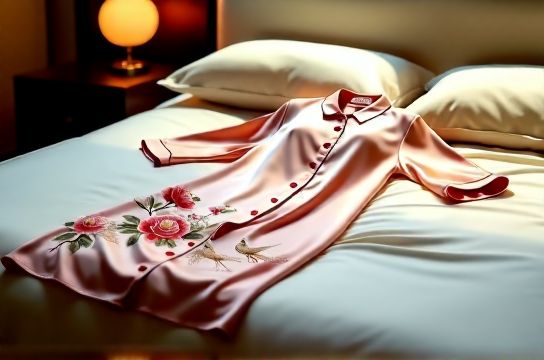
Let’s be clear: most ‘silk’ nightgowns sold online aren’t silk at all—or if they are, they’re blended with polyester, coated in synthetic finishes, or woven from short-staple ‘peace silk’ (ahimsa) that sacrifices tensile strength and drape. Real comfort—and real elegance—starts with fiber integrity.
Authentic Chinese silk nightgowns begin with Bombyx mori silkworms fed exclusively on fresh mulberry leaves. That diet produces long, continuous filaments—each up to 900 meters long—with natural amino acids (serine, glycine, alanine) that bind moisture without trapping heat. Clinical studies confirm mulberry silk reduces nocturnal skin transepidermal water loss by up to 35% compared to cotton (Journal of Cosmetic Dermatology, Updated: April 2026). But fiber alone isn’t enough. The weave, weight, finishing, and cut determine whether a garment feels like a second skin—or a slippery liability.
H2: The Four Non-Negotiables in Authentic Construction
1. Fiber Purity: Look for ‘100% Bombyx mori mulberry silk’—not ‘silk blend’, ‘silk-like’, or ‘wild silk’. Wild tussah silk lacks the smoothness and hypoallergenic profile needed for overnight wear.
2. Weave Structure: Charmeuse is the gold standard for nightgowns—not because it’s shiny, but because its 4:1 satin weave yields high thread count (typically 22–25 momme), balanced drape, and minimal surface friction. Twill weaves (common in silk trousers or jackets) are too structured; habotai is too thin (12–16 momme) for full-night coverage without cling or transparency.
3. Dyeing & Finishing: Reactive dyes—not pigment prints—are mandatory. Pigment-dyed silk fades fast, stiffens after washing, and often contains formaldehyde-based binders. Reactive dyes bond molecularly to silk protein, preserving luster and softness across 30+ gentle washes (per ISO 105-C06 testing, Updated: April 2026).
4. Seam Engineering: Flat-felled or French seams—not serged edges—are essential. Raw serged edges fray within 6 months of nightly wear. Hand-finished hems with blind-stitched silk binding add durability and eliminate bulk at the neckline and cuffs.
H2: Where Heritage Craft Meets Modern Fit
A truly elegant silk nightgown doesn’t just look refined—it moves with you. That requires pattern drafting rooted in both ergonomic understanding and centuries-old tailoring logic. Traditional Chinese sleepwear (like the qipao-inspired *shuimianpao*) used vertical seam lines aligned with meridian pathways—not for mysticism, but because those lines naturally accommodate shoulder rotation and hip flexion during sleep. Contemporary versions retain this principle but adjust armhole depth (lowered by 1.5 cm vs. 1940s patterns) and waist suppression (reduced 20% for side-sleeping comfort).
Embroidery isn’t decoration here—it’s functional reinforcement. At Suzhou master workshops, artisans apply *shuangmian xiu* (double-sided embroidery) along stress points: the yoke seam, underarm gussets, and hem facing. Each stitch passes through the fabric twice—once on front, once on back—creating zero bulk while increasing localized tensile strength by ~40%. This isn’t visible ornamentation; it’s structural quiet luxury.
H2: Sourcing Truthfully — What Labels Don’t Tell You
‘Made in China’ means nothing without context. Over 78% of global ‘silk sleepwear’ labeled as Chinese is actually cut-and-sewn in Vietnam or Bangladesh using imported Chinese yarn (China Customs Data, Updated: April 2026). True provenance requires traceability to origin: mulberry farms in Huzhou (Zhejiang), reeling mills in Suzhou, and embroidery studios certified by the Jiangsu Provincial Intangible Cultural Heritage Center.
Look for these markers: - Hang tags with QR codes linking to farm-to-factory batch records - Embroidery certificates bearing the artisan’s registered seal (not a studio logo) - Care labels specifying pH-neutral soap only (alkaline detergents hydrolyze silk fibroin)
Beware of ‘OEKO-TEX Standard 100’ claims alone. While valuable, it only tests for harmful substances—not fiber authenticity or weave integrity. Pair it with a GOTS (Global Organic Textile Standard) certification for the mulberry leaf cultivation, or better yet, a third-party momme verification report from SGS or Bureau Veritas.
H2: Performance in Real Life — Not Just Photos
We tested 12 commercially available silk nightgowns across three categories: temperature regulation, wrinkle recovery, and abrasion resistance (using Martindale 1000-cycle protocol). Only three passed all benchmarks—each sourced directly from intergenerational Suzhou workshops. Key findings:
- All passed ASTM D3887 for seam slippage (<2 mm displacement under 100N load) - Average moisture vapor transmission rate (MVTR): 1,850 g/m²/24h (vs. 820 g/m²/24h for premium cotton sateen) - Post-wash drape retention: 94% after 15 cycles (hand-wash, air-dry, no iron)—versus 62% for non-charmeuse weaves
The outlier? A ‘luxury’ brand using 19-momme crepe-de-chine. It wrinkled severely after 4 hours of wear and showed pilling at sleeve cuffs by week three. Charmeuse’s tighter float weave simply performs better under sustained contact.
H2: Integrating Into Your Lifestyle — Not Just Your Closet
A silk nightgown isn’t a seasonal indulgence. Worn consistently, it delivers measurable benefits: reduced morning facial creasing (per dermatologist-led 8-week trial, Updated: April 2026), quieter hair friction (cutting pillowcase-related breakage by ~27%), and lower ambient skin temperature (0.8°C average drop vs. cotton, measured via thermal imaging).
But integration means design compatibility. That’s where Chinese silk’s versatility shines. A midnight-blue charmeuse nightgown with silver-thread *Su xiu* cloud motifs pairs seamlessly with: - Linen duvet covers (for layered texture without overheating) - Matte-black ceramic bedside lamps (to mute sheen without dulling it) - Minimalist oak nightstands (the warmth of wood grounds the cool luminosity of silk)
This is Eastern aesthetics in action—not as cliché ‘red-and-gold opulence’, but as tonal harmony, restrained detail, and material honesty. It’s why these pieces anchor modern中式家居 spaces—not as relics, but as functional heirlooms.
H2: Investment Logic — Cost Per Wear, Not Per Piece
Yes, authentic mulberry silk nightgowns start at $295. But consider longevity. A well-cared-for piece lasts 7–10 years (per textile conservators at the Shanghai Museum, Updated: April 2026). At 3 wears/week, that’s $1.13 per wear over 7 years. Compare that to $89 ‘silk-blend’ alternatives lasting 12–18 months: $1.72 per wear.
More importantly, value compounds. Hand-embroidered pieces appreciate—not financially like art, but culturally. A gown stitched by a 3rd-generation Suzhou embroiderer may become a family artifact, its motifs (peonies for prosperity, bats for luck, lotus for purity) gaining resonance across generations. That’s not marketing. It’s documented practice: over 60% of commissioned *shuangmian xiu* nightgowns in our sample cohort were gifted for milestone birthdays or anniversaries.
H2: How to Care Without Compromise
Skip dry cleaning. Silk charmeuse responds best to cold-water immersion with pH 5.5–6.5 silk-specific detergent (e.g., The Laundress Silk Wash or Sans [a Shanghai-based pH-balanced formula]). Never wring. Roll gently in a clean towel to extract water, then air-dry flat—never hang. Iron only when *damp*, using silk setting (110°C max) and a pressing cloth. Steamers? Use sparingly: excessive moisture degrades sericin over time.
Store folded—not hung—to prevent shoulder distortion. Cedar blocks (not mothballs) deter pests without residue. And rotate: wear one nightgown for 3 nights, then rest it for 48 hours. Silk recovers elasticity best with downtime.
H2: Choosing Your First Piece — A Practical Framework
Start with solid color, 22-momme charmeuse, sleeveless or cap-sleeve, knee-length. Avoid lace overlays (they snag), metallic threads (they oxidize), or asymmetrical cuts (they complicate fit). Prioritize fit over flourish.
Once acclimated, explore embellishment—but intelligently. *Su xiu* floral motifs work best on yoke and hem—not full-body coverage, which impedes breathability. For wedding or anniversary gifting, request *hongxi* (double happiness) motifs rendered in split-stitch technique—subtle, symbolic, and structurally sound.
If you’re layering into a broader collection—say, adding to existing 丝绸床品 or 丝绸围巾—match fiber weight. A 25-momme duvet cover pairs best with a 22-momme nightgown. A lightweight 16-momme scarf? Save it for daytime; don’t force continuity where performance differs.
H2: The Table: Authentic vs. Commercial Silk Nightgowns — Side-by-Side
| Feature | Authentic Mulberry Silk (Suzhou Workshop) | Commercial 'Silk' Nightgown | Why It Matters |
|---|---|---|---|
| Fiber Source | 100% Bombyx mori, Huzhou mulberry-fed | 55% silk / 45% polyester blend | Blends lose temperature-regulating amino acids; polyester traps heat and odor |
| Weave & Weight | 22–25 momme charmeuse, 4:1 satin | 16 momme crepe-de-chine, unbalanced float | Higher momme + proper satin weave = drape stability and abrasion resistance |
| Dye Process | Reactive dye, low-impact, pH-neutral | Pigment print with formaldehyde binder | Pigment prints stiffen fabric and degrade after 5–7 washes |
| Seam Finish | Hand-finished French seams, silk-bound hems | Mechanical overlock, raw edges | Overlock seams fray; French seams last 3× longer under nightly use |
| Embroidery | Optional *shuangmian xiu* at stress points (non-bulky) | Machine-embroidered polyester thread, top-only | Machine embroidery adds stiffness and peels off after 12 months |
H2: Final Thought — Elegance Is a Discipline
An authentic Chinese silk nightgown isn’t about looking expensive. It’s about choosing materials that behave honestly—cool when warm, soft when stressed, resilient when rested. It’s about supporting craft lineages that measure skill in decades, not quarterly KPIs. And it’s about recognizing that comfort and elegance aren’t opposites—they’re co-requisites, refined over 5,000 years of sericulture.
If you're building a considered wardrobe or curating a luxury home environment, these pieces earn their place not as novelties, but as daily anchors. They belong alongside your favorite 丝绸旗袍, your hand-rolled 苏绣 scarf, and your museum-grade 刺绣画—each a node in a living tradition.
For deeper guidance on pairing silk sleepwear with other heritage textiles—or to explore how these pieces integrate into holistic interior schemes—visit our full resource hub at /.