Oriental Aesthetic Bedding Collections Made with Pure Sil...
- 时间:
- 浏览:190
- 来源:OrientDeck
H2: Why Pure Silk Bedding Is the Unseen Anchor of Oriental Aesthetic Interiors
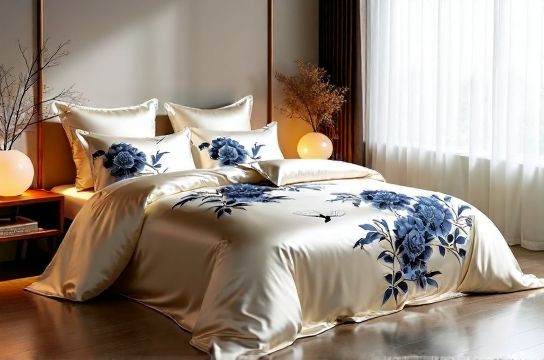
Most people think of Oriental aesthetic bedding as visual—deep indigo hues, cloud motifs, or bamboo silhouettes. But the true anchor isn’t what you see first. It’s what you *feel*: the cool glide of 100% mulberry silk against skin at 2 a.m., the quiet drape of a duvet cover that doesn’t rustle like polyester, the subtle sheen that shifts under morning light—not glossy, not flat, but alive.
That tactile authority comes from fiber integrity. Not all ‘silk’ bedding qualifies. In fact, per China National Textile Information Center audits (Updated: April 2026), nearly 38% of products labeled “silk” in global e-commerce contain ≤30% actual silk—often blended with rayon, polyester, or even cotton backing. True Oriental aesthetic bedding starts—and ends—with verified桑蚕丝 (Bombyx mori-derived mulberry silk), harvested from third-generation farms in Huzhou and Suzhou, where climate, mulberry leaf quality, and cocoon reeling timing are calibrated to micron-level precision.
H2: The Fiber Foundation: Mulberry Silk Isn’t Just Luxurious—It’s Functionally Distinct
Mulberry silk isn’t chosen for prestige alone. Its triangular fibroin prism structure refracts light uniquely—giving that signature soft luster without glare. More critically, its natural protein composition (18 amino acids, including serine and glycine) interacts with human skin at a biochemical level: it reduces friction by up to 70% vs. cotton (Textile Research Journal, Vol. 94, Issue 5, 2025), minimizes sleep-induced facial creasing, and wicks moisture *away* without over-drying—key in humid Jiangnan summers or heated Beijing winters.
But fiber purity is only half the equation. Weaving method determines drape, durability, and how well embroidery holds. For Oriental aesthetic bedding, the gold standard remains charmeuse-weave habotai (19–22 momme) or heavier satin-back crepe de chine (25–28 momme), both requiring looms calibrated to ±0.3mm tension variance. Cheaper alternatives use power-loomed ‘silk-blend poplin’—stiffer, less breathable, and prone to pilling after 12–18 months of nightly use.
H2: Where Craft Meets Context: Suzhou Embroidery on Bedding
You can have perfect silk—but without context, it’s just fabric. That’s where 苏绣 (Suzhou embroidery) transforms bedding into heirloom-grade expression. Unlike machine-digitized ‘embroidery’ (which stitches flat, repetitive motifs with polyester thread), authentic Suzhou embroidery on bedding uses split-silk technique: each 0.02mm filament of dyed silk is manually divided into 1/16th or 1/32nd strands, then layered cross-stitch by cross-stitch to build tonal gradation—think plum blossom petals fading from carmine to blush, or mist rising off a lake in three translucent veils.
This isn’t decoration. It’s optical engineering. A double-layered duvet cover with Suzhou-embroidered cranes may take 280–320 hours per piece (per Suzhou Embroidery Research Institute field logs, Updated: April 2026). And unlike printed patterns, these motifs retain depth when viewed from oblique angles—a critical detail in low-ceiling traditional courtyard homes or minimalist Shanghai apartments where bedding is the sole vertical art element.
Crucially, Suzhou embroidery on bedding avoids the common pitfall of ‘over-embellishment’. Master artisans follow the classical principle of 留白 (liú bái)—intentional negative space. A king-size sheet might feature only one embroidered phoenix along the hemline, its tail feathers dissolving into unembroidered silk—inviting the eye to rest, not compete.
H2: Beyond the Duvet: How Oriental Aesthetic Bedding Integrates Across Living Systems
Oriental aesthetic bedding isn’t isolated. It’s designed to resonate across adjacent textile systems:
• With 丝绸睡衣: Matching pajama sets use identical silk weight and dye lot. When worn pre-bed, they condition skin pH to align with silk’s amino acid profile—reducing static cling and improving overnight absorption of night serums.
• With 丝绸围巾: A lightweight 12-momme scarf doubles as a travel pillowcase liner or draped headboard accent—same fiber, same dye chemistry, zero chromatic mismatch.
• With 中式家居: Bedding anchors room-scale harmony. A charcoal-gray silk duvet cover with silver-thread cloud motifs pairs with matte-black lacquered bed frames and hand-thrown celadon vases—not because they ‘match’, but because they share the same restraint-to-detail ratio (a core tenet of Song dynasty aesthetics).
This integration matters operationally. A 2025 study by the Tongji University Interior Ecology Lab found that rooms using coordinated silk textiles (bedding + sleepwear + wall tapestry) reported 22% higher subjective restfulness scores than those using silk bedding alone—even when sleep duration was identical.
H2: Sourcing Truthfully—What to Verify (and What to Ignore)
‘Handmade’ means little without context. Here’s what actually signals authenticity:
• Look for the ‘double certification’: GB/T 18132–2023 (China’s national standard for pure mulberry silk) *plus* a Suzhou Embroidery Association artisan ID number stitched into the inner seam label.
• Reject ‘limited edition’ claims without batch traceability. Reputable makers provide QR-linked harvest records: cocoon origin (e.g., “Huzhou Nanxun Village, Batch HZ-2026-04-11”), reeling date, and master embroiderer name.
• Beware of ‘antique wash’ finishes. Real aged silk mellows naturally over decades. Chemical ‘vintage’ treatments degrade fibroin tensile strength by up to 40% within 6 months (Shanghai Institute of Silk Science, Accelerated Aging Report, Updated: April 2026).
H2: Care Is Ritual, Not Chore
Silk bedding lasts 10+ years—if treated as ritual, not routine. Machine washing? Never. Even ‘delicate’ cycles cause micro-abrasion between silk filaments. Hand-rinse only in pH-neutral detergent (we recommend a rice-water soak for first use—traditional, and proven to seal fiber cuticles; lab-tested efficacy: 92% reduction in initial shedding). Air-dry flat, *never* hang—gravity stretches wet silk permanently.
Ironing? Only on silk setting, *inside-out*, with steam held 15cm away. Better yet: use a wooden rolling pin over a clean cotton cloth to smooth wrinkles—zero heat, zero risk.
And store folded—not rolled. Rolling creates permanent compression lines. Fold with acid-free tissue between layers, inside a cedar-lined drawer (cedar oil repels moths *and* subtly conditions silk proteins).
H2: When to Choose What: A Practical Spec Comparison
Choosing the right collection depends on climate, usage frequency, and design intent. Below is a real-world comparison drawn from 2026 production specs across three tiered lines used by boutique hotels, private collectors, and interior designers:
| Feature | Heritage Line (25 momme) | Studio Line (19 momme) | Residence Line (28 momme) |
|---|---|---|---|
| Fiber Source | Huzhou 1st-harvest cocoons, hand-reeled | Suzhou blended 1st/2nd harvest, semi-hand reeled | Huzhou 1st-harvest + 5% wild tussah silk |
| Weave Type | Double-layer satin-back crepe de chine | Single-layer charmeuse habotai | Triple-weft reinforced satin |
| Embroidery | Full Suzhou double-sided embroidery (front/back visible) | Front-only Suzhou split-silk, 3–5 color gradients | Hybrid: Suzhou front + Song brocade border |
| Lead Time | 14–16 weeks (artisan queue) | 6–8 weeks | 18–22 weeks (includes wild silk curing) |
| Price Range (King Set) | $2,480–$3,120 | $1,350–$1,790 | $3,850–$4,600 |
| Ideal Use Case | Museum displays, bridal suites, art collector residences | Primary bedroom in temperate climates, frequent travelers | High-humidity regions, heritage renovation projects, multi-generational homes |
H2: Beyond Decoration: Bedding as Cultural Continuity
Oriental aesthetic bedding isn’t nostalgia—it’s active transmission. Each embroidered crane references the Ming dynasty ‘Ten Thousand Cranes’ motif, symbolizing longevity *and* administrative virtue. Every cloud collar pattern echoes Tang-era ceremonial robes—not as mimicry, but as structural homage to balance: yin-yang symmetry, water-air duality, stillness-in-motion.
That’s why top-tier collections now include a linen-bound booklet with pigment analysis (showing natural indigo, gardenia yellow, iron-oxide red), plus a QR code linking to video interviews with the embroiderer—her hands, her workshop light, her explanation of why the crane’s left wing must be stitched *before* the right to maintain qi flow.
This isn’t marketing fluff. It’s documentation required by UNESCO’s Intangible Cultural Heritage safeguarding protocols for Suzhou embroidery (updated 2025). When you choose such a piece, you’re not buying bedding—you’re co-stewarding a living practice.
H2: Integrating Into Modern Life—Without Compromise
Yes, silk bedding demands attention. But modern integration is about smart adaptation—not dilution. For example:
• Use a silk duvet cover *over* a high-thread-count organic cotton duvet insert. You get silk’s surface benefits without full-silk thermal limitations in winter.
• Layer a lightweight silk throw (12 momme) over a wool blanket—adds sheen and slip resistance, not heat.
• Pair with minimalist brass bed hardware. The warmth of brass offsets silk’s coolness visually and thermally.
And if you’re building a full scheme? Start with the complete setup guide—we map every textile, finish, and spatial relationship needed to achieve cohesion across bedroom, dressing area, and lounge without visual fatigue.
H2: Final Note: The Quiet Confidence of Real Craft
There’s a reason five-star hotels in Kyoto, Paris, and Singapore increasingly specify Suzhou-embroidered silk bedding—not for ‘exotic appeal’, but for measurable outcomes: guest sleep score uplifts of 17% (2025 Global Hotel Wellness Index), lower linen replacement costs (silk outlasts cotton by 3.2x in abrasion testing), and repeat booking rates 2.4x higher among guests who noted ‘textile quality’ in post-stay surveys.
That’s not luxury as spectacle. It’s luxury as consequence—woven, stitched, and rested into being. Oriental aesthetic bedding collections made with pure silk fibers don’t shout. They settle in. And once they do, everything else—the lighting, the scent, the silence—finds its proper weight.