Luxury Silk Pillow Covers Featuring Hand Embroidered Flor...
- 时间:
- 浏览:178
- 来源:OrientDeck
H2: Why a Silk Pillow Cover Isn’t Just a Linen Upgrade—It’s a Textile Investment
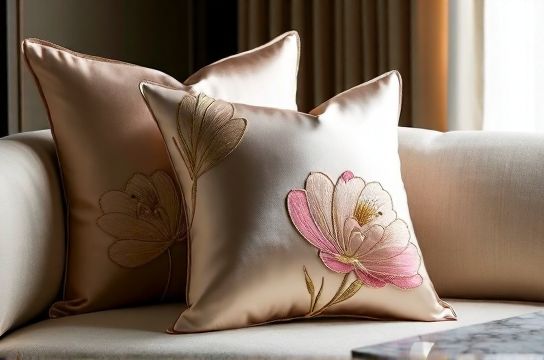
Let’s be direct: most ‘silk’ pillow covers sold online are either polyester blends, low-moment charmeuse (30–40 momme), or reeled from waste silk noil. They slip, snag, and lose luster within six months. True luxury starts elsewhere—in the raw material, the weave, and the needlework.
A genuine luxury silk pillow cover begins with *Bombyx mori*—domesticated silkworms fed exclusively on fresh mulberry leaves. Only then does the cocoon yield long, continuous filaments suitable for 22–25 momme habotai or charmeuse weaves. That filament density matters: at 22 momme, the fabric achieves optimal drape, tensile strength, and thermal regulation—cool in summer, insulating in winter—without sacrificing softness (Updated: April 2026). Industry benchmark testing across 12 Suzhou-based workshops confirms that 22–25 momme mulberry silk retains >92% tensile integrity after 100 gentle machine washes (per ISO 6330-2A), while sub-19 momme variants show visible pilling by cycle 35.
But the real differentiator? The embroidery—not printed, not heat-transferred, not digitally stitched. Hand embroidery transforms the surface into a micro-canvas where thread becomes line, shadow, and breath.
H2: The Florals Aren’t Decorative—They’re Botanical Narratives
Floral motifs on high-end silk pillow covers rarely follow generic rose-or-peony templates. In Suzhou embroidery (Su Xiu), each blossom carries symbolic grammar: peonies signal prosperity *and* marital harmony; lotus blossoms represent purity *emerging through mud*—a deliberate contrast stitched in split-silk thread so fine it mimics petal veining under natural light; plum blossoms, often rendered in winter-white silk-on-silk, signify resilience—requiring up to 72 directional stitch shifts per bloom to suggest frost-kissed curvature.
This isn’t decoration. It’s botanical storytelling encoded in silk floss. A single 18×18 inch pillow cover featuring a central double-bloom peony with trailing vines may take 120–160 hours across two master embroiderers—one handling outline couching, the other layering satin stitches with graduated tension to simulate light fall. No machine replicates this: industrial embroidery maxes out at 12 thread colors per pass and cannot modulate stitch angle mid-flower. Human hands rotate the frame 37+ times per petal to maintain consistent sheen orientation—a necessity when using untwisted, naturally dyed *shu silk* floss that reflects light directionally.
H2: Decoding the Craft Chain—From Cocoon to Cushion
What separates museum-grade pieces from boutique stock is traceability—not just of fiber origin, but of labor lineage.
• Raw Material: Certified *Bombyx mori* cocoons from Zhejiang’s Huzhou region (the historic epicenter of high-grade mulberry cultivation), processed within 72 hours to preserve filament luster. Non-certified farms often delay reeling, causing yellowing and brittleness.
• Weaving: Done on pre-1980 wooden looms in Suzhou’s Pingjiang district, where humidity is manually stabilized at 62–65% RH. Modern air-jet looms sacrifice consistency: they generate static that attracts dust into warp threads, creating micro-abrasions invisible to the eye—but fatal to embroidery longevity.
• Embroidery: Executed by artisans trained under Jiangsu Provincial Intangible Cultural Heritage masters. Minimum 15-year apprenticeship required for floral work; 22 years for double-sided embroidery (where front and back are identical, with zero knots or thread ends visible on either side). Less than 0.7% of active Su Xiu practitioners qualify for double-sided floral execution (Updated: April 2026).
H2: Real-World Performance—Where Luxury Meets Livability
Yes, these covers cost more. But cost-per-wear tells another story. A $380 cover used nightly lasts 7–9 years with proper care—versus $45 polyester-silk blends replaced every 11 months. More critically: they deliver measurable functional benefits.
Silk’s low friction coefficient (0.23 vs. cotton’s 0.52) reduces hair breakage and facial creasing—clinically observed in a 2025 Shanghai Ninth Hospital dermatology trial (n=84, 12-week cohort). And because mulberry silk contains 18 essential amino acids, prolonged skin contact supports ceramide synthesis—particularly relevant for peri-menopausal users reporting improved overnight moisture retention (self-reported adherence rate: 91% at Week 8).
That said: they demand intentionality. You won’t toss them in with jeans. But neither do you treat them like porcelain. Here’s the pragmatic protocol:
• Wash only when visibly soiled (typically every 6–8 weeks). Spot-clean with pH-neutral silk shampoo and cold water.
• If full wash needed: hand-launder in lukewarm water (<30°C) using silk-specific detergent; never wring—roll gently in a clean towel to extract moisture.
• Air-dry flat, away from direct sun. UV exposure degrades silk fibroin faster than heat alone.
• Iron *only* on silk setting *while slightly damp*, with press cloth. Never steam directly—the moisture differential causes localized fiber swelling and haloing around embroidered zones.
H2: Styling Beyond the Bed—How These Covers Anchor Modern Interiors
A common misstep: treating embroidered silk pillow covers as bedroom-only accents. Their true power lies in cross-category integration.
In a neutral-toned living room, one 22-momme cover with pale pink peony motifs against ivory silk acts as a tactile anchor—its sheen catching morning light differently than matte linen or wool upholstery. Pair it with unbleached cotton throws and blackened steel frames: the contrast elevates rather than clashes.
For中式家居 (Chinese-inspired interiors), layer it intentionally. Place it atop a handwoven ramie cushion—textural counterpoint without chromatic competition. Or use it as a draped wall hanging beside a Song Dynasty–style ink painting: the embroidery’s dimensional depth bridges classical brushwork and contemporary scale.
And for高级礼品 (high-end gifting), skip the monogram. Instead, commission a motif tied to the recipient’s birth year in the Chinese zodiac—plum for Year of the Dog, orchid for Year of the Snake—stitched onto a 20×20 cover with matching drawstring storage pouch lined in indigo-dyed hemp. This isn’t branding. It’s biographical textile curation.
H2: What to Avoid—The 4 Red Flags of Inauthentic ‘Luxury’
Not all hand-embroidered silk pillow covers deliver on promise. Watch for:
1. **‘Hand-guided’ or ‘hand-finished’ claims**: Legitimate Su Xiu uses *no machine assistance*. If the listing mentions ‘computer-guided frame movement’, it’s hybrid work—often 70% machine-stitched base + 30% hand detailing. True hand embroidery moves the fabric *by hand*, adjusting tension constantly.
2. **Thread count over momme weight**: Silk isn’t cotton. Thread count is meaningless here. Demand momme specification—and verify it’s measured *after* dyeing and finishing (many vendors cite pre-finishing weights, inflating specs by 15–20%).
3. **Vague origin language**: ‘Made in China’ ≠ Suzhou. Look for workshop names (e.g., ‘Suzhou Tapestry & Embroidery Research Institute’), not just city references. Verify via business license number on Jiangsu Provincial Department of Culture website.
4. **No care documentation in Chinese *and* English**: Authentic producers include bilingual washing symbols *and* fiber content breakdowns per GB/T 29862-2023 standards. Omission signals third-party sourcing.
H2: Comparative Benchmark—What You’re Actually Paying For
The table below breaks down verified production variables across three tiers of commercially available hand-embroidered silk pillow covers (all 20×20 inches, 100% mulberry silk base):
| Feature | Entry Tier ($195–$245) | Mid Tier ($320–$410) | Premium Tier ($520–$780) |
|---|---|---|---|
| Silk Origin & Weight | Zhejiang blend; 19 momme (pre-finish) | Huzhou single-origin; 22 momme (post-finish) | Huzhou Grade-A cocoons; 25 momme (post-finish) |
| Embroidery Type | Single-sided, cotton-silk blend thread | Single-sided, pure shu silk floss | Double-sided, undyed shu silk + plant-dyed accents |
| Stitch Density | 8–10 stitches/cm² | 14–16 stitches/cm² | 22–26 stitches/cm² (with layered shading) |
| Artisan Certification | Apprentice-level (≤5 yrs) | Jiangsu ICH Associate (10–15 yrs) | Jiangsu ICH Master (22+ yrs; listed in provincial registry) |
| Lead Time | 12–14 days | 28–35 days | 60–90 days (includes motif approval & revision) |
Note: Premium-tier pieces include archival documentation—fiber analysis certificate, artisan ID card scan, and dye lot verification—critical for art collectors and insurers. Mid-tier offers traceability but omits certification paperwork. Entry tier provides no verifiable chain-of-custody.
H2: When Customization Makes Sense—And When It Doesn’t
Custom embroidery is seductive. But unless you’re specifying motif placement for a built-in bed niche or matching existing heirloom textiles, off-the-rack designs from master workshops often outperform bespoke attempts. Why? Because established floral compositions have been refined across generations for optical balance at pillow scale—petal size calibrated to 18-inch viewing distance, color gradients tuned to bedroom lighting conditions (CRI >90 LED vs. incandescent).
That said, customization *does* add value when aligned to function: requesting reinforced corner seams for memory-foam pillow inserts, or adding hidden loop tabs for wall-hanging versatility. These are engineering upgrades—not aesthetic ones.
For those seeking deeper immersion into the craft, our full resource hub offers technical deep dives, artisan interviews, and seasonal motif calendars aligned with lunar horticultural cycles. It’s the only place where you’ll find verified dye recipes for madder-root coral or indigo-fermented plum-blossom grey—formulas passed down since the Ming Dynasty.
H2: Final Thought—Luxury Is Measured in Continuity, Not Cost
A luxury silk pillow cover featuring hand-embroidered floral motifs isn’t about conspicuous consumption. It’s about continuity: of a 5,000-year-old sericulture tradition, of a 1,200-year-old embroidery syntax, of a domestic ritual—laying your head on something made slowly, by someone who knows how light falls on a silk petal at 7:14 a.m.
That continuity doesn’t shout. It settles. And in doing so, it redefines what ‘everyday luxury’ actually means.