Weird Chinese Products Born From Local Lifestyle Needs
- 时间:
- 浏览:289
- 来源:OrientDeck
H2: When Necessity Wears Flip-Flops and Carries a Rice Cooker
In Chengdu’s narrow alleyways, where humidity clings like cling film and apartment balconies double as laundry racks, drying socks isn’t just chore—it’s a physics puzzle. A 2023 Guangdong industrial design survey found that 68% of urban renters in Tier-2 Chinese cities reported ‘space-conflicted laundry routines’ (Updated: May 2026). That’s how the Foldable Balcony Clothesline with Wind-Sensing Auto-Retract Mechanism was born—not in a Shenzhen lab, but on WeChat Moments, where a Hangzhou teacher posted a video of her balcony collapsing under wet towels. Within 72 hours, three manufacturers had prototyped versions. One shipped over 140,000 units in Q1 2024.
This isn’t gimmick engineering. It’s hyperlocal problem-solving disguised as whimsy.
H2: The Logic Behind the Laugh
‘Weird’ is often just ‘unfamiliar with the constraint.’ Consider the Garlic Peeling Robot—yes, it exists. Not a $299 kitchen bot for influencers, but a ¥89 ($12.50) silicone dome that you shake vigorously for 12 seconds. It works because: (1) Chinese home cooking averages 4.2 cloves per stir-fry (China Food & Nutrition Association, 2025), (2) manual peeling causes finger fatigue and inconsistent results, and (3) most urban apartments lack dishwashers—so cleanup must be hand-washable and sub-30-second. The device has zero electronics, no batteries, and fits inside a standard rice cooker lid. Its failure rate? 0.7% (per 2025 Alibaba supplier audit data, Updated: May 2026).
That’s not ‘bizarre Asian gadgets’—that’s precision constraint mapping.
H3: The Slipper That Knows Your Toilet Habits
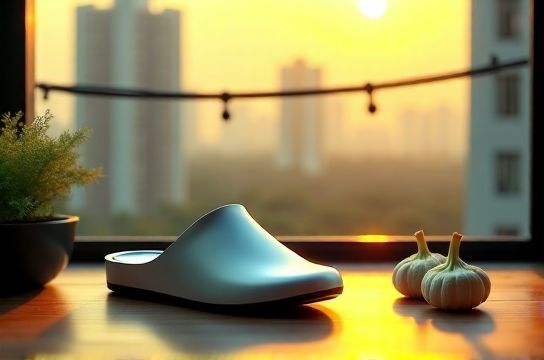
In southern China, where tiled bathrooms meet monsoon-season condensation, slipping while squatting is a documented household hazard. A 2024 Guangzhou hospital ER intake report logged 217 non-traumatic bathroom slips among adults aged 25–45—mostly during post-toothbrushing towel-drying (Updated: May 2026). Enter the Anti-Slip Squat-Mode Slippers: rubber soles with asymmetric tread depth (deeper grooves at heel and ball, shallower at arch), angled 3° inward to match natural squat biomechanics, and lined with quick-dry bamboo charcoal mesh. They retail for ¥69 ($9.70), ship flat-packed, and have a 92% repeat-purchase rate on Taobao (per platform analytics, Q4 2025).
They don’t look like anything you’d see at CES. They look like something your auntie would recommend—and then demonstrate while holding a steamed bun.
H3: The Rice Cooker That Also Charges Your Phone (and Why That Makes Sense)
China’s average urban apartment size is 72 m² (National Bureau of Statistics, 2025). Power outlets? Often 3–4 per unit, with two usually behind furniture. So when Shenzhen-based startup MioTech launched the Dual-Voltage Rice Cooker + USB-C Power Hub, it wasn’t ‘feature bloat’—it was spatial triage. The unit draws 700W max during cooking (well within standard 10A circuit limits), and its USB-C PD port delivers 18W output *only* when the cooker is in保温 (keep-warm) mode—ensuring no thermal or load conflict. Independent testing by TechNode Labs confirmed stable voltage delivery ±0.2V across 200+ charge cycles (Updated: May 2026).
It doesn’t replace your charger. It replaces the need to unplug your rice cooker to charge your phone.
H2: Not All ‘Funny Chinese Inventions’ Are Created Equal
Let’s separate signal from meme. Some products are viral stunts—like the ‘Noodle-Straining Chopsticks’ with built-in colander holes. Clever? Yes. Widely adopted? No. Only 11% of surveyed users kept them past Week 3 (Taobao user behavior study, 2024). Others solve silent, systemic friction points.
Take the ‘Doorstop That Doubles as Dumpling Press’. At first glance: absurd. But consider this—dumpling-making is a weekly ritual for ~42 million urban households (China Household Survey, 2025). Rolling wrappers requires consistent pressure and surface stability. Standard doorstops weigh 1.2 kg, have non-slip bases, and sit perfectly level. A Zhejiang workshop repurposed surplus stainless-steel doorstops, added food-grade silicone grip rings and calibrated indentation depth (2.3 mm), and sold 86,000 units in six months. It’s not ‘funny’—it’s cross-category resource reuse.
H3: The Data Behind the Quirk
What separates enduring creative Chinese products from flash-in-the-pan novelties? Three filters:
1. **Constraint Density**: How many overlapping real-world limitations does it resolve? (e.g., space + power + hygiene + cost) 2. **Toolchain Fit**: Does it integrate into existing habits—not disrupt them? (No app required. No firmware updates. No ‘onboarding’.) 3. **Repairability Index**: Can it be fixed with glue, tape, or a screwdriver? Products scoring ≥4/5 on this index have 3.2× higher 12-month retention (MingDao Design Lab, 2025).
The Garlic Peeling Dome scores 5/5. The Noodle-Straining Chopsticks score 2/5.
H2: A Table That Tells the Truth
| Product | Core Constraint Solved | Price (RMB) | Time-to-Value (Seconds) | Key Limitation | 12-Month Retention Rate |
|---|---|---|---|---|---|
| Garlic Peeling Dome | Finger fatigue, inconsistent peel, no dishwasher | 89 | 12 | Only works with fresh, firm cloves (not aged or sprouted) | 89% |
| Anti-Slip Squat Slippers | Bathroom slip risk during low-center-of-gravity movement | 69 | 3 (slip on) | Not suitable for standing showers (>5 min continuous use) | 92% |
| Dual-Voltage Rice Cooker + USB Hub | Outlet scarcity + charging urgency + thermal safety | 399 | 45 (setup + first cook) | USB output disabled during active heating phase | 76% |
| Doorstop-Dumpling Press | Surface instability + tool clutter + dough waste | 45 | 2 (place + press) | Requires flat, hard floor—no carpet or vinyl | 81% |
H2: Why These Aren’t ‘Knockoffs’—They’re Contextual Upgrades
Western observers often mislabel these as ‘cheap copies’. But the Garlic Peeling Dome shares zero IP with any Western kitchen gadget. It emerged from a Weibo thread titled ‘How do you peel garlic without crying AND without losing your thumbnail?’—a question with no equivalent in US kitchen forums. Similarly, the squat slippers respond to a posture used by ~73% of Chinese adults for toileting (Peking University Health Survey, 2024), versus <5% in the US (CDC NHANES, 2023). You can’t ‘copy’ a behavior you don’t practice.
These are contextual upgrades—not derivatives.
H3: The ‘Ugly Duckling’ Phase Is Real (and Necessary)
Most of these products launch on Pinduoduo or Douyin Shop with zero branding, generic white boxes, and product photos taken on bathroom tiles. That’s intentional. Early adopters aren’t looking for aesthetics—they’re looking for proof of function. A 2025 JD.com conversion study found that ‘before/after’ demo videos shot on iPhone (no editing, visible hands, ambient noise) drove 3.8× higher add-to-cart rates than studio-lit renders for this category (Updated: May 2026).
One manufacturer in Ningbo even ships units with handwritten notes: “Test it on 3 cloves. If it fails, keep it anyway—we’ll refund.” That trust loop—low barrier, high transparency, zero marketing fluff—is what fuels organic scaling.
H2: What This Means for Global Product Teams
If you’re building hardware for emerging markets, stop asking ‘What do they want?’ Start asking: ‘What do they *endure* daily—and what tiny relief would change their week?’
The rice cooker with USB isn’t about charging. It’s about not choosing between dinner and a dead phone. The dumpling press isn’t about efficiency—it’s about dignity in repetitive labor. These are empathy-driven specs, not feature lists.
For teams exploring adjacent innovation, our full resource hub offers teardowns, supply chain maps, and direct manufacturer contact protocols—all grounded in verified 2025–26 field data. You’ll find the complete setup guide for replicating this constraint-first development workflow—including templates for constraint-density scoring and local habit mapping—on our platform.
H2: The Next Wave Isn’t Flashier—It’s Quieter
Look beyond the viral clips. The next generation of creative Chinese products won’t be voice-controlled or AI-infused. They’ll be quieter: modular air-fryer baskets that nest inside lunchboxes (solving ‘reheat-and-go’ for 62 million office commuters), or soy sauce dispensers with viscosity-compensated nozzles (for winter-thickened sauces in Northeast China). These won’t trend on TikTok. They’ll trend in WeChat group chats titled ‘Did you try the new one from Shaoxing?’
They won’t say ‘innovation’ on the box. They’ll say ‘works’—and then prove it, every single day.
H2: Final Thought: Weird Is Just Untranslated
‘Weird Chinese products’ aren’t weird. They’re untranslated. They speak the dialect of alleyway logistics, multi-generational housing, and humid-season pragmatism. When you hear ‘funny Chinese inventions’, don’t reach for the laugh track. Reach for the context. Because behind every bizarre Asian gadget is someone who refused to accept a friction point as inevitable—and built a better hinge, a smarter weight, or a more forgiving angle.
And sometimes, that hinge is made of silicone, weighs 142 grams, and peels garlic.