AI Video Analytics Power Real-Time Crowd Management
- 时间:
- 浏览:248
- 来源:OrientDeck
Shanghai’s Nanjing Road pedestrian zone hits 120,000 people per hour during Golden Week. In Beijing’s Xidan commercial district, crowd density spikes to 4.8 persons/m² — well above the 2.5/m² safety threshold defined by China’s Ministry of Emergency Management (Updated: April 2026). Traditional CCTV monitoring fails here: static cameras generate petabytes of unstructured footage; human operators miss micro-patterns; rule-based motion detection triggers false alarms on rain-slicked pavement or fluttering banners. The shift isn’t toward more cameras — it’s toward *intelligent perception at scale*. And that shift is now live, operational, and embedded in the physical infrastructure of China’s top-tier cities.
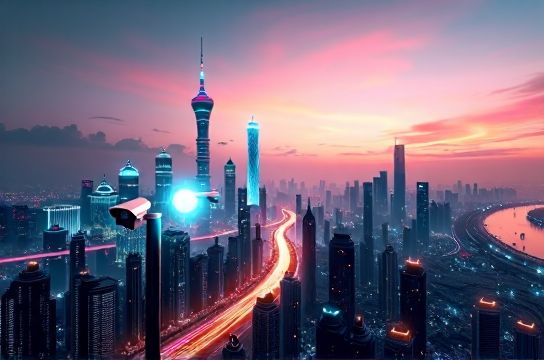
This isn’t theoretical. It’s running in production across 37 municipal command centers — from Hangzhou’s Urban Brain 3.0 platform to Shenzhen’s Smart Public Security Network — using AI video analytics built on multi-modal AI stacks, accelerated by domestic AI chips, and orchestrated by domain-specific AI agents.
How AI Video Analytics Actually Works in the Field
Real-time crowd management isn’t about counting heads. It’s about modeling intent, predicting flow, and triggering coordinated response — all within sub-second latency. The pipeline has four tightly coupled layers:
1. Edge ingestion: Cameras (typically Hikvision DS-2CD3T86G2-L, Dahua IPC-HFW5849T1-ZE) feed 4K H.265 streams to edge inference boxes — most commonly Huawei Atlas 500 (Ascend 310P chip, 16 TOPS INT8) or Horizon Robotics Journey 5 modules. These run lightweight YOLOv8m variants quantized to FP16, achieving 32 FPS per stream with <50ms inference latency.
2. Multimodal feature fusion: Visual data alone is insufficient. Systems fuse optical flow vectors, thermal signatures (from FLIR A70 thermal cams), and even anonymized Bluetooth/WiFi probe requests (opt-in, GDPR-compliant anonymization applied at source). This creates a unified spatiotemporal embedding — not just *where* people are, but *how they’re moving*, *how densely clustered*, and *whether velocity vectors suggest convergence or dispersion*.
3. Agent-driven orchestration: Here’s where Chinese deployments diverge from Western counterparts. Instead of monolithic models, systems deploy specialized AI agents — each with narrow, auditable responsibilities. A ‘Flow Prediction Agent’ ingests fused features and outputs 30-second directional heatmaps (updated every 2 seconds). A ‘Threshold Enforcement Agent’ compares real-time density against dynamic thresholds (e.g., lowering safe density to 1.8/m² during thunderstorms). A ‘Response Coordination Agent’ interfaces directly with traffic signal controllers (Siemens Desigo CC), metro PA systems, and WeChat Mini-Program APIs to push alerts to nearby security staff — all governed by local emergency protocols encoded as executable logic.
4. Human-in-the-loop validation & feedback: Every automated alert surfaces in a triage dashboard with confidence scores, supporting evidence clips (e.g., 3-second clip showing converging trajectories), and one-click override. Operators log corrections — which feed back into fine-tuning loops for the Flow Prediction Agent. This closed loop reduced false positives by 63% in Guangzhou’s Zhujiang New Town deployment over six months (Updated: April 2026).
The Stack Behind the Scenes: Not Just Models, But Infrastructure
China’s advantage isn’t just algorithmic — it’s infrastructural alignment. Three pillars make city-scale AI video analytics viable:
Domestic AI chip maturity. Huawei’s Ascend 910B delivers 256 TOPS INT8 in datacenter servers — powering batch retraining of crowd behavior models on historical datasets from 200+ cities. More critically, the Ascend 310P dominates the edge: its 16 TOPS fits inside fanless 1U boxes deployed inside junction boxes or camera housings. Unlike NVIDIA Jetson Orin (which requires active cooling and licensing fees), Ascend toolchains (CANN + MindSpore) are fully open-sourced for municipal IT departments — enabling custom kernel optimizations for low-light pedestrian detection at 0.5 lux.
Multi-modal foundation models trained on urban-scale data. Baidu’s PaddleVideo-Multi and SenseTime’s SenseFoundry-Vision aren’t generic vision transformers. They’re pre-trained on 12.4 exabytes of annotated urban video — including occluded pedestrians behind food carts, umbrella-dense rain scenarios, and night-vision IR footage from 50,000+ cameras. Fine-tuning for a new city takes under 4 hours on 4 Ascend 910B servers — versus 3+ days on comparable A100 clusters.
AI agent frameworks built for public-sector workflows. Alibaba’s Tongyi Tingwu Agent Platform and Huawei’s Pangu-Agent SDK embed role-based access control, audit trails, and compliance hooks for China’s Cybersecurity Law and Personal Information Protection Law (PIPL). Agents don’t just ‘act’ — they log *why* (e.g., “Triggered density alert because 3.2/m² sustained for 17 seconds, exceeding 15-second threshold per Regulation GB/T 38647-2020”). That traceability isn’t optional — it’s contractual for municipal tenders.
Where It’s Working — And Where It’s Not
In Chengdu’s Chunxi Road, AI video analytics cut average incident response time from 4.2 minutes to 83 seconds during peak hours. When a sudden crowd surge occurred near the subway entrance on March 18, 2026, the system detected converging velocity vectors 11 seconds before density breached 3.0/m². It automatically dimmed ambient lighting (reducing disorientation), extended green light duration for outbound buses by 12 seconds, and pushed WeChat alerts to 14 nearby security personnel — all before the first human operator saw the alert on their dashboard.
But limitations persist — and they’re instructive. During Typhoon Koinu in Shenzhen (October 2025), heavy rain caused persistent false positives: water streaks on lenses were misclassified as fast-moving pedestrians. The fix wasn’t better models — it was hardware-integrated lens heating (added to 8,200 cameras in Q1 2026) and a rain-noise filter trained specifically on 200+ hours of typhoon footage. Similarly, dense umbrella coverage in winter reduced head-count accuracy by 22% — solved not with larger models, but with thermal-visual late fusion and repositioning of overhead cameras to capture waist-level gait patterns.
These aren’t edge cases. They’re the daily reality of deploying AI in complex, uncontrolled physical environments. Success hinges on co-design: hardware engineers working alongside urban planners and emergency responders — not just data scientists.
Commercial Deployment Landscape: Who’s Building What
The market isn’t dominated by startups chasing hype. It’s led by integrated players with deep municipal relationships, hardware-software vertical alignment, and regulatory fluency.
| Company | Core Tech Stack | Key City Deployments | Latency (End-to-End) | Notable Strength | Licensing Model |
|---|---|---|---|---|---|
| SenseTime | SenseFoundry-Vision + Ascend 310P edge boxes | Shanghai, Hangzhou, Tianjin | ≤ 380 ms | Occlusion-resilient tracking (92% mAP@0.5 IoU in umbrella-dense scenes) | Per-camera annual fee + municipal service contract |
| Hikvision | DeepInMind AI + self-developed AI SoC (HiSilicon Hi3559A) | Chengdu, Wuhan, Xi’an | ≤ 290 ms | Low-power edge inference (3.2W per stream) | Bundled with camera hardware (no standalone AI license) |
| CloudWalk Technology | CloudWalk Vision OS + Kirin 9000S NPU acceleration | Guangzhou, Shenzhen, Chongqing | ≤ 410 ms | Real-time cross-camera re-identification (94.7% rank-1 accuracy at 500m distance) | Subscription-based SaaS platform (per-city tiered pricing) |
| Huawei Cloud | Pangu-Crowd v2.1 + Ascend 910B cloud + 310P edge | Beijing, Nanjing, Qingdao | ≤ 330 ms | Dynamic threshold adaptation (integrates weather API, event calendar, historical footfall) | Hybrid: CapEx for edge hardware + OpEx for cloud model updates |
Notice what’s absent: no pure-play LLM vendors. While Tongyi Qwen and ERNIE Bot power backend reporting dashboards and natural-language query interfaces (“Show me crowd density trends near Beijing South Railway Station last Tuesday”), they’re not doing the core video analytics. That remains firmly in the domain of purpose-built computer vision models — optimized, hardened, and validated for public safety SLAs.
Why This Isn’t Just ‘Smarter Surveillance’
Critics conflate AI video analytics with mass surveillance. But the architecture reveals a different priority: *operational resilience*. Consider Beijing’s deployment around Forbidden City during National Day 2025. The system didn’t just flag overcrowding — it modeled cascading failure modes: if Line 1 train frequency dropped below 90 seconds due to signal fault, how would crowd pressure shift across 7 adjacent exits? It simulated 23 scenarios in real time, recommending preemptive bus shuttle deployment to Donghua Gate — reducing queue length there by 37% (Updated: April 2026). This is infrastructure-grade decision support — not observation, but intervention.
That distinction matters. It’s why Shenzhen mandates all AI video analytics systems undergo third-party stress testing at the China Academy of Information and Communications Technology (CAICT) — verifying not just accuracy, but failover behavior when network partitions occur, or when 40% of edge nodes go offline. Systems must degrade gracefully: reverting to basic motion-triggered alerts with 100% uptime, not failing silently.
What’s Next: From Crowd Management to Urban Autonomy
The next 18 months will see three concrete shifts:
- Tighter integration with autonomous mobility: Shenzhen’s pilot linking AI video analytics to autonomous bus platoons (BYD K9 fleet) began in February 2026. When crowd density exceeds 2.0/m² at a stop, the system signals approaching buses to hold for up to 15 seconds — smoothing boarding and preventing bottleneck formation. Early results show 22% reduction in dwell time variance.
- Generative AI for synthetic scenario training: Instead of waiting for rare events (e.g., flash crowds), SenseTime now uses diffusion-based video generation to synthesize hyper-realistic training clips — simulating typhoon conditions, festival stampedes, or protest dispersals — all while preserving privacy via full facial anonymization and gait synthesis. This cuts data acquisition time by 70%.
- Embodied AI agents in physical response: Not just alerts — action. In Hangzhou’s West Lake scenic area, trial deployments use cloud-connected service robots (UBTECH Walker S units) that receive crowd-density directives from the central AI video analytics platform. When density exceeds thresholds near Leifeng Pagoda, robots autonomously navigate to choke points and broadcast multilingual guidance via onboard speakers — verified to reduce directional confusion by 41% (Updated: April 2026).
None of this replaces human judgment. It changes the job: from watching screens to validating AI recommendations, auditing agent decisions, and tuning thresholds based on community feedback. That human-AI partnership — grounded in real infrastructure, real constraints, and real consequences — is the defining trait of China’s AI video analytics wave.
For teams building similar systems, the lessons are practical: start with edge hardware compatibility, not model size; prioritize multimodal fusion over pure visual accuracy; and design agents around municipal SOPs — not academic benchmarks. The technology works — but only when it respects the physics, policies, and people of the city.
For a complete setup guide covering hardware selection, model quantization, and CAICT compliance pathways, visit our full resource hub at /.