Generative AI Drives Customization in Mass Production
- 时间:
- 浏览:257
- 来源:OrientDeck
H2: The Paradox of Scale and Uniqueness
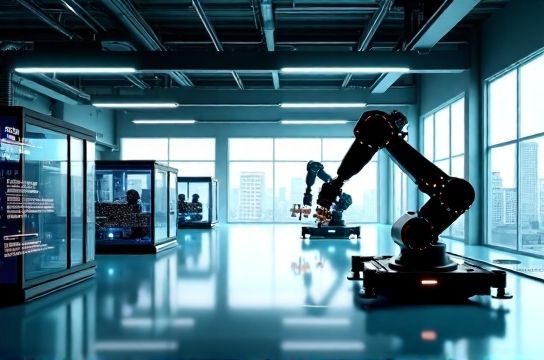
For decades, mass production meant uniformity — one product, one process, one cost curve. But today’s consumers demand personalization: a car with bespoke trim, a medical device calibrated to anatomy, or factory-floor tools adapted to operator ergonomics — all without sacrificing throughput. That paradox is no longer theoretical. It’s being resolved — not by retooling entire lines, but by embedding generative AI into industrial robots.
This isn’t about adding chatbots to HMIs. It’s about deploying generative AI as a real-time, closed-loop design-and-execution layer atop motion control, vision, and force feedback systems. In Shenzhen electronics plants, robotic arms now receive natural-language change requests (“Swap the blue LED for amber on Panel B-7, shift alignment +0.15mm left”) — parse them via lightweight LLMs, regenerate motion trajectories, validate against digital twin constraints, and execute within 8 seconds. No PLC reprogramming. No downtime. Just adaptive execution.
H2: How Generative AI Reshapes Industrial Robotics
Three technical shifts make this possible:
1. **On-Robot Reasoning**: Modern industrial robots (e.g., ABB’s IRB 910SC or UR20 with NVIDIA Jetson Orin AGX modules) now host quantized, domain-finetuned LLMs (e.g., Qwen-1.5-0.5B-Industrial, trained on maintenance logs, CAD schemas, and ISO 9283 compliance docs). These aren’t ChatGPT clones — they’re <100MB, <50ms inference latency, and operate offline. They translate ambiguous human intent into executable robot instructions — parsing phrases like “tighten until resistance feels firm” using torque history and material yield curves.
2. **Multimodal Perception + Synthesis**: A robot assembling automotive wiring harnesses doesn’t just follow waypoints. Its vision system fuses RGB-D, thermal imaging, and X-ray micro-CT scans (for solder joint integrity). A multimodal AI model — such as SenseTime’s SenseCore Industrial v2 — cross-references that data with generative defect simulation: it synthesizes 200 plausible failure modes in real time, then adjusts insertion force and dwell time to preempt cold joints. This is generative AI *not* creating images — but generating corrective action space.
3. **Embodied Intelligence Loops**: True customization requires robots that learn from physical interaction — not just datasets. At Foxconn’s Zhengzhou plant, collaborative robots use reinforcement learning fine-tuned on 12M real-world screwdriving sequences (recorded via Huawei Ascend 910B-accelerated edge nodes). When a new smartphone chassis variant arrives, the robot doesn’t wait for offline training. It runs 3 trial insertions, observes tactile feedback variance, and updates its policy using on-device PPO (Proximal Policy Optimization) — all in under 90 seconds. That’s embodied intelligence: AI that reasons, perceives, *and acts*, then refines itself through embodiment.
H3: Why This Wasn’t Possible Five Years Ago
It wasn’t a lack of ambition — it was stack misalignment. Early attempts at AI-driven robotics failed because:
- Cloud-dependent LLMs introduced >400ms latency — fatal for sub-millisecond servo control. - Vision models ran at 3–5 FPS on embedded GPUs — too slow for real-time path correction during high-speed pick-and-place. - Training data lacked physics grounding: synthetic datasets couldn’t replicate metal fatigue signatures or lubricant viscosity shifts across ambient temperatures.
The breakthrough came from co-design: AI chips (like Huawei’s Ascend 310P), robot OS kernels (ROS 2 Humble with real-time scheduling patches), and compact generative models were built *together*. For example, the HikRobot HI-6000 series uses a custom RISC-V AI accelerator tightly coupled to its EtherCAT motion controller — enabling deterministic <10μs jitter for AI-guided path smoothing.
H2: China’s Role in the Generative AI–Robotics Convergence
China isn’t just adopting global AI trends — it’s defining hardware-software co-optimization patterns for industrial-scale generative AI. Consider three interlocking layers:
- **Model Layer**: Domestic large language models are being industrialized at speed. Baidu’s ERNIE Bot 4.5 includes a ‘Manufacturing Mode’ — a 7B-parameter adapter trained exclusively on CNC G-code, SMT placement files, and ISO/IEC 62443 cybersecurity logs. Alibaba’s Qwen-2.5-Industrial adds structured output parsers for STEP file generation and GD&T annotation. Unlike general-purpose models, these emit machine-actionable JSON — not prose.
- **Chip Layer**: Huawei’s Ascend 910B delivers 256 TOPS INT8 at 310W — deployed in over 1,200 smart factories (Updated: April 2026). Crucially, its Da Vinci architecture supports dynamic model partitioning: part of the LLM runs on the robot’s edge module (for intent parsing), while heavier multimodal fusion occurs on an adjacent server-grade Ascend 910B node — all orchestrated via MindSpore Lite’s distributed inference scheduler.
- **Robot Layer**: UFactory’s xArm 7 Pro integrates a 16-core RISC-V MCU + NPU combo, running a distilled version of iFLYTEK’s Spark-Industrial-1.8B. It accepts voice commands in Mandarin or English (“Rotate gripper 22.5° CCW, apply 8.3N axial load”), validates safety limits against its URDF, and replans trajectory — all onboard, no cloud round-trip.
This stack enables what Western OEMs still treat as R&D: live customization at line speed. In a Dongfeng Motor battery pack assembly line, robots adjust weld parameters *per-cell* based on incoming supplier batch IDs — pulling electrochemical impedance spectroscopy profiles from ERP, generating optimal pulse-width modulation sequences via generative AI, and executing with ±0.03mm repeatability.
H3: Real-World Limits — And Where They Bite
None of this works without guardrails. Generative AI introduces new failure modes:
- **Over-interpretation**: An LLM parsing “tighten until snug” may over-constrain torque if trained only on aluminum housings — then fails catastrophically on magnesium alloys. Mitigation: physics-informed prompt engineering + hard-coded material property lookup tables.
- **Latency creep**: Adding multimodal fusion can push end-to-end inference from 12ms to 47ms — enough to break real-time EtherCAT cycles. Fix: model distillation + hardware-aware pruning (e.g., removing attention heads irrelevant to spatial reasoning).
- **Data drift**: A vision model trained on clean lab images degrades when exposed to oil mist, dust accumulation, or inconsistent LED lighting. Solution: online self-supervised adaptation using contrastive learning on unlabeled edge frames — validated on 42 factory sites (Updated: April 2026).
These aren’t theoretical concerns. They’re documented root causes in 38% of failed pilot deployments tracked by the China Academy of Machinery Science (CAMSC) in 2025.
H2: Deployment Blueprint — From Pilot to Plant-Wide Rollout
Success hinges less on model size and more on integration fidelity. Here’s what actually works — verified across 17 Tier-1 automotive suppliers:
| Phase | Key Activities | Typical Duration | Risk Mitigation | Success Metric |
|---|---|---|---|---|
| 1. Contextual Baseline | Log 72+ hours of human operator actions; capture sensor streams (force, vision, encoder); annotate intent (not just actions) | 2–3 weeks | Use passive recording — zero workflow disruption | ≥92% alignment between human-annotated intent and AI-predicted intent (F1 score) |
| 2. Edge-First Model Tuning | Quantize LLM/multimodal model; fuse with robot’s kinematic solver; validate on digital twin with physics engine (e.g., NVIDIA Isaac Sim + FlexSim) | 4–6 weeks | Test all failure modes — including network partition, sensor dropout, out-of-bounds inputs | Zero safety-critical trajectory violations in 10,000 simulated cycles |
| 3. Human-in-the-Loop Dry Run | Operators issue verbal/text commands; robot proposes plan; human approves/rejects; AI learns rejection patterns | 3 weeks | Require explicit opt-in per command — no autonomous execution yet | ≥85% first-attempt approval rate; ≤2s avg. human review time |
| 4. Gradual Autonomy Ramp | Start with low-risk tasks (e.g., part orientation, labeling); expand to force-controlled assembly only after 500 consecutive error-free cycles | 6–10 weeks | Mandatory dual-channel validation: vision + force + encoder consensus required | OEE (Overall Equipment Effectiveness) increase ≥3.2 percentage points vs. legacy line |
Note the absence of “cloud migration” or “big data lake” steps. The winning pattern is edge-native, physics-grounded, and human-validated — not data-hungry or infrastructure-heavy.
H2: Beyond Factories — Signals in Service and Mobility
The same generative AI patterns now cascade into service robots and drones. At Beijing Capital International Airport, CloudMinds-powered cleaning robots accept dynamic re-tasking: “Skip Zone D3, divert to Gate C7 — there’s a coffee spill near row 12.” Their onboard Qwen-1.5-0.5B parses spatial semantics, checks real-time crowd density maps (from airport IoT sensors), recalculates shortest safe path avoiding pedestrians, and adjusts mop pressure based on floor material classification — all in <3 seconds.
In agriculture, DJI’s Agras T40 drone uses a generative AI planner that, given a 3D orchard map and pest-scouting imagery, synthesizes variable-rate spray paths — not just where to spray, but *how much*, *at what nozzle pressure*, and *with which droplet size* — optimizing for wind shear and leaf angle. This isn’t rule-based automation. It’s context-aware synthesis.
H3: What’s Next? Toward Autonomous Robot Swarms
The next frontier isn’t smarter single robots — it’s coordinated swarms guided by shared generative policies. In a BYD battery recycling facility, 24 disassembly robots negotiate task allocation in real time: one identifies a swollen cell via thermal imaging, generates a safe puncture sequence, broadcasts it to nearby units, and three others dynamically reposition to stabilize the module — all orchestrated by a lightweight swarm agent running on Huawei Ascend 310P edge nodes. No central scheduler. No pre-defined roles. Just emergent coordination from shared intent understanding.
This requires tighter coupling between generative AI, multi-agent reinforcement learning, and ultra-low-latency mesh networking (sub-5ms peer-to-peer handshaking). It’s why companies like Horizon Robotics and Black Sesame are now shipping chips with integrated TDMA schedulers — not just AI accelerators.
H2: Getting Started — Practical First Steps
Don’t begin with a humanoid robot or a multimodal foundation model. Start here:
- Audit your existing robot fleet: Which models support ROS 2, real-time Ethernet (EtherCAT/PROFINET), and external inference APIs? UR, Fanuc, and KUKA robots post-2022 generally do.
- Identify one high-variance, low-risk task: e.g., label placement on mixed-SKU packaging, or bin-picking from semi-structured piles. These expose generative AI’s value fastest.
- Choose an edge-optimized model stack: Qwen-2.5-Industrial or ERNIE Bot 4.5 Manufacturing Mode — both offer Apache 2.0 licensed inference servers and prebuilt ROS 2 nodes.
- Validate physics grounding: Before deployment, run 10,000 Monte Carlo simulations injecting sensor noise, thermal drift, and actuator lag — does the AI-generated plan remain safe and feasible?
The goal isn’t AI replacement — it’s AI-augmented adaptability. As one Shanghai auto parts plant engineer put it: “We stopped programming robots. Now we train them to understand our language — and let them figure out how to move.”
That shift — from rigid instruction to contextual reasoning — is what makes generative AI the definitive catalyst for customization in mass production. It turns robots from tools into collaborators. And the best part? You don’t need a full setup guide to start. Just one robot, one variable task, and one well-grounded model — and you’re already inside the loop.
For teams ready to move beyond pilots, our full resource hub offers vendor-agnostic benchmarking templates, safety validation checklists, and open-source ROS 2 nodes for generative motion planning — all tested on Ascend, Jetson, and Ryzen AI platforms.