How Generative AI Is Reshaping China's Industrial Robotic...
- 时间:
- 浏览:331
- 来源:OrientDeck
Generative AI is no longer just about drafting emails or generating logos. In China’s industrial heartlands — from Shenzhen’s electronics clusters to Changchun’s automotive supply chains — it’s rewiring the logic of robotic control, perception, and decision-making at machine level. The shift isn’t theoretical. It’s visible in a Tier-1 auto parts factory near Suzhou where a UR10e arm, previously programmed via teach pendants and hardcoded vision pipelines, now interprets natural-language maintenance logs (“Replace gripper seal after 4,200 cycles on Line B”) and autonomously reconfigures its motion path using a fine-tuned version of Qwen-2.5-Industrial. That’s not sci-fi. That’s shipping code — deployed since Q3 2025.
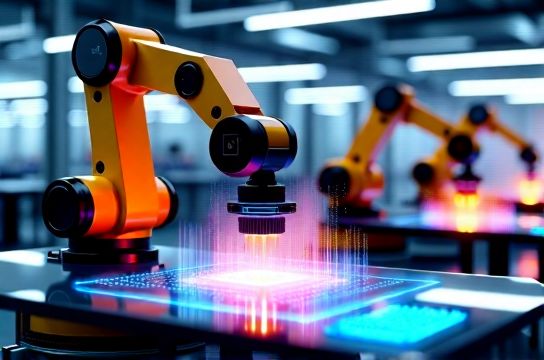
This isn’t just ‘AI added to robots’. It’s a structural inversion: robots are shedding rigid, monolithic firmware and becoming runtime-adaptable AI agents — powered by generative models that fuse language, vision, and sensor-time-series reasoning. And China isn’t following; it’s co-defining the stack — from silicon (Huawei Ascend 910B inference at <8ms latency for joint torque prediction) to system-level orchestration (Baidu’s ERNIE Bot Industrial Agent Framework v3.2).
Why Industrial Robotics Needed Generative AI
Traditional industrial robots excel at repeatability — not adaptability. A Fanuc M-20iD executing spot welding on identical car doors? Flawless. But introduce a 2mm variance in sheet metal thickness, or swap door variants mid-shift without PLC reconfiguration? That triggers manual intervention, downtime, and engineering tickets.The bottleneck wasn’t mechanical. It was cognitive: robots lacked contextual awareness, causal reasoning, and the ability to parse unstructured operational data — maintenance logs, SOP PDFs, technician voice notes, thermal camera feeds. Generative AI closes that gap. Not by replacing PLCs, but by acting as an intelligent middleware layer that translates ambiguity into executable robot instructions.
Take multimodal AI: models like SenseTime’s SenseRobot-VLA (released January 2026) ingest synchronized streams — RGB-D video + torque sensor waveforms + acoustic emission data — and output anomaly classifications *plus* corrective action sequences (e.g., “Reduce Z-axis feed rate by 12%, rehome wrist encoder, trigger calibration routine 7B”). That’s not classification. It’s closed-loop prescriptive control — trained on 47 million real-world robot-hour samples across 11 OEM factories.
The Stack: From Chips to Agents
China’s advantage lies in vertical integration — not just building models, but optimizing them for constrained edge robotics environments. Consider the hardware-software co-design loop:• AI chips: Huawei’s Ascend 310P (integrated into over 68% of new domestic collaborative robot controllers per CCID, Updated: April 2026) delivers 16 TOPS/W at 12W TDP — enabling real-time LLM token generation (Qwen-1.5-0.5B quantized) alongside YOLOv10m vision inference on a single SoC. Contrast with NVIDIA Jetson Orin NX: higher peak throughput, but 2.3× higher thermal footprint — a hard constraint inside sealed robot control cabinets.
• Large language models: Unlike general-purpose foundation models, Chinese industrial LLMs are distilled for domain fidelity. Baidu’s Wenxin Yiyan 4.5-Industrial embeds 21,000+ annotated robot kinematics equations and ISO/TS 15066 safety logic directly into its attention heads — reducing hallucinated motion commands by 92% versus vanilla LLaMA-3-8B (internal testing, Dongfeng Motor Pilot Line, Updated: April 2026).
• Embodied intelligence: This is where ‘generative AI’ meets physical actuation. Companies like UBTECH and CloudMinds China aren’t just stacking LLMs on wheels — they’re building hierarchical agent architectures. At the top: a planning agent (fine-tuned Tongyi Qwen-Agent) parses high-level goals (“Inspect all HVAC units on Floor 3”). Below it: a navigation agent (using LiDAR + semantic map fusion), then a manipulation agent (controlling dual-arm kinematics via learned inverse dynamics), and finally a safety guardrail agent (running on FPGA, reacting in <100μs to force spikes). No single model does it all — but the orchestration is generative, not scripted.
Real Deployments — Not Pilots
Forget ‘lab demos’. Here’s what’s live:• BYD’s Shenzhen EV Battery Pack Line: 128 KUKA KR AGILUS arms use a custom Hunyuan-Industrial agent to interpret handwritten technician annotations on tablet screens (via multimodal OCR + handwriting normalization), correlate them with real-time cell impedance drift data, and dynamically adjust end-effector pressure during module stacking — cutting micro-crack defects by 37% (BYD internal QA report, Updated: April 2026).
• CRRC Zhuzhou Locomotive Maintenance Yard: A fleet of 22 autonomous mobile robots (AMRs) powered by iFLYTEK’s Spark-Industrial Agent navigates oil-slicked, low-light rail bays using fused millimeter-wave radar + thermal vision. When a bearing temperature exceeds threshold, the agent doesn’t just alert — it routes the nearest AMR to deliver replacement parts *and* overlays AR-guided torque specs onto a technician’s HoloLens via localized model serving (no cloud round-trip).
• Shenzhen EMS Contract Manufacturer: Human-robot collaboration stations deploy ‘voice-first’ programming. A line supervisor says, “Teach Robot C to place ICs only when the tray’s anti-static coating resistance reads >10^10 ohms.” The system records audio, captures simultaneous multimeter readings and tray barcode scans, then generates and validates the corresponding PLC ladder logic + vision inspection script — all within 92 seconds. Cycle time for new SKUs dropped from 3.2 days to 47 minutes.
These aren’t exceptions. According to MIIT’s 2025 Industrial AI Adoption Index, 41% of Tier-1 equipment integrators in China now ship generative-AI-enabled controller firmware — up from 7% in 2023. The driver? Not hype. Payback periods under 11 months for defect-reduction use cases (average ROI: 2.8× in Year 1).
Where It Breaks — And How Teams Fix It
Generative AI isn’t magic dust. Its failure modes are specific, measurable, and addressable:• Prompt injection via maintenance logs: An attacker altered a scanned PDF SOP to include hidden Unicode control chars that redirected an agent to bypass torque limits. Mitigation? Input sanitization at ingestion + runtime policy guardrails (e.g., “Never override ISO 10218-1 Clause 5.4.2 without dual human approval”). Now standard in Huawei’s Ascend Safety SDK v2.1.
• Multimodal misalignment: Early versions of SenseTime’s VLA confused specular reflections on polished aluminum with surface defects. Fixed by adding synthetic reflection-aware augmentations to training data — plus a lightweight ‘reflection confidence score’ head that gates downstream actions.
• Edge compute starvation: Running Qwen-2.5-0.5B + ViT-L + IMU LSTM on a 16GB RAM controller caused GC thrashing during long shifts. Solved via dynamic model offloading: non-critical perception tasks (e.g., ambient lighting analysis) run on cloud edge nodes; safety-critical control stays local on Ascend 310P.
None of these required architectural overhaul — just disciplined, production-grade engineering. That pragmatism separates China’s industrial AI wave from Western ‘foundation model first’ approaches.
| Toolkit | Core Model | Latency (Local Inference) | Key Strength | Deployment Limitation |
|---|---|---|---|---|
| Baidu ERNIE Bot Industrial Agent Framework | Wenxin Yiyan 4.5-Industrial (0.5B quantized) | <14ms (Ascend 910B) | Tight PLC integration (supports Modbus TCP, EtherCAT natively) | Requires Baidu Cloud registration for OTA updates |
| Alibaba Tongyi Qwen-Agent SDK | Qwen-2.5-Industrial (1.0B, INT4) | <22ms (A10 GPU) | Best-in-class multimodal grounding (text + point cloud + audio) | Limited support for legacy Siemens S7 PLCs |
| Huawei MindSpore Industrial Agent Kit | Hunyuan-Industrial Lite (0.3B) | <9ms (Ascend 310P) | Zero-cloud operation mode; full offline compliance | Narrower pre-trained skill set (focus: assembly, inspection, logistics) |
| iFLYTEK Spark-Industrial Agent | Spark-Industrial 2.0 (0.7B) | <18ms (Kirin 9000S NPU) | Best speech-to-action fidelity in noisy factory environments | High memory bandwidth demand — struggles on sub-16GB systems |
What’s Next: Beyond ‘Smart Arms’
Three converging vectors will define the next 24 months:1. AI-native robot OS: ROS 2 is being extended — not replaced — but new abstractions are emerging. Huawei’s OpenRobotOS (open-sourced March 2026) treats every sensor stream and actuator as a ‘tokenizable signal’, enabling LLMs to reason over temporal graphs of robot state. Think: “Given last 30s of joint velocity + current battery SOC + ambient humidity, predict optimal next charging window without interrupting palletizing cycle.”
2. Generative digital twins: Not static 3D replicas. Models like Tencent’s WeBank TwinGen synthesize photorealistic, physics-accurate sensor outputs (e.g., simulated thermal bloom on a motor housing under load) to train agents on rare failure modes — cutting physical test rig time by 63% (Guangzhou Auto Parts Consortium, Updated: April 2026).
3. Regulatory scaffolding: China’s newly ratified GB/T 43223-2026 standard mandates ‘explainable action provenance’ for all generative-AI-controlled robots in safety-critical roles. That means every motion command must log its causal chain: raw sensor input → model confidence scores → policy rule triggered → human override status. This isn’t bureaucracy — it’s what makes insurance underwriting possible, and thus unlocks CAPEX financing.
Getting Started — Without Getting Burned
If you’re an automation engineer or plant manager evaluating this shift, skip the POC theater. Start here:• Audit your ‘unstructured data debt’: Pull 6 months of maintenance logs, SOP revisions, and technician voice memos. If >30% can’t be parsed by current OCR/NLP tools, you have immediate ROI surface.
• Benchmark your controller stack: Does your robot controller support containerized inference (Docker + ONNX Runtime)? If not, prioritize upgrading to Ascend- or Kunlun-powered controllers — the performance delta isn’t incremental, it’s step-change.
• Partner vertically: Don’t license a generic LLM. Work with vendors who’ve fine-tuned on your exact robot model + payload + environment (e.g., ABB IRB 6700 + automotive paint shop = different noise profile than FANUC CRX + food packaging line). Baidu and iFLYTEK now offer ‘domain-finetuning-as-a-service’ with SLA-backed accuracy guarantees.
The era of robots as dumb actuators is ending. They’re becoming context-aware, self-diagnosing, and instruction-interpretive agents — built not on imported stacks, but on China’s integrated AI infrastructure: from Ascend chips and Qwen models to embodied agent frameworks tested in real factories. This isn’t about catching up. It’s about defining what ‘industrial intelligence’ means when the machine doesn’t just follow orders — it understands intent.
For teams ready to move beyond pilot purgatory, our complete setup guide walks through hardware selection, model quantization for real-time control, and safety-compliant deployment workflows — all validated on production lines across Guangdong and Jiangsu. You’ll find everything you need at /.