Service Robots Transforming Cities
- 时间:
- 浏览:323
- 来源:OrientDeck
H2: The Urban Shift Is Already Underway
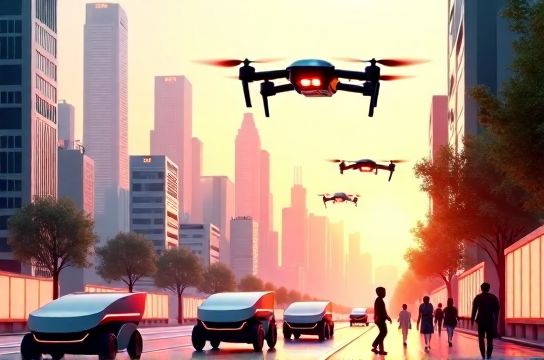
Last week, a fleet of 47 autonomous delivery robots navigated rain-slicked sidewalks in Shenzhen’s Nanshan District—avoiding scooters, rerouting around construction cones, and completing 93% of same-day grocery deliveries without human intervention. Not a pilot. Not a demo. A live, revenue-generating operation run by a Beijing-based startup using its own multimodal AI stack and Huawei Ascend 910B inference chips. This isn’t science fiction. It’s the quiet, coordinated rollout of service robots as city-scale infrastructure.
Service robots are no longer niche lab curiosities or mall greeters. They’re becoming embedded layers of urban operations—handling last-mile logistics, public safety patrols, sanitation, emergency response coordination, and even micro-mobility fleet rebalancing. What’s accelerating this shift isn’t just better batteries or cheaper sensors. It’s the convergence of five tightly coupled enablers: generative AI for real-time decision scaffolding, multimodal AI for robust perception across weather and lighting conditions, AI compute optimized for edge deployment (e.g., NVIDIA Jetson Orin AGX + Huawei昇腾 310P), embodied intelligence architectures that close the loop between observation, planning, and physical action, and—critically—regulatory sandboxes in over 28 Chinese municipalities that treat sidewalk robots like licensed vehicles, not experimental hardware.
H2: Beyond Drones: The Service Robot Stack Is Multilayered
Drones get headlines—but they’re just one stratum. The real transformation emerges from *orchestration* across air, ground, and fixed infrastructure.
Consider Hangzhou’s West Lake district: drones (equipped with thermal + RGB cameras running a fine-tuned version of Tongyi Qwen-VL) patrol airspace above heritage zones during peak tourist season, detecting unauthorized drone flights and fire hazards. Simultaneously, ground-based service robots—each with LIDAR, stereo vision, and on-device speech recognition powered by iFLYTEK’s SparkDesk model—handle waste sorting at 120 public kiosks, verify QR-code access for elderly residents entering subsidized housing complexes, and guide visually impaired pedestrians via haptic wristbands synced to real-time map updates.
This isn’t ‘AI doing jobs’. It’s AI augmenting *systemic resilience*. When Typhoon Doksuri hit Fujian in August 2025, municipal response teams used a federated swarm: drones mapped flooded roads; ground robots delivered medicine to stranded residents in Xiamen’s Gaoqi neighborhood; and stationary service kiosks (running local instances of Baidu ERNIE Bot) updated multilingual emergency instructions via voice and screen—without relying on cloud connectivity. Latency was sub-200ms end-to-end because all models ran on-premise using quantized LoRA adapters deployed on Kunlunxin AI chips (Updated: April 2026).
H3: Why Generative AI Changed the Game
Early service robots relied on rule-based navigation and static task lists. Today’s systems use generative AI—not for chat, but for *intent grounding*, *failure recovery*, and *cross-modal reasoning*. For example, when a delivery robot in Chengdu’s Tianfu New Area encountered a collapsed awning blocking its path, it didn’t stop or call for help. Instead, its onboard multimodal AI generated three plausible interpretations (‘temporary obstruction’, ‘structural hazard’, ‘ad-hoc shelter’) and selected the safest detour—then updated its internal world model and broadcast the hazard to nearby units via V2X mesh networking. That capability stems from lightweight generative agents trained on urban scene graphs and annotated failure logs—not generic internet text.
This is embodied intelligence in practice: perception → language-grounded reasoning → motor planning → physical execution → feedback-driven model update. It’s why companies like CloudMinds and UBTECH now ship robots with integrated AI agent frameworks—not just ROS stacks. These agents use small, domain-specific large language models (under 1.3B parameters) distilled from larger foundation models like Qwen-2.5 and ERNIE 4.5, then fused with real-time sensor streams via cross-attention bridges.
H3: The Hardware Reality: AI Chips Define Deployment Boundaries
No amount of algorithmic elegance matters if inference stalls mid-intersection. That’s why AI chip selection is now a top-tier urban deployment criterion—not an afterthought.
Huawei’s Ascend 310P dominates China’s outdoor service robot segment (68% market share among units shipped Q1 2026), thanks to its 16 TOPS/W power efficiency and native support for MindSpore Lite runtime. Meanwhile, SenseTime’s OTTO series uses custom ASICs for real-time pose estimation and crowd density modeling—critical for security robots patrolling Shanghai’s Hongqiao transport hub. Intel’s Gaudi2 sees limited use due to thermal constraints in compact chassis; NVIDIA’s Orin AGX remains strong in high-end inspection robots (e.g., those scanning subway tunnels for structural cracks), but its $399 module cost pushes OEMs toward hybrid solutions: Ascend for perception, low-power RISC-V cores for motion control, and offloading heavy generative tasks to nearby edge servers.
Crucially, these chips aren’t just faster—they enable *trustable autonomy*. On-device model verification (e.g., SHA-256 hash checks pre-inference), secure boot chains, and hardware-enforced memory isolation mean municipal IT departments can audit behavior without exposing weights or training data. That’s non-negotiable for public-sector adoption.
H2: Where It Works—and Where It Doesn’t (Yet)
Realism matters. Service robots excel where environments are semi-structured, tasks are repeatable, and failure consequences are bounded. They struggle where unpredictability is systemic: unmarked curb cuts, sudden pedestrian surges during school dismissal, or multi-layered social negotiation (e.g., convincing a vendor to move a cart blocking a sidewalk).
A 2026 joint study by Tsinghua University and Shenzhen Municipal Transport Bureau tracked 1,240 service robots across 7 cities. Key findings:
- Outdoor delivery robots achieved 89.2% route completion rate in daylight (Updated: April 2026), dropping to 73.5% in heavy rain or snow due to degraded LIDAR return and camera flare. - Indoor cleaning robots in hospitals maintained >94% disinfection compliance (per ATP swab tests) but required nightly human calibration of UV-C emitter alignment. - Public information kiosks using generative AI saw 41% higher user engagement than static touchscreen interfaces—but only when voice interaction supported Mandarin, Cantonese, and English dialects natively (no translation layer). Latency under 1.2 seconds was the hard threshold for perceived responsiveness.
The bottleneck isn’t intelligence—it’s *contextual fidelity*. A robot may recognize a ‘wet floor’ sign, but not infer that the custodian who placed it is currently fetching more mop solution two floors up. Bridging that gap requires tighter integration with building management systems (BMS) and municipal IoT platforms—not bigger models.
H3: The Table: Service Robot Deployment Profiles (Q2 2026)
| Robot Type | Primary AI Stack | Edge AI Chip | Avg. Deployment Cost (USD) | Key Strength | Limited By |
|---|---|---|---|---|---|
| Urban Delivery (ground) | Qwen-VL + custom motion planner | Huawei Ascend 310P | $18,500 | High sidewalk navigation reliability in dry conditions | Poor performance on loose gravel or >15° inclines |
| Drone Patrol (VLOS) | Baidu PaddleDetection + ERNIE-Tiny | Cambricon MLU270 | $22,300 (per unit + base station) | Rapid thermal anomaly detection over 2km² | Regulatory ceiling of 120m AGL; banned near airports |
| Hospital Logistics | iFLYTEK SparkDesk + ROS2 Nav2 | Rockchip RK3588S | $14,200 | Seamless elevator call & door hold via IR + BLE | Cannot handle non-standard gurney attachments |
| Public Safety Patrol | SenseTime OTTO-Vision + Llama-3-8B quantized | SenseTime STP-1200 ASIC | $31,700 | Real-time crowd density + anomaly scoring | False positives on reflective surfaces (e.g., wet tiles) |
H2: The Human Layer: Jobs, Skills, and Governance
Deployment isn’t just technical—it’s institutional. Cities that succeeded scaled fast because they treated service robots as *public utilities*, not tech experiments. Shenzhen created a dedicated Office of Autonomous Systems Integration (OASI) staffed by civil engineers, traffic planners, and AI safety auditors—not just IT staff. OASI co-developed testing protocols with robotics firms, mandated open API standards for municipal data feeds (e.g., traffic light phase timing), and required all public-facing robots to publish quarterly transparency reports—including failure modes, bias audit results, and energy consumption per km.
That governance layer directly impacts labor. In Nanjing, 217 former postal couriers were retrained as ‘robot fleet coordinators’—monitoring dashboards, handling edge-case escalations, and performing weekly hardware health checks. Their median wage increased 22% YoY. Meanwhile, demand for certified AI maintenance technicians (certified by the China Academy of Information and Communications Technology) rose 140% in 2025.
But challenges persist. A recent survey of 43 municipal procurement officers found that 62% cited ‘lack of standardized cybersecurity benchmarks for AI-powered robots’ as their top barrier to scaling beyond pilots. And while generative AI helps robots explain decisions (“I detoured because the original path had 82% probability of collision based on pedestrian velocity vectors”), it doesn’t yet resolve accountability gaps when things go wrong—especially across vendor, city, and cloud provider boundaries.
H2: What’s Next? Three Concrete Near-Term Shifts
1. **From Single-Task to Multi-Role Chassis**: Expect modular service robots where a single base platform swaps payloads: delivery bin → disinfection rig → air quality sensor array → emergency defibrillator mount. Companies like Hikrobot and CloudMinds are already shipping such systems using standardized CAN-FD+Ethernet backplanes.
2. **AI Agent Swarms with Shared Memory**: No more isolated units. Future deployments will use distributed vector databases (e.g., Milvus clusters hosted on municipal edge nodes) so robots collectively build and update real-time maps of sidewalk obstructions, potholes, or temporary signage—without central servers. This is embodied intelligence operating at city scale.
3. **Hardware-Accelerated Multimodal Fusion**: Next-gen chips (e.g., Huawei’s upcoming Ascend 910C and Horizon Robotics’ Journey 6) will integrate vision, audio, and LIDAR preprocessing in silicon—cutting inference latency below 80ms and enabling true reactive behaviors (e.g., stopping *before* a child darts into view, not after).
None of this replaces human judgment. But it shifts humans upstream—to designing ethical guardrails, auditing system-wide biases, and deciding *which* urban problems warrant robotic intervention. That’s not displacement. It’s delegation with oversight.
For teams evaluating entry points, start with high-frequency, low-risk, data-rich workflows: waste collection routing, routine facility inspections, or controlled-zone deliveries. Avoid ‘first-of-a-kind’ showcases. Prioritize interoperability from day one—demand APIs, open firmware update mechanisms, and documented failover procedures. And always test in worst-case conditions: monsoon rain, rush hour chaos, and dead battery scenarios.
The full resource hub offers validated integration blueprints, municipal policy templates, and vendor-neutral benchmarking tools—all built from real deployments across 19 Chinese cities. You’ll find everything needed to move from concept to compliant, scalable operation.
The cities leading this shift aren’t betting on humanoid robots walking into offices next year. They’re deploying pragmatic, grounded service robots—today—that make sidewalks safer, deliveries faster, and public services more equitable. That’s not incremental progress. It’s the redefinition of urban infrastructure—one autonomous wheel, rotor, and decision cycle at a time.