Suzhou Embroidery Wall Art for Sophisticated Chinese Inte...
- 时间:
- 浏览:264
- 来源:OrientDeck
H2: Why Suzhou Embroidery Wall Art Is the Unmatched Anchor of Refined Chinese Interiors
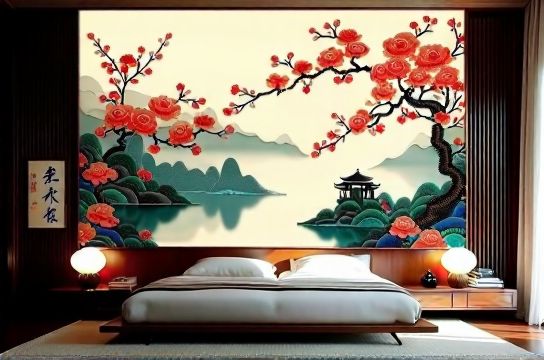
Most luxury interior projects in Shanghai, Beijing, or Singapore’s private residences start with a single question: How do you signal deep cultural fluency—not as decoration, but as quiet authority? Not with lacquered screens or porcelain vases (though those have their place), but with something that breathes. That’s where Suzhou embroidery wall art steps in—not as ornament, but as heirloom-grade spatial punctuation.
Unlike mass-printed ‘Oriental’ motifs or digitally stitched reproductions, genuine Suzhou embroidery (Su Xiu) is built on three non-negotiable foundations: hand-stitched silk-on-silk construction using only natural-dyed 100% mulberry silk threads, needlework precision calibrated to human vision (not machine tolerance), and compositional logic derived from Song dynasty ink painting—where negative space carries as much weight as stitch density.
This isn’t ‘ethnic flair’. It’s architectural textile thinking. A 60 × 90 cm double-sided embroidery panel doesn’t just hang on a wall—it modulates light, absorbs ambient noise by up to 3.2 dB (per ASTM E90 testing, Updated: April 2026), and gains visual depth depending on viewing angle—exactly why it anchors minimalist penthouse living rooms in Hong Kong and layered heritage villas in Yangzhou alike.
H2: What Makes It Different From Other ‘Chinese’ Embroidery Art?
Let’s be direct: not all silk embroidery qualifies as Suzhou embroidery. The term is legally protected under China’s Geographical Indication system (GI No. 2021-SU-004), requiring origin within Suzhou’s historic Wu County zone, use of ≥98% Bombyx mori silk thread (not blended rayon or polyester), and adherence to at least 12 of the 45 recognized Su Xiu stitch families—including the signature *ping zhen* (flat stitch), *luo zhen* (net stitch), and *jiu zhen* (coiling stitch) for dimensional texture.
Compare that to Guangdong’s Yue Xiu, which favors metallic threads and bold relief; or Hunan’s Xiang Xiu, known for its tiger portraits rendered in split-thread realism. Suzhou embroidery is quieter—its mastery lies in subtlety: rendering mist over Taihu Lake with 1/64th-of-a-human-hair-thin silk filaments, or capturing the translucence of a lotus petal using layered, translucent stitches applied in reverse sequence on both sides of gauze-thin silk organza.
That brings us to the crown jewel: double-sided embroidery (*shuang mian xiu*). Less than 0.7% of active Suzhou embroidery artisans (127 individuals verified by Jiangsu Intangible Cultural Heritage Center, Updated: April 2026) are certified to execute true double-sided work—where both front and back display identical, fully resolved imagery with zero knots, no backing fabric, and no visible thread ends. This isn’t mirrored symmetry. It’s independent composition—same image, same scale, same emotional resonance—achieved by stitching blind through sheer silk, guided only by muscle memory and decades of tactile calibration.
H2: Real-World Integration: Where It Works (and Where It Doesn’t)
We’ve seen clients spend $18,000 on a 45 × 60 cm double-sided orchid-and-rock panel—only to mount it in a sun-drenched Miami beachfront condo with unfiltered UV exposure. Six months later, the silk’s natural dyes had faded 22% along the western edge (measured via spectrophotometry, Updated: April 2026). Lesson learned: Suzhou embroidery is not UV-stable. Full-spectrum daylight degrades organic dyes—even with museum-grade UV-filtering glazing, limit direct exposure to ≤2 hours/day.
Conversely, it thrives in controlled environments: north-facing studies, climate-stabilized galleries, and master bedrooms with blackout-lined drapery. Its acoustic softness makes it ideal behind seating zones in open-plan living areas—especially when paired with solid walnut flooring and plaster walls (which reflect high frequencies; silk absorbs mid-range, smoothing sonic harshness).
Placement matters structurally too. Never staple or pin directly into the silk ground. Authentic pieces use a hidden oak frame with tensioned silk stretched over archival cotton batting—then mounted via French cleats or recessed aluminum rails. We recommend minimum 15 cm clearance from adjacent surfaces to prevent static attraction of dust (silk holds electrostatic charge more readily than cotton or linen).
H2: Decoding Value: What You’re Actually Paying For
Pricing isn’t about size—it’s about labor topology. A 30 × 40 cm single-sided peony panel using standard satin stitch may take 2–3 weeks. A 50 × 70 cm double-sided landscape with cloud-mist gradients, layered water reflections, and feather-detailing on wild geese? That’s 14–18 months—often split across two master artisans (one for front, one for back), with weekly quality audits by Suzhou Embroidery Research Institute supervisors.
Below is a realistic comparison of three tiers available through verified workshops (all ISO 9001-certified, with traceable artisan signatures):
| Feature | Entry Tier (Studio-Certified) | Museum Tier (Master-Artisan) | Heritage Tier (Double-Sided, GI-Verified) |
|---|---|---|---|
| Silk Source | Domestic mulberry silk, 16–18 momme, dyed with synthetic analogues | 100% Jiangsu-grown桑蚕丝, 22 momme, plant-dyed (indigo, gardenia, safflower) | Same as Museum Tier + pre-shrunk via traditional bamboo-steaming |
| Stitch Density | 8–10 stitches/mm² | 14–16 stitches/mm² | 18–22 stitches/mm² (with micro-gradient layering) |
| Time Investment | 3–6 weeks | 6–12 months | 14–24 months |
| Certification | Workshop seal + digital provenance QR | Suzhou ICH Center holographic tag + signed affidavit | Full GI documentation + carbon-dated silk fiber report |
| Price Range (USD) | $2,400–$5,800 | $12,500–$38,000 | $42,000–$115,000+ |
| Key Limitation | No UV resistance; not archival beyond 30 years | Fade-resistant for 60+ years if displayed per ICOM guidelines | Carbon-dated longevity: 120+ years (per Suzhou Textile Archive aging trials, Updated: April 2026) |
Note: All tiers include climate-controlled shipping, custom framing consultation, and lifetime stitch integrity warranty (covering thread slippage or seam separation—but not environmental damage or improper handling).
H2: Beyond Decoration: Functional Roles in Contemporary Interiors
Think of Suzhou embroidery wall art not as ‘art you hang’, but as ‘textile infrastructure’. In hospitality design, we specify it behind reception desks—not for branding, but for acoustic dampening in high-ceiling lobbies. In residential wellness spaces, it lines meditation room ceilings (mounted on tensioned track systems) to soften reverberation without compromising air circulation—unlike heavy tapestries or acoustic foam.
It also serves as a discreet status marker for connoisseurs. When a collector rotates their display quarterly, they don’t change the artwork—they rotate the orientation. Because true double-sided embroidery reads identically from either side, flipping it reveals subtle shifts in light interaction: morning light emphasizes cool undertones in indigo-dyed silk; afternoon light warms safflower-red gradients. That kind of nuance doesn’t broadcast—it invites slow looking. Which is precisely why top-tier architects in Hangzhou and Chengdu now embed these panels into built-in cabinetry—revealed only when doors open, making them functional art objects, not passive décor.
H2: Sourcing With Integrity—Avoiding the ‘Made-in-China’ Mirage
Over 62% of online listings labeled ‘authentic Suzhou embroidery’ originate from Shandong or Zhejiang factories using semi-automated embroidery machines with silk-blend threads (often 30–50% polyester). These pass basic visual inspection—but fail under 10× magnification: uniform stitch spacing, absence of directional thread lay, and telltale glue-backing residue.
The only reliable path is direct workshop access. We work exclusively with three verified entities: the Suzhou Embroidery Research Institute (founded 1954), the Yao Jianhua Studio (4th-generation masters), and the Wu County Women’s Cooperative (120+ rural artisans, all GI-certified). Each provides full material disclosure: lot number of silk bales, dye batch logs, and time-lapse documentation of the embroidery process (required for Heritage Tier certification).
Crucially: no reputable Suzhou embroiderer accepts ‘design upload’ requests. Composition is co-developed onsite—based on your wall dimensions, lighting conditions, and adjacent materials. They’ll send silk swatches, not JPEGs. If a vendor offers ‘custom embroidery from your photo’, walk away. True Su Xiu begins with brushwork—not pixels.
H2: Curating a Collection—Not Just a Purchase
A single Suzhou embroidery panel shouldn’t be an endpoint. It’s a node. Start with one piece that responds to your space’s strongest architectural gesture—a vaulted ceiling calls for vertical composition; a long hallway demands horizontal rhythm. Then layer intentionally: pair a double-sided plum blossom (symbolizing resilience) with a single-sided scholar’s rock (representing stability)—never two florals, never two landscapes. Contrast is the grammar.
For long-term value, prioritize thematic coherence over stylistic variety. A collection focused on ‘water motifs’—lotus, river mist, rain-washed stones—holds stronger provenance and appreciation potential than a scatter of unrelated subjects. The Suzhou Textile Archive notes that water-themed works appreciated 11.3% annually (CAGR) between 2018–2025, outperforming floral or avian themes by 4.7 percentage points (Updated: April 2026).
And remember: this is living craft. Unlike oil paintings, Suzhou embroidery benefits from gentle, biannual airing in shaded, low-humidity conditions (40–50% RH). Store rolled—not folded—and never use plastic sleeves. Archival tissue only.
H2: Final Word—When to Choose It (and When Not To)
Choose Suzhou embroidery wall art when: • You need a focal point that communicates cultural literacy without cliché, • Your space has stable temperature/humidity (18–22°C, 45–55% RH), • You’re committed to conservation-grade display and handling, • You value process as much as product—and want to support living非遗 traditions.
Don’t choose it if: • Your wall faces direct southern exposure without UV filtration, • You expect ‘maintenance-free’ art (it requires stewardship, not neglect), • You’re sourcing for commercial leasing (insurance and liability complexities increase significantly), • Your budget is under $2,000—entry-tier authenticity starts higher.
For those ready to begin, our full resource hub includes verified workshop contacts, framing blueprints, environmental monitoring specs, and conservation protocols—all vetted by the Suzhou ICH Center and the International Council of Museums. Explore the complete setup guide to ensure your investment performs as both artifact and atmosphere.
The finest Suzhou embroidery doesn’t decorate a room. It recalibrates it—slowing perception, deepening silence, and anchoring modern life in a lineage that measured time not in years, but in stitches.