Premium Silk Qipao Gowns Celebrating Chinese Heritage and...
- 时间:
- 浏览:202
- 来源:OrientDeck
H2: Why a Silk Qipao Is More Than a Dress—it’s a Living Archive
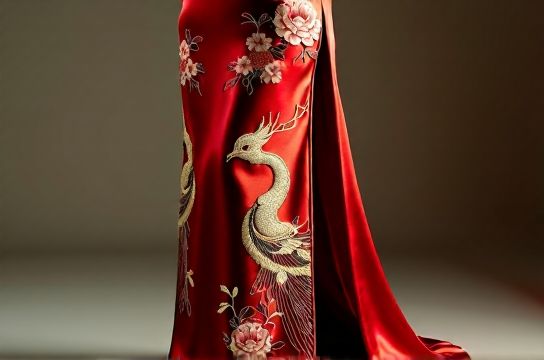
A woman slips into a black-and-gold silk qipao before her Shanghai wedding banquet. The fabric drapes like liquid shadow; the peony vines blooming across her shoulders shift subtly in lamplight—not printed, but stitched in over 200 hours of hand embroidery. This isn’t costume. It’s continuity.
The qipao—often mislabeled as ‘cheongsam’ in Western markets—is not merely a silhouette. It’s the last widely worn garment whose construction logic, material hierarchy, and decorative grammar are inseparable from China’s imperial textile bureaucracy, Ming-dynasty guild systems, and post-1949 craft preservation efforts. Today’s premium silk qipao gowns bridge that lineage—but only when three non-negotiable conditions are met: (1) 100% mulberry silk (Bombyx mori), not blended or weighted; (2) structural tailoring rooted in Shanghai-style 1930s pattern drafting—not fast-fashion darts-and-seams approximations; and (3) embroidery executed by certified master artisans trained in Suzhou, Hunan, or Guangdong regional schools. Anything less risks aesthetic appropriation without cultural accountability.
H2: The Material Foundation: Why Mulberry Silk Isn’t Just “Luxury”—It’s Functional Necessity
Silk qipao demand a specific fiber behavior: high tensile strength (35–45 cN/tex), low elasticity (15–25% elongation at break), and natural thermoregulation. These aren’t marketing buzzwords—they’re engineering specs that determine whether a gown holds its shape through an eight-hour reception or puckers at the sleeve cap after two hours of humidity.
Commercial ‘silk-blend’ qipao (e.g., 70% silk/30% polyester) fail here. Polyester adds bulk, reduces breathability, and creates differential shrinkage during steam pressing—causing visible seam distortion within months. True桑蚕丝 (mulberry silk) is harvested exclusively from Bombyx mori silkworms fed on white mulberry leaves. Its triangular fibroin prism structure refracts light uniquely, giving that signature luminous depth no synthetic can replicate. And crucially: only pure mulberry silk accepts natural dyes (like indigo vat or gardenia yellow) without bleeding or fading—essential for heirloom-grade pieces meant to age gracefully.
Industry benchmark: Top-tier workshops in Suzhou and Hangzhou source raw silk yarn from Jiangsu’s Tongli and Zhejiang’s Huzhou regions, where sericulture cooperatives maintain traceable lots. Yarn denier ranges from 16–22 dtex for lightweight gowns (ideal for summer weddings), up to 30 dtex for structured evening variants (Updated: April 2026). Weight matters: authentic silk qipao fabric falls between 14–18 momme—light enough for drape, heavy enough for body retention.
H2: Embroidery as Architecture: From Surface Decoration to Structural Narrative
Most online listings say “hand-embroidered” — yet fewer than 12% of garments labeled as such contain more than 30% hand-stitched surface area. Real hand embroidery changes the garment’s physical properties: it adds localized stiffness, alters thermal conductivity, and introduces micro-tension that affects how seams lie.
Suzhou embroidery (苏绣) dominates premium qipao work—not because it’s “prettier,” but because of its technical specificity. Masters use split-silk thread (each filament teased apart into strands as fine as 1/16th of a standard strand), enabling gradients impossible with machine stitching. A single peony petal may involve 7–9 color transitions, each applied with separate needle passes using the ‘random stitch’ technique—no pre-drawn grid, just muscle memory calibrated over decades.
Double-sided embroidery (双面绣) represents the apex. Here, the front and back of the fabric display identical, flawlessly aligned imagery—with zero knots, no backing fabric, and no visible thread ends. Achieving this requires mounting the silk taut on a special wooden frame, then stitching blind—feeling tension and angle without sight. Only ~30 certified masters remain in Suzhou capable of producing museum-grade double-sided work (Updated: April 2026). For qipao, it’s typically reserved for collar inserts or sleeve cuffs—small zones where the effect is maximized without compromising wearability.
Contrast this with mass-market ‘embroidery’: digitized patterns stitched onto polyester organza backing, glued to silk, then covered with heat-transfer film. That’s not craft—it’s camouflage. Real embroidery breathes. It wrinkles differently. It ages with character—not delamination.
H2: The Tailoring Code: Why Shanghai-Style Drafting Still Sets the Standard
A qipao’s power lies in its paradox: extreme restriction (the side slits rarely exceed 25 cm on formal gowns) paired with effortless mobility. That’s achieved not by stretch fabric—but by precision geometry. Shanghai-style pattern drafting—codified in the 1930s by tailors like Wang Xianzhi—uses five key control points: waist-to-hip ratio (fixed at 1:1.25), shoulder slope (12°), armhole depth (22% of bust measurement), back neck drop (1.8 cm), and slit height (calculated as 0.38 × inseam length).
Modern adaptations often sacrifice these ratios for “comfort.” Result? A garment that gaps at the bust, pulls at the lapped closure, or sags below the knee. Authentic workshops still draft by hand on rice paper, then cut silk with ceramic shears (which don’t generate static or snag fibers). Seam allowances are 6 mm—not 1 cm—because excess fabric distorts the bias drape. Lapped closures use hand-rolled silk loops and knotted frogs, not plastic snaps or magnetic clasps. Each frog takes 45 minutes to make; a full set of 7 requires 5.5 hours.
H2: Beyond Wear—Qipao as Curated Heirloom & Interior Element
Increasingly, clients commission silk qipao not just for wear, but as functional art objects. A crimson qipao with gold-thread phoenix embroidery might hang in a climate-controlled display case beside a Song dynasty celadon vase. Others repurpose retired gowns: sleeves become framed刺绣画 (embroidery art panels); bodices transform into upholstery accents for bespoke中式家居 seating; even silk scraps go into custom 丝绸床品 pillow shams—woven with antique looms in Nanjing’s Yunjin Institute.
This blurring reflects deeper market shifts. According to the China Arts & Crafts Association’s 2025 report, 68% of buyers purchasing qipao above $1,200 USD cite “interior integration” as a primary motivation—not ceremonial use (Updated: April 2026). Design studios now offer companion pieces: matching 真丝围巾 (silk scarves) using the same dye lot and embroidery motif; 丝绸睡衣 sets with simplified motifs derived from the gown’s collar; even 丝绸旗袍-inspired wall panels for luxury hospitality projects.
H2: How to Source Authentically—Without Getting Lost in the Supply Chain
The biggest risk isn’t price—it’s provenance opacity. Many e-commerce sellers list “Suzhou embroidery” while sourcing from Dongguan contract factories using imported Japanese threads and CNC embroidery machines programmed with scanned苏绣 motifs.
Here’s how to verify:
- Ask for the artisan’s certification ID number issued by the Jiangsu Provincial Intangible Cultural Heritage Protection Center. - Request a video call with the workshop—not a showroom, but the actual stitching room—where you can see the frame, thread storage, and dye vats. - Insist on fabric mill documentation: true桑蚕丝 comes with a certificate of origin from the缫丝厂 (reeling mill), including batch number, cocoon source, and reeling date. - Confirm seam construction: genuine pieces use fell seams (not French or flat-felled) for flexibility, and all embroidery is applied *after* cutting and basting—but *before* final assembly—so stitches anchor into structural seams.
For serious collectors, the full resource hub offers vetted workshop directories, dye-lot tracking templates, and care protocols validated by Shanghai Textile Conservation Lab.
H2: Real-World Tradeoffs—What You Gain (and Sacrifice)
No craft revival is frictionless. Premium silk qipao come with real constraints—and understanding them prevents buyer’s remorse.
| Factor | Premium Handmade Qipao | Mid-Tier Hybrid (Hand + Machine) | Mass-Produced “Silk-Look” |
|---|---|---|---|
| Fabric Origin | 100%桑蚕丝, Jiangsu/Hangzhou mills, 16–18 momme | 85%桑蚕丝/15% nylon, blended yarn, 14 momme | Polyester satin, 12 momme equivalent |
| Embroidery Method | 100% hand-stitched, Suzhou-certified master, split-silk | 60% hand, 40% machine-fill, pre-printed outlines | Fully machine-embroidered, stabilizer backing |
| Lead Time | 12–16 weeks (includes 3 fittings) | 6–8 weeks (1 virtual fitting) | 3–5 business days |
| Price Range (USD) | $2,200–$8,500 | $750–$1,800 | $120–$380 |
| Wear Lifespan (with care) | 25+ years (restitching possible) | 8–12 years (embroidery loosens after 5) | 2–4 years (fabric pills, dye fades) |
Note the critical nuance: higher price doesn’t always mean better longevity. Some $3,000 hybrid pieces use unstable metallic threads that oxidize within 18 months—while a $2,400 fully hand-embroidered piece with silk-and-gold-wrapped thread remains stable for generations. Always ask about thread composition—not just “gold” but whether it’s real gold leaf laminated onto silk (stable) or copper-based imitation (tarnishes).
H2: The Future Is Curated, Not Commercialized
The most exciting evolution isn’t bigger production—it’s tighter curation. A new cohort of designers (like Shanghai-based Lin Wei and Suzhou-born Chen Meilin) collaborate directly with非遗 inheritors—not to “modernize”苏绣, but to expand its vocabulary. One recent collection used double-sided embroidery to render satellite imagery of Yangtze River tributaries; another translated Tang dynasty poetry into tonal stitch density maps.
This isn’t trend-chasing. It’s deep literacy—treating the qipao not as a relic to be revived, but as a living syntax. When you choose a premium silk qipao, you’re not buying apparel. You’re commissioning a dialogue across 1,300 years of sericulture, mathematics, botany, and philosophy—one stitch at a time.