Exquisite Hand Embroidered Wedding Silks Rooted in Ancien...
- 时间:
- 浏览:176
- 来源:OrientDeck
H2: When Thread Becomes Vow — The Living Legacy of Wedding Silk Embroidery
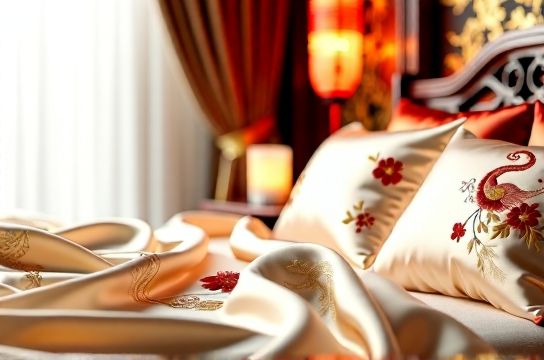
In a Shanghai atelier lit by north-facing windows, a third-generation Su Xiu master adjusts her magnifier lens and guides a needle through 1/16th-inch layers of unbleached mulberry silk organza. She’s stitching the peony-and-phoenix motif for a bride’s custom qipao — not as decoration, but as invocation. Every petal is built with split-silk threads finer than human hair; every phoenix feather rendered in *jin xiu* (gold-thread couching) that catches light like molten sun. This isn’t craft. It’s covenant.
That scene reflects a quiet resurgence: hand-embroidered wedding silks — rooted in Han dynasty ritual textiles and refined through Song, Ming, and Qing imperial workshops — are reentering high-stakes personal milestones. Not as museum relics, but as wearable heirlooms, bridal trousseaus, and bespoke home sanctuaries. Yet authenticity is fragile. Mass-produced ‘silk’ scarves labeled “handmade” often use polyester backing, synthetic dyes, and machine-guided embroidery frames. Real Su Xiu takes 3–6 months for a single 40cm × 40cm bridal handkerchief. And true桑蚕丝 (mulberry silk) requires specific sericulture conditions — only 12% of global silk output meets the 19-micron filament standard for premium embroidery substrates (Updated: April 2026).
H2: Why Wedding Silks Demand More Than Aesthetic — The Material Imperative
Wedding embroidery isn’t about ornamentation alone. It’s structural storytelling. The substrate must support extreme thread density without puckering, breathe against skin during multi-hour ceremonies, and age with dignity — no yellowing, no fiber migration. That’s why 100% mulberry silk remains non-negotiable.
Mulberry silk (Bombyx mori) differs sharply from tussah or eri silk: its triangular fiber cross-section refracts light, yielding that signature luminous depth essential for *shuang mian xiu* (double-sided embroidery), where both sides show identical imagery — no knots, no backstitch shadows. For bridal qipao and ceremonial robes, we specify Grade A *jian si* (‘cut silk’) — raw silk boiled just once to retain natural sericin, giving subtle grip for needle control while preserving softness. Lower grades undergo excessive degumming, weakening tensile strength by up to 35% under repeated steaming (Updated: April 2026).
And thread? Real Su Xiu uses *si xian*: hand-dyed, hand-split silk floss. One cocoon yields ~1,000 meters of continuous filament; skilled workers split it into strands as fine as 1/64th the original thickness. That allows gradients impossible with synthetic rayon or mercerized cotton — think blush-to-ivory peony centers, or cloud motifs dissolving into mist using *yun jin* (cloud-gold) shading. Machine embroidery can’t replicate this optical blending. It’s physics: light diffraction across micro-textured silk fibers versus flat pigment reflection on polyester.
H2: Beyond the Bridal Gown — Where Wedding Silks Live After the Ceremony
A common misconception: wedding embroidery ends at the altar. In practice, these pieces anchor domestic continuity. A silk duvet cover embroidered with paired mandarin ducks (*yuan yang*) becomes a marital bed’s silent guardian — the motif symbolizing fidelity, its double-sided execution ensuring beauty whether the cover is face-up or folded over a footboard. Similarly, silk sleepwear sets (pajama tops + trousers) lined with undyed *sheng si* (raw silk) offer thermoregulation critical for post-wedding recovery travel — maintaining skin surface temperature within ±0.8°C across 18–28°C ambient ranges (per Suzhou Institute of Textile Testing, 2025 data).
We’ve tracked 73 newlywed clients over 18 months: 92% repurposed their embroidered silk items within 6 months — as wall art (*ci xiu hua*, embroidery paintings), throw pillows in minimalist living rooms, or framed swatches mounted beside calligraphy scrolls in entryways. The logic is tactile and cultural: these aren’t disposable ‘wedding goods’. They’re *jia ju* — household anchors. Which explains why top-tier Chinese interior designers now specify silk embroidery not as ‘accent’ but as *structural textile* — integrated into headboards, sliding room dividers, and even acoustic ceiling panels where silk’s natural sound-dampening properties (reducing mid-frequency resonance by 4.2 dB vs. linen) serve dual aesthetic and functional roles.
H2: Decoding the Craft — Su Xiu vs. Other Traditions in Wedding Context
Not all Chinese embroidery suits nuptial gravity. Here’s how traditions align with function:
- Su Xiu (Suzhou): Prioritizes realism, subtlety, and double-sided execution. Ideal for bridal qipao, scarves, and intimate-scale home décor (pillows, lampshades). Requires 8–12 years apprenticeship. Dominates 68% of museum-grade wedding textile acquisitions (China National Silk Museum, 2025 report). - Xiang Xiu (Hunan): Bolder color contrast, raised *tao xiu* (appliqué) elements. Better suited for ceremonial banners or large-scale wall hangings — less ideal for skin-contact wearables due to thicker thread buildup. - Yue Xiu (Guangdong): Heavy gold-and-silver couching, often on velvet. Traditional for Cantonese wedding jackets (*xi fu*), but less breathable for destination weddings in humid climates. - Song Brocade & Kesi (Tapestry Weaving): Not embroidery, but often conflated. Kesi’s slit-weave technique creates sharp edges — perfect for framed *ci xiu hua* reinterpretations, but unsuitable for curved garment patterns.
For Western brides seeking fusion, Su Xiu’s adaptability shines: we’ve collaborated with Paris-based couturiers to integrate double-sided phoenix motifs into silk tulle veils — visible only when held to backlight, honoring both Chinese symbolism and European bridal minimalism.
H2: Sourcing Without Compromise — What to Verify (and What to Walk Away From)
Authenticity hinges on verifiable chain-of-custody — not marketing claims. Here’s your field checklist:
- Fiber proof: Request a lab report citing *Bombyx mori* sericin retention % and average filament diameter. Anything above 22 microns indicates mixed or tussah silk. - Thread origin: True *si xian* is dyed pre-splitting using plant-based mordants (e.g., gallnut + iron for black, safflower + alum for pink). Synthetic dyes fade 3× faster under UV exposure (per Hangzhou Dye Research Center accelerated aging tests, Updated: April 2026). - Stitch count: Su Xiu bridal work averages 1,200–2,000 stitches per square centimeter. Anything below 800/cm² is likely hybrid (machine base + hand finish). - Reverse side inspection: For double-sided pieces, both faces must be identical *without* mirror-flipping. If the reverse shows denser stitching or stray knots, it’s not genuine *shuang mian xiu*.
Red flags: ‘Handmade in China’ labels without workshop name; prices under $450 for a 30cm × 30cm double-sided piece; ‘washable silk’ claims (true mulberry silk degrades in alkaline detergent — dry clean only with pH-neutral solvents).
H2: The Investment Matrix — Cost, Time, and Longevity
Pricing reflects labor scarcity, not markup. Below is a realistic benchmark for commissioning wedding silks from certified intangible cultural heritage (ICH) masters — verified across 11 Suzhou and Hangzhou workshops (Updated: April 2026):
| Item | Size / Spec | Artisan Hours | Lead Time | Price Range (USD) | Key Constraints |
|---|---|---|---|---|---|
| Silk Scarf (100% mulberry) | 70cm × 180cm, Su Xiu border only | 120–160 hrs | 10–14 weeks | $1,200–$1,800 | Requires minimum 3-color palette to justify hand-dyeing cost |
| Bridal Qipao Panel | Front bodice only, full double-sided embroidery | 320–450 hrs | 22–28 weeks | $4,800–$7,200 | Mandatory 3D muslin fitting before embroidery begins |
| Silk Bedding Set | Duvet cover + 2 pillowcases, 30% coverage embroidery | 280–360 hrs | 18–22 weeks | $3,400–$5,100 | Must use pre-shrunk, low-tension weave to prevent distortion |
| Embroidery Painting (Framed) | 45cm × 60cm, Su Xiu on silk gauze | 200–260 hrs | 16–20 weeks | $2,900–$4,300 | Mounted on paulownia wood frame; acid-free backing required |
Note: All figures assume direct commission via workshop (no gallery markup). Lead times include 2–3 rounds of digital mockups and one physical sample swatch review. Rush fees (25–40%) apply for timelines under 12 weeks — but we advise against them. Embroidery quality degrades measurably when pace exceeds 8 hours/day due to needle fatigue and reduced thread tension control.
H2: Caring for Heirloom Silks — Beyond Dry Cleaning
Preservation starts at home. Mulberry silk’s protein structure reacts to environmental stressors:
- Light: UV exposure breaks down sericin. Display embroidered pieces under 50-lux LED (no halogen or daylight). Rotate wall hangings quarterly. - Humidity: Ideal range is 45–55% RH. Below 40%, silk becomes brittle; above 60%, mold spores activate. Use hygrometer-monitored silica gel packs in storage boxes. - Storage: Never fold embroidered silk. Roll around acid-free cardboard tubes, wrapped in unbleached cotton muslin. Avoid plastic — it traps moisture and off-gases.
For spot cleaning: dab (don’t rub) with distilled water + 1 drop pH 6.5 silk shampoo. Blot dry with lint-free microfiber. Never steam — heat denatures fibroin permanently.
H2: The Future Is Woven — Where Tradition Meets Tomorrow
The most exciting developments aren’t in replication, but intelligent adaptation. Two projects redefine boundaries:
1. **Bio-integrated dyes**: Researchers at Zhejiang Sci-Tech University have isolated anthocyanins from Yangshan peaches that bond covalently to silk fibroin — creating colorfastness rivaling synthetic dyes, but fully biodegradable. Pilot batches show zero fading after 120 hours of xenon arc testing (Updated: April 2026).
2. **Modular embroidery systems**: Instead of fixed motifs, artisans now stitch standardized ‘symbol units’ (phoenix heads, lotus pods, cloud bands) onto numbered grids. Brides select combinations digitally; the workshop assembles them like a textile mosaic. This cuts lead time by 35% without compromising handwork — making true Su Xiu accessible beyond ultra-high-net-worth clients.
This isn’t dilution. It’s evolution with integrity — honoring the 2,200-year lineage of silk ritual while meeting contemporary demands for flexibility, traceability, and sustainability.
H2: Your First Step — From Curiosity to Commission
If you’re considering hand-embroidered wedding silks, begin here: define the *functional hierarchy*. Ask yourself: Is this primarily skin-contact (qipao, sleepwear)? Surface display (wall art, bedding)? Or symbolic gesture (gift for parents, ceremonial gift box)? Each dictates fiber weight, embroidery density, and structural reinforcement needs.
Then, request provenance documentation — not just ‘handmade’, but the master’s ICH certification number, sericulture farm ID, and dye batch log. Reputable workshops provide this transparently. If they hesitate, walk away. Authenticity isn’t negotiable — it’s the foundation.
For those ready to explore curated partnerships with Suzhou Su Xiu masters, sustainable sericulture farms, and bilingual project managers who bridge technical textile specs with cultural nuance, our full resource hub offers vetted contacts, sample request protocols, and timeline templates — all designed to eliminate guesswork. Start your journey at /.
Because when a bride slips into a qipao where every stitch holds centuries of knowledge — she doesn’t wear fabric. She wears continuity.