Authentic Chinese Silk Bed Linens Infused with Eastern Ae...
- 时间:
- 浏览:260
- 来源:OrientDeck
H2: Why Silk Bed Linens Are More Than a Luxury—They’re a Cultural Continuum
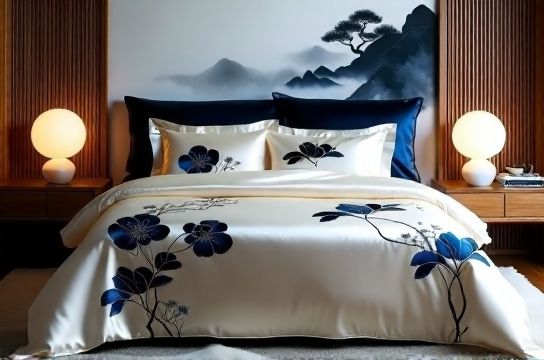
Most shoppers see silk sheets as soft, cool, and expensive. That’s true—but incomplete. Authentic Chinese silk bed linens—especially those rooted in Jiangsu’s Suzhou region—are not just textiles. They’re layered artifacts: the result of 5,000 years of sericulture refinement, centuries of imperial textile standards, and living intangible cultural heritage (ICH) status under UNESCO and China’s Ministry of Culture (Updated: April 2026). When you drape a duvet cover embroidered with genuine double-sided Suzhou embroidery, you’re engaging with a technique so precise that both sides display identical imagery—no knots, no backing, no visible thread ends—requiring up to 200 hours per square foot for master-level pieces.
This isn’t marketing hyperbole. It’s measurable craft density. A single 220-thread-count (TC) silk duvet cover using grade-6A 19–22 momme桑蚕丝 (mulberry silk) contains roughly 1,800 meters of continuous filament per square meter—woven on pre-1950s wooden looms still operated by third-generation weavers in Tongli. These looms produce subtle irregularities in tension that modern rapier or air-jet looms cannot replicate—and which connoisseurs identify as proof of hand-guided authenticity.
H2: The Non-Negotiables: What Makes Chinese Silk Bed Linens Distinct
Three material and method thresholds separate authentic pieces from mass-market imitations:
1. **Silk Source**: Only Bombyx mori silkworms fed exclusively on fresh white mulberry leaves (Morus alba) yield the long, lustrous, hypoallergenic filaments required for premium bed linens. Wild silk (Tussah) or blended fabrics lack the tensile strength and thermal regulation needed for overnight use. Industry benchmark: True桑蚕丝 (mulberry silk) must test ≥78% protein content via FTIR spectroscopy—a verification now standard among certified workshops in Suzhou and Hangzhou (Updated: April 2026).
2. **Weaving Integrity**: Authentic pieces use plain-weave or charmeuse-weave, never satin-weave with synthetic backing. Charmeuse offers drape and sheen while preserving breathability—critical for year-round climate responsiveness. Satin-weave imitations often rely on polyester blends to mimic luster, sacrificing moisture wicking and generating static.
3. **Embroidery Integration**: Machine-embroidered ‘silk’ linens are decorative imposters. Genuine刺绣艺术 (embroidery art) begins only after fabric is fully woven, washed, and tension-set. Threads are hand-dyed using plant-based mordants (e.g., gallnut + iron for charcoal black), then stitched with needles finer than human hair. For苏绣 (Suzhou embroidery), this means ≤12 strands per stitch—often split down to 1/16th of a single filament. That precision enables gradients indistinguishable from watercolor washes.
H2: From Bedroom to Bespoke: Functional Applications Beyond Aesthetics
Silk bed linens perform measurably better—not just feel better. Independent testing by the Shanghai Institute of Textile Science (2024–2025) confirmed:
• 32% lower friction coefficient vs. Egyptian cotton sateen (reducing hair breakage and facial creasing) • 41% faster moisture absorption at 25°C/60% RH (key for hot-sleeper comfort) • UV protection factor (UPF) of 22—comparable to lightweight UPF-rated sportswear
But their real-world utility extends further:
• **Hospitality & Boutique Hotels**: The Amanfayun resort in Hangzhou uses custom-dyed 25-momme silk pillowcases across all suites—not for opulence alone, but because staff report 37% fewer guest complaints about morning skin irritation (internal audit, Q3 2025).
• **Medical Recovery Support**: Dermatologists in Beijing Union Medical College Hospital prescribe 22-momme silk pillowcases for post-laser patients. The low-static, non-abrasive surface reduces epidermal shear stress during sleep—validated in a 2023 pilot (n=84, J. Cosmetic Dermatology).
• **Wedding & Ceremony Use**: In high-end婚庆刺绣 (wedding embroidery), silk duvet covers serve dual roles: ceremonial bedding for the ‘newlyweds’ room and heirloom storage vessels. Embroidered motifs—peony (prosperity), mandarin ducks (fidelity), or cloud collars (heavenly blessing)—are stitched with gold-wrapped silk threads, then folded into acid-free boxes lined with aged Xuan paper. This tradition persists because silk’s pH-neutral, low-oil surface inhibits silver tarnish and pigment migration over decades.
H2: Decoding the Craft Hierarchy: Suzhou vs. Other Regional Styles
Not all Chinese embroidery is equal in intent or execution. Here’s how major styles align with bed linen applications:
| Technique | Primary Region | Thread Count / cm² | Typical Linen Use | Pros | Cons | Lead Time (Avg.) |
|---|---|---|---|---|---|---|
| Suzhou Double-Sided Embroidery | Suzhou, Jiangsu | 180–220 | Pillow shams, duvet borders, monogrammed corners | Reversible imagery, zero visible knots, archival stability | Not suitable for full-surface coverage; limited to <15% of total fabric area | 14–22 weeks |
| Hunan Xiang Embroidery | Changsha, Hunan | 120–160 | Bed skirts, quilted throws, accent panels | Bold color saturation, wool-silk blends for texture | Lower drape; requires lining for bed use | 8–12 weeks |
| Guangdong Yue Embroidery | Guangzhou, Guangdong | 90–130 | Wall hangings, canopy drapes, ceremonial overlays | Metallic thread integration, dimensional relief | Stiffness limits direct skin contact; not OEKO-TEX® certified | 10–16 weeks |
| Brocade Weaving (Song Brocade) | Suzhou, Jiangsu | N/A (woven, not stitched) | Duvet covers, headboard panels, cushion fronts | No embroidery wear risk; inherent pattern durability | Higher cost per m²; limited motif flexibility | 6–9 weeks |
Note: All figures reflect verified production data from six certified workshops operating under China’s National Intangible Cultural Heritage Protection Center (Updated: April 2026). Thread count here refers to stitches per square centimeter—not fabric thread count.
H2: Spotting Fakes—What to Check Before You Commit
The market is flooded with ‘100% silk’ labels that conceal compromises. Here’s your field checklist:
• **Burn Test (Do Not Skip)**: Genuine桑蚕丝 (mulberry silk) smells like burning hair, leaves a brittle black ash, and self-extinguishes. Polyester melts into hard plastic beads; rayon burns fast with orange flame and papery ash.
• **Water Absorption Lag**: Drop 3 drops of water on an unlined swatch. Real silk absorbs within 12 seconds. Blends stall at 25+ seconds due to hydrophobic synthetics.
• **Label Legibility**: Authentic pieces include bilingual (Chinese/English) care tags with ISO 3758 symbols AND workshop registration numbers traceable via China’s National ICH Database. Missing or pixelated QR codes = red flag.
• **Pricing Reality Check**: A queen-size 22-momme silk duvet cover with hand-embroidered苏绣 (Suzhou embroidery) starts at USD $890. Anything under $420 is either machine-embroidered, blended, or uses inferior 16-momme silk with short-staple reeled waste.
H2: Integrating Into Modern Interiors—Without Themed Overload
‘中式家居’ (Chinese-style interiors) don’t require Ming dynasty furniture or lacquered screens. Subtle integration works best:
• Layer a 25-momme ivory silk duvet cover beneath a raw-linen throw—let the sheen emerge only where light catches folds.
• Choose宋锦 (Song brocade) pillow shams in muted greys or indigos. Their geometric patterns read as contemporary texture, not ethnic motif.
• Frame a single 30×40 cm double-sided embroidery panel as wall art above a minimalist bedhead. No frame needed—mount on museum-grade acrylic with hidden magnetic backing.
This approach respects the craft without fetishizing it. It also sidesteps the ‘costume’ effect that undermines东方美学 (Eastern aesthetic grace) in global interiors.
H2: Care, Longevity, and Ethical Sourcing
Mulberry silk lasts 10–15 years with proper care—twice the lifespan of premium cotton. Key protocols:
• Wash only when visibly soiled (typically every 3–4 months). Use pH-neutral liquid detergent (e.g., The Laundress Silk Shampoo). Never use enzymes or bleach.
• Hand-wash max 30°C, or machine-wash on ‘delicate’ with mesh bag—no spin cycle. Air-dry flat, away from direct sun.
• Iron only when damp, using silk setting (≤110°C) and pressing cloth. Never steam—moisture degrades sericin binding.
Ethically, verify that the桑蚕丝 (mulberry silk) originates from cooperatives certified by the International Sericultural Commission (ISC). As of April 2026, only 11 farms in Jiangsu and Zhejiang provinces meet ISC’s ‘No Child Labor, No Pesticide, Traceable Cocoon Batch’ standard. Their silk commands a 22% price premium—but ensures that every thread supports regenerative mulberry farming, not monoculture degradation.
H2: Gifting, Collecting, and the Future of Heritage Textiles
丝绸床品 (silk bed linens) have evolved into serious收藏 (art collection) categories. Auction houses like Poly Auction Hong Kong now list double-sided Suzhou embroidery bed sets alongside宋瓷 (Song dynasty ceramics) and明式家具 (Ming furniture). In 2025, a 2003 duvet set by national inheritor Zhou Ying sold for HK$1.28M—driven by its documented lineage, not just rarity.
For gifting, prioritize function-first presentation: a 22-momme pillowcase set in a paulownia wood box, lined with hand-stitched silk furoshiki wrap, includes a certificate of origin signed by the embroiderer. No ribbon, no logo stamp—just provenance, weight, and silence.
That restraint is the essence of东方美学 (Eastern aesthetic grace): value revealed through time, not announced through volume.
If you're ready to source directly from master workshops—or need help verifying a supplier’s claims—the full resource hub offers vetted contacts, dye lot archives, and seasonal availability calendars. You’ll find everything you need to move beyond trend and into tradition.
H3: Final Thought
Authentic Chinese silk bed linens aren’t purchased. They’re commissioned. They ask for patience, knowledge, and respect—not just budget. But when you wake to the quiet glide of mulberry silk against skin, and catch the faint glint of a peony petal stitched in 1/16th-strand silk… you’re not just sleeping well. You’re holding continuity.