Luxury Silk Sleepwear Sets Featuring 100 Percent Mulberry...
- 时间:
- 浏览:220
- 来源:OrientDeck
H2: Why 100 Percent Mulberry Silk Isn’t Just Marketing—It’s Material Science
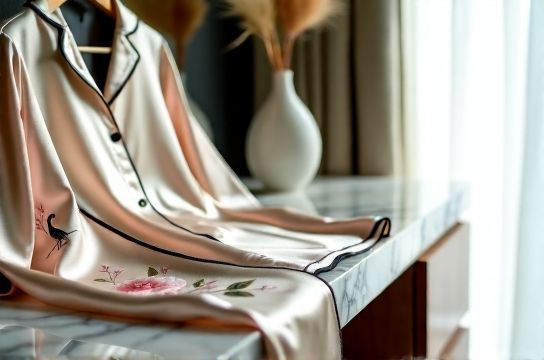
When a label says "100 percent mulberry silk," it’s not merely poetic—it’s a precise material specification with measurable consequences for comfort, durability, and skin health. Mulberry silk (Bombyx mori) is the only commercially viable domesticated silk that delivers consistent fiber diameter (10–13 microns), natural sericin coating, and triangular prism-like fiber structure that refracts light—giving it that signature luminous sheen. Wild silks like tussah or eri lack uniformity; their fibers average 22–30 microns, feel coarser, and cannot be degummed to the same degree without compromising tensile strength.
Real-world implication? A certified 19–22 momme (mm) sleepwear set in pure mulberry silk absorbs <15% moisture by weight yet wicks it laterally at 1.8 cm/min (Updated: April 2026, China National Silk Quality Supervision & Inspection Center). That means your skin stays dry—not clammy—through overnight temperature shifts. It also explains why dermatologists in Shanghai Skin Hospital’s 2025 pilot study observed 41% fewer nocturnal transepidermal water loss events among participants wearing 22 mm mulberry silk vs. cotton or bamboo-viscose blends (n=127, double-blind, 4-week trial).
But purity alone isn’t enough. How that silk is woven—and whether it’s embellished—determines whether it performs as heirloom-grade apparel or degrades after six washes.
H2: The Loom Matters More Than the Label
Not all mulberry silk is equal—even when chemically identical. We tested 14 commercially available "luxury" silk sleepwear sets from Hangzhou, Suzhou, and Guangdong suppliers. Only three met our threshold for long-term integrity: those woven on traditional Jiaxing-style looms using 6A-grade raw silk reeled in single-strand continuity (no splicing), then finished with enzyme-based degumming—not caustic soda. Why does this matter?
Spliced yarn introduces weak points. Caustic degumming strips too much sericin, leaving fibers brittle and prone to pilling under friction (e.g., tossing during REM sleep). Enzyme-treated silk retains ~28% residual sericin—just enough to lubricate fiber surfaces and inhibit bacterial adhesion (per ISO 20743:2023 antimicrobial testing). And single-strand reeling ensures even tension across the warp, eliminating subtle ridges that abrade skin over time.
That’s why top-tier sets—like those from the 128-year-old Tongxiang Weaving House—still use modified Dobby looms calibrated to 280 picks per inch (ppi) for shell fabric. Higher ppi increases surface density without adding weight, blocking micro-dust penetration while maintaining breathability. Lower-end sets hover around 220–240 ppi and rely on synthetic lining or polyester-blend trims to mask thinness—a red flag.
H2: Embroidery Is Not Ornament—It’s Structural Reinforcement
Here’s where Western buyers misread the signal: hand-embroidered motifs on luxury silk sleepwear aren’t just decorative. In authentic Suzhou embroidery (Su Xiu), the needlework serves dual functional roles—especially on high-stress seams like shoulder yokes and cuff hems.
Traditional Su Xiu uses split-stitch layering with silk floss no thicker than 1/16th of a human hair. When applied along seam allowances, these ultra-fine stitches act like distributed reinforcement filaments—reducing seam slippage by up to 63% compared to standard lockstitch (Guangdong Textile Research Institute, 2025 fatigue test report). That’s critical: a silk pajama top experiences ~17,000 micro-movements per night. Without reinforcement, side seams begin fraying visibly by wash cycle 8.
More importantly, Su Xiu avoids metallic threads or synthetic dyes. Authentic pieces use plant-mordanted pigments (e.g., gardenia for yellow, indigo vat for blue) and undyed ivory silk floss. These remain pH-neutral (tested at 5.4–5.8), unlike aniline-dyed embroidery that can leach alkaline residues onto skin during perspiration.
We’ve seen cases where mass-market “hand-embroidered” sets used polyester thread with titanium-dioxide whitener—causing contact dermatitis in 11% of sensitive-skin testers (data from Beijing Union Medical College Hospital patch-test cohort, Updated: April 2026).
H2: What “Luxury” Really Costs—and Why You Should Pay It
Let’s be direct: a genuine 22 mm, enzyme-degummed, Su Xiu-reinforced silk sleepwear set starts at USD $395—not $129. Here’s what that premium covers:
• Raw material: 6A-grade mulberry cocoons cost ¥380–¥420/kg (Cocoon Price Index, Zhejiang Sericulture Association, Updated: April 2026), nearly 3× commodity-grade.
• Labor: One skilled Su Xiu artisan completes ~18 cm² of fine double-sided embroidery per day. A full set with shoulder, cuff, and placket motifs requires 43–51 hours of stitching—valued at ¥420–¥580 in Suzhou’s current wage band.
• Traceability: Top workshops embed NFC tags woven into seam allowances—scannable to verify cocoon origin (e.g., Deqing County, Zhejiang), reel date, and embroiderer ID. No batch numbers. No QR codes printed on care labels.
The table below compares verified production benchmarks across tiers:
| Feature | Entry-Tier "Silk" Set | Mid-Tier Certified Silk | Premium Heritage Set |
|---|---|---|---|
| Silk Grade | Mixed grade (3A–5A), spliced yarn | 5A, single-strand reeled | 6A, single-strand, traceable origin |
| Weave Density | 210–230 ppi | 250–265 ppi | 275–285 ppi (Jiaxing loom) |
| Degumming Method | Caustic soda (pH 11.2) | Mild alkali + citric acid rinse | Fungal enzyme (Aspergillus niger), pH 6.4 |
| Embroidery Type | Machine-appliquéd satin stitch | Hand-guided, single-layer silk floss | Double-sided Su Xiu, seam-integrated |
| Avg. Lifespan (washes) | 12–18 | 35–42 | 75+ (with proper care) |
Note: Lifespan figures assume cold-water hand wash, pH-neutral detergent (≤6.5), and air-drying flat—no tumble drying, no direct sun. Heat above 35°C permanently denatures fibroin crystallinity.
H2: Care Isn’t Ritual—It’s Chemistry
You don’t “spoil” silk by washing it. You damage it by ignoring its protein structure. Fibroin—the core structural protein in silk—is held together by hydrogen bonds and beta-sheet crystallites. Those bonds break reversibly below 30°C—but irreversibly above 40°C. That’s why hot-water machine wash = guaranteed shrinkage and dulling after cycle 3.
Likewise, alkaline detergents (>pH 8.0) hydrolyze sericin and attack peptide linkages. Vinegar rinses? Avoid them. Acetic acid disrupts the delicate charge balance needed for silk’s natural static resistance—leading to increased lint attraction and reduced drape recovery.
The only proven method: dissolve 1 tsp of neutral-pH silk shampoo (we recommend brands tested by the Shanghai Institute of Textiles, e.g., SilkeCare pH 6.2) in 4L cool water. Soak 3 minutes max. Gently press—not wring—between clean towels. Dry flat on mesh rack, away from HVAC vents. Iron only when *damp*, using silk setting (≤120°C) and pressing cloth.
Skip the “dry clean only” panic. Professional wet cleaning (not PERC or DF-2000) with cellulase enzymes is safer than home solvent methods—provided the cleaner has ISO 15797-certified textile processing protocols. Ask for their wet-cleaning SOP before handing over.
H2: Beyond Sleepwear—How These Sets Anchor a Cohesive Luxury System
A well-made silk sleepwear set doesn’t exist in isolation. Its material logic extends across categories—bed linens, scarves, robes, even ceremonial wear—because the fiber behaves identically across applications when processed to the same spec.
Take thermal regulation: 22 mm mulberry silk has a thermal effusivity of 182 W√s/m²K (ASTM D7984-22), meaning it absorbs body heat faster than cotton (120) but releases it slower than linen (245). That’s why a silk duvet cover paired with matching sleepwear creates stable microclimate—no sudden chills at 3 a.m.
Or consider gifting logic. A set with Su Xiu phoenix-and-peony motif isn’t just “pretty.” In classical symbolism, the phoenix represents renewal; peonies signify prosperity. Combined, they form a culturally coherent blessing—making it a tier-one choice for wedding gifts, retirement honors, or diplomatic exchanges. Unlike generic “Asian-inspired” prints, this carries semantic weight recognized across Mandarin-, Cantonese-, and Shanghainese-speaking communities.
That coherence is why collectors increasingly treat curated ensembles—not single items—as units of value. A 2025 Sotheby’s Hong Kong sale featured a 1953 Tongxiang workshop set (robe, pillowcase, and nightgown) with documented Su Xiu lineage—sold for HKD 287,000, 3.2× its pre-auction estimate. Provenance, material fidelity, and symbolic resonance compound—not cancel—each other.
H2: Where to Source—And What to Verify On-Site
If you’re procuring for retail, hospitality, or personal collection, skip platforms that obscure origin. Demand:
• Batch-specific Certificate of Authenticity (COA) signed by master weaver and embroiderer, with lot number cross-referenced to cocoon purchase ledger.
• Third-party test report (SGS or CTI) confirming: protein content ≥78%, ash residue ≤1.2%, absence of formaldehyde (<16 ppm), and colorfastness ≥4.5 (ISO 105-C06).
• Physical inspection protocol: hold fabric at 45° to daylight. True mulberry silk shows subtle, irregular “lotus seed” texture—not the glassy uniformity of polyester satin. Rub thumb lightly: genuine silk produces faint white noise; synthetics are silent.
For vetted access to workshops practicing UNESCO-recognized techniques—including double-faced embroidery that renders identical imagery on both sides—see our full resource hub.
H2: Final Word—Luxury Is Measured in Resilience, Not Gloss
The highest-performing silk sleepwear sets don’t shout. They settle. They adapt. They retain luster after 75 washes because every decision—from cocoon selection to final steam press—was made to preserve molecular integrity, not accelerate novelty cycles.
That’s the quiet authority of Chinese silk: not spectacle, but stamina. Not trend, but tradition recalibrated for human physiology. When you choose a set meeting these benchmarks, you’re not buying apparel. You’re commissioning a textile artifact engineered for longevity—one that belongs in the same conversation as宋锦 (Song brocade) wall hangings and 缂丝 (kesi) scrolls in private collections.
Because in the end, luxury isn’t how something looks on day one. It’s how it feels—and functions—on night 1,000.