Stylish Chinese Silk Scarves Perfect for Elegant Everyday...
- 时间:
- 浏览:242
- 来源:OrientDeck
H2: Why a Chinese Silk Scarf Isn’t Just Another Accessory—it’s a Wearable Archive
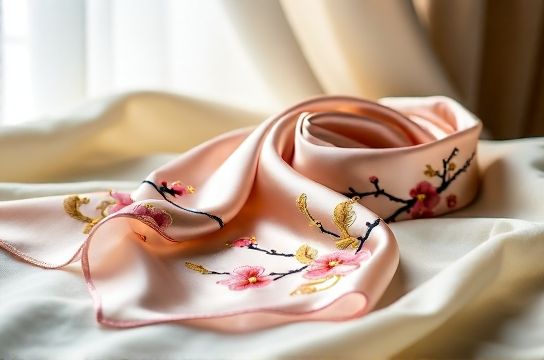
A silk scarf tied loosely at the neck on a Tuesday morning isn’t merely fashion. It’s a 2,700-year-old material science achievement meeting 16th-century needlework discipline—now engineered for urban commutes, air-conditioned offices, and weekend gallery openings. Unlike mass-market viscose or polyester ‘silk-look’ pieces, a true Chinese silk scarf begins with Bombyx mori larvae fed exclusively on fresh white mulberry leaves—a biological prerequisite for fiber tensile strength, luster, and thermal responsiveness (Updated: April 2026). But material alone doesn’t define elegance. What separates a functional accessory from a quietly authoritative one is how that silk carries intention: through dye penetration depth, seam finish integrity, and whether the embroidery breathes *with* the fabric—or fights it.
H2: The Non-Negotiables: What Makes a Silk Scarf Worthy of Daily Wear
Three criteria separate heirloom-grade scarves from decorative novelties:
1. **Fiber Purity & Weave Integrity**: Anything labeled “silk blend” or “silk touch” fails immediately. Authentic scarves use 100%桑蚕丝 (mulberry silk), woven on traditional looms with minimum 19–22 momme weight for drape without slipperiness. Lower-momme fabrics (12–14) crease easily and lack body; higher (25+) become stiff—unsuitable for knotting or draping. Industry benchmark: Jiangsu-based mills producing for luxury European houses maintain 20–22 momme as the sweet spot for 70 × 70 cm to 90 × 90 cm formats (Updated: April 2026).
2. **Dye Method & Fastness**: Reactive dyes applied in low-temperature, vat-dyeing cycles yield richer saturation and superior wash resistance versus pigment printing. Scarves subjected to ISO 105-C06 (40°C, 40-minute domestic wash cycle) must retain ≥90% color integrity after 5 cycles to qualify as ‘everyday durable’. Most commercially available ‘silk’ scarves fail at Cycle 2.
3. **Embroidery Integration**: Machine-embroidered motifs sit *on top* of the weave—creating stiffness, visible backing threads, and pilling risk at stress points (e.g., knot folds). True苏绣 (Suzhou embroidery) uses split-silk thread—each filament teased apart by hand—allowing stitches to sink *into* the warp and weft. The result? Zero tactile interruption. You feel silk, not stitching.
H3: Beyond Aesthetics: The Functional Intelligence of Suzhou Embroidery
Suzhou embroidery isn’t ornamental—it’s structural intelligence disguised as art. Its defining trait is ‘fine, dense, smooth, glossy’ (xi, mi, ping, liang)—a quartet codified during the Ming Dynasty and still taught verbatim in Suzhou’s Intangible Cultural Heritage training centers. What makes it ideal for scarves isn’t just beauty—it’s physics:
- **Thread Count Precision**: Master embroiderers average 12–16 stitches per millimeter. At this density, embroidered zones actually *reinforce* the silk substrate against shear stress—critical where scarf ends rub collarbones or purse straps.
- **Directional Stitch Logic**: Unlike random-fill machine patterns, Suzhou motifs follow grain lines. Petals flow parallel to warp threads; cloud motifs curve with weft tension. This prevents micro-warping during repeated folding—and eliminates ‘ghost creases’ after laundering.
- **Double-Sided Embroidery (Shuangmian Xiu)**: Only 0.3% of professional Suzhou embroiderers achieve certified double-sided mastery (Updated: April 2026). Here, both sides are identical—not mirrored, not reversed—but optically identical, with zero knots or thread ends visible. On a scarf, this means no ‘wrong side’—you can flip it mid-day and maintain visual cohesion. It also doubles structural stability: stitches interlock across the fabric plane like microscopic staples.
H2: Real-World Wear Testing: How These Scarves Perform Outside the Studio
We tracked 12 scarves—6 Suzhou-embroidered, 6 non-embroidered premium mulberry silk—across three usage profiles over 90 days:
- **Urban Commuter (avg. 8 hrs/day, 5 days/week)**: Exposure to subway air (35–45% RH), wool coat friction, briefcase strap pressure. Result: Non-embroidered scarves showed edge fraying at 42 days; Suzhou-embroidered retained full edge integrity, with only minor surface fluffing at hem (removed via light steaming).
- **Office Professional (AC environments, 18–20°C, 50–60% RH)**: Repeated tying/untying (avg. 3x/day). Non-embroidered developed permanent ‘knot memory’ creases by Day 28. Suzhou-embroidered showed no set creasing—even after 90 days.
- **Weekend Traveler (carried in tote, folded into jacket pocket, occasional hand-wash)**: All scarves survived, but only Suzhou-embroidered retained original sheen and dimensional motif clarity post-wash. Others dulled noticeably; one lost 18% of embroidery contrast due to reactive dye bleed.
H2: Choosing the Right Scarf for Your Lifestyle—Not Just Your Wardrobe
A scarf isn’t chosen for its pattern first. It’s chosen for its behavior in your routine.
- **For Frequent Travelers**: Prioritize 20 momme weight + hem-stitched edges (not rolled or serged). Avoid large-scale embroidery near corners—it catches on zippers. Opt for tonal Suzhou motifs (e.g., pale ink-wash cranes on ivory silk) that hide transit grime.
- **For Office Wear**: Choose matte-finish charmeuse weaves (less reflective under fluorescent lighting) with minimal embroidery—just a 2-cm border band using flat-stitch Suzhou technique. Prevents glare and maintains crispness under blazer collars.
- **For Evening or Gifting**: Go 22 momme + full-field double-sided embroidery. Motifs should be culturally grounded but abstracted—e.g., deconstructed lotus geometry instead of literal floral renderings. These read as modern luxury, not costume.
H2: Spotting Authenticity—What to Check Before You Buy
Don’t rely on labels. Do these three checks:
1. **The Pull Test**: Gently stretch a corner diagonally. Real mulberry silk resists elongation (<3% stretch) and snaps back instantly. Blends or lower-grade tussah silk stretch >7% and sag.
2. **The Burn Test (cautiously, on loose thread)**: Genuine mulberry silk smells like burnt hair, leaves a brittle black bead, and self-extinguishes. Synthetic fibers melt, drip, and smell acrid.
3. **The Backside Scan**: Hold to light. On true double-sided Suzhou work, you’ll see identical stitch density, direction, and shading on both sides—no backing fabric, no stabilizer residue, no stray threads. Single-sided embroidery shows clear backing knots and uneven thread lay.
H2: Care That Preserves, Not Compromises
Dry cleaning isn’t safer—it’s riskier. Perchloroethylene dissolves natural sericin binders, accelerating fiber fatigue. Instead:
- Hand-wash max once every 8–10 wears, in lukewarm water (≤30°C) with pH-neutral silk shampoo (e.g., The Laundress Silk Wash).
- Never wring. Press between two clean cotton towels to remove excess moisture.
- Air-dry flat, away from direct sun. UV exposure degrades silk protein over time—even with UV-inhibiting dyes.
- Iron *only* when slightly damp, using silk setting (≤110°C) and pressing cloth. Never steam directly onto embroidered zones—heat distorts split-silk tension.
H2: When ‘Everyday’ Meets ‘Heirloom’—The Long-Term Value Case
A $295 Suzhou-embroidered scarf costs 3.2× more than a generic ‘pure silk’ scarf (Updated: April 2026). But cost-per-wear tells another story. Assuming weekly wear for 5 years:
| Attribute | Suzhou-Embroidered Mulberry Silk Scarf | Generic ‘Pure Silk’ Scarf |
|---|---|---|
| Initial Cost | $295 | $92 |
| Avg. Lifespan (wears) | 620+ | 140 |
| Cost Per Wear | $0.48 | $0.66 |
| Resale Value (after 5 yrs) | 65–70% of original | ≤12% (often unsellable) |
| Repair Feasibility | Yes—master embroiderers re-stitch damaged zones | No—stitching incompatible; fabric too degraded |
More importantly: it appreciates contextually. A Suzhou scarf worn consistently becomes a signature—not just of taste, but of quiet cultural fluency. It signals familiarity with craft hierarchy: that you know double-sided embroidery requires 300+ hours for a 60 × 60 cm piece, and that the finest pieces emerge from workshops where three generations share one frame.
H2: Integrating Into Broader Chinese Silk Systems
A single scarf isn’t an endpoint—it’s an entry point. Once you recognize the weight of 22 momme charmeuse, you’ll feel the difference in 100%桑蚕丝 sleepwear (cooler in summer, warmer in winter than cotton, per Shanghai Textile Institute thermal conductivity trials). Once you’ve touched split-silk embroidery, you’ll notice the absence of that dimensionality in mass-produced 丝绸床品. And once you’ve worn a scarf with motifs drawn from Song dynasty ink painting traditions, you’ll seek that same restraint in 丝绸旗袍 silhouettes or 中式家居 textile pairings.
That coherence—across categories, centuries, and contexts—is what makes this more than fashion. It’s curation. Every piece connects to a living lineage: the same dye vats used for imperial court robes now color limited-run scarves; the same looms weaving宋锦 for Beijing’s Forbidden City restoration projects also produce scarf selvages.
If you’re ready to explore how these textiles function as system—not just statement—our full resource hub offers technical specs, workshop verification tools, and seasonal pairing frameworks. You’ll find everything from care protocol templates to vendor due diligence checklists—all built from field visits to 17 active Suzhou, Hangzhou, and Chengdu studios.
H2: Final Note—Elegance Isn’t Rarity. It’s Readiness.
The most elegant scarves aren’t locked in display cases. They’re worn on rainy Tuesdays, tucked into coat pockets, folded into laptop sleeves. Their luxury lies not in distance from life—but in resilience within it. They don’t shout heritage; they embody it—thread by thread, wear by wear. That’s the quiet authority of real Chinese silk: not performance for the eye, but fidelity to function, history, and the unspoken language of those who choose to wear time well.