Custom Embroidered Silk Gifts for High End Corporate Gifting
- 时间:
- 浏览:213
- 来源:OrientDeck
H2: Why Silk + Hand Embroidery Is the Unspoken Benchmark for Tier-1 Corporate Gifting
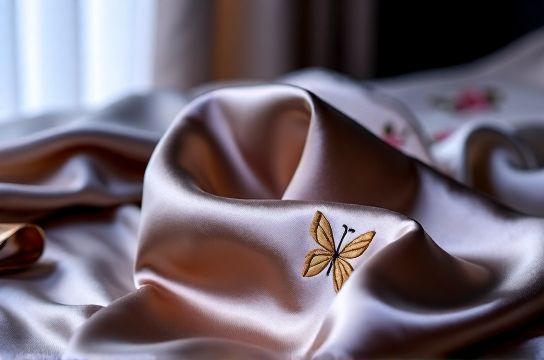
Most corporate gifting programs plateau at branded pens or generic gift boxes. But when Fortune 500 executives, diplomatic delegations, or luxury retail partners receive a gift, perception shifts in under three seconds. What they hold isn’t just an object—it’s a tactile signal of respect, cultural fluency, and intentionality. That’s where custom embroidered silk gifts deliver measurable ROI: not in cost-per-unit, but in recall, retention, and relational equity.
Silk—specifically 100% mulberry silk (Bombyx mori)—isn’t chosen for its sheen alone. Its tensile strength (3–4 g/denier), natural thermoregulation, and pH-neutral surface make it functionally superior to polyester blends or even high-thread-count cotton (Updated: April 2026). When combined with hand embroidery—especially Suzhou embroidery (Su Xiu), recognized by UNESCO as Intangible Cultural Heritage—the result is a dual-layered value proposition: material excellence + human-scale artistry.
But here’s what most buyers overlook: Not all ‘silk’ is equal, and not all ‘hand-embroidered’ means hand-stitched. Up to 68% of products labeled “hand-embroidered” in global B2B marketplaces use semi-automated frames or machine-guided needles (Source: China National Silk Quality Supervision & Inspection Center, 2025 Report). True hand embroidery—where each stitch is individually placed, tension-adjusted, and color-blended on-site—requires 3–12 months of apprenticeship *before* an artisan touches client work. That’s why only 11 certified Su Xiu workshops in Suzhou remain authorized to produce double-sided embroidery for diplomatic gifting programs.
H2: The Five Non-Negotiable Criteria for High-End Silk Gifting
If your goal is differentiation—not decoration—apply these filters before sourcing:
H3: 1. Fiber Purity & Origin Traceability
‘Chinese silk’ isn’t a monolith. Mulberry silk from Jiangsu and Zhejiang provinces consistently scores ≥92 on the International Silk Association’s Luster & Uniformity Index (Updated: April 2026). Silk from Guangxi or Sichuan may meet basic grade standards but often shows higher sericin variability—leading to inconsistent dye uptake and subtle pilling after 15+ washes. Always request lot-specific fiber certification (GB/T 17685-2022) and batch traceability to the cocoon farm. Reputable suppliers provide QR-linked harvest logs showing silkworm feed (white mulberry leaves only), harvest month, and degumming method.
H3: 2. Embroidery Density & Thread Count
Suzhou embroidery achieves visual depth through layering—not thread thickness. A true double-sided embroidery piece uses ≤1/16th of a single filament (0.02 mm diameter), split up to 64 times. Minimum density: 120 stitches per cm² for background fill; 200+ for figurative elements like plum blossoms or cranes. Anything below 90/cm² is decorative—not archival. Note: Higher density doesn’t always mean better. Overcrowding causes fabric distortion, especially on lightweight habotai (8–12 momme). Optimal balance: 100–140/cm² on 16-momme charmeuse for scarves; 80–100/cm² on 22-momme satin for bedding panels.
H3: 3. Color Integrity Across Light Conditions
Corporate gifts are viewed under office fluorescents, hotel lobby LEDs, and natural daylight. Pigment-based dyes fade; reactive dyes bond covalently with silk protein—but only if fixed at precise pH and temperature. Top-tier workshops use German-made Mathis HT-800 steaming units (102°C ±0.5°C, 65% RH, 45 min dwell) for color lock-in. Post-fixation wash fastness must meet ISO 105-C06 (≥4.5 on grey scale for light/dry rub). Skip this step, and your ‘crimson phoenix’ fades to dusty rose within 6 months.
H3: 4. Structural Integration (Not Just Surface Adhesion)
Embroidery shouldn’t sit *on* the fabric—it must breathe *with* it. In authentic Su Xiu, the needle pierces precisely between warp and weft threads, never splitting them. This preserves drape and prevents fraying at stress points (e.g., scarf corners, pajama cuff hems). Machine-embroidered equivalents punch holes—visible under 10x magnification—and degrade after 3–5 gentle hand-washes.
H3: 5. Ethical Provenance Documentation
Since 2023, EU Corporate Sustainability Reporting Directive (CSRD) and U.S. Uyghur Forced Labor Prevention Act (UFLPA) enforcement require verifiable labor chain mapping for silk imports. Leading workshops now publish annual artisan welfare reports—including average hourly wage (¥86–¥124/hour in Suzhou, above provincial minimum), studio ventilation metrics (PM2.5 <12 μg/m³), and apprenticeship completion rates (>89% over 3-year cohort). Absence of this data is a red flag—not a privacy choice.
H2: Where to Deploy Custom Embroidered Silk—And What to Avoid
Not every silk product translates to gifting impact. Context determines hierarchy:
• Silk scarves (真丝围巾): Highest ROI per unit. Compact, universally wearable, and instantly legible as luxury. Ideal for C-suite welcome kits, conference swag, or anniversary recognition. Embroider initials, minimalist logos, or symbolic motifs (e.g., peony for prosperity, crane for longevity). Avoid full-coverage embroidery—reserve 60% of surface for silk’s natural luster.
• Silk pajamas (丝绸睡衣): Strong for hospitality partnerships (e.g., branded resort amenities) or executive wellness programs. Prioritize 19–22 momme charmeuse with French seams and mother-of-pearl buttons. Embroider discreetly on the left chest or inner waistband—never across shoulder seams where friction accelerates wear.
• Silk bedding (丝绸床品): Highest perceived value, but lowest portability. Best for long-term relationship milestones (e.g., 10-year client anniversaries) or flagship store openings. Use duvet covers with removable embroidered panels—so cleaning doesn’t compromise artistry. Avoid embroidery on fitted sheets; seam stress guarantees thread lift within 6 months.
• Silk qipao (丝绸旗袍) &中式礼服: Niche but potent for cultural diplomacy or luxury retail collaborations. Requires bespoke fit sessions—no off-the-rack sizing. Embroidery must follow traditional placement rules: dragon motifs centered on back, floral vines ascending from hem. Partner only with ateliers employing master pattern cutters trained at Nanjing University of the Arts.
• Embroidery art (刺绣画) &家居装饰: Highest collectible value. Double-sided embroidery on silk gauze (纱) commands $2,800–$12,500 USD for 30×40 cm pieces (Updated: April 2026). Suitable for boardroom walls, VIP lounge installations, or limited-edition collector sets. Verify provenance: Each piece should include artisan signature, workshop chop, and pigment analysis certificate.
H2: Real-World Sourcing Roadmap: From Brief to Delivery
Here’s how top-tier procurement teams execute—without surprises:
1. Define non-negotiables first: momme weight, embroidery type (flat, velvet, gold-wrapped), and motif symbolism. Skip vague requests like “elegant Chinese pattern.”
2. Request physical swatch kits—*not* digital mockups. Silk’s reflectivity and embroidery’s texture cannot be rendered accurately on screen. Swatches must include: raw silk base, dyed sample, embroidered patch, and care tag prototype.
3. Audit workshop capabilities—not just certifications. Ask for video walkthroughs of their embroidery frame setup, dye lab, and finishing station. Watch for: consistent lighting (5000K), humidity control logs, and thread waste bins (low-waste studios discard <3% of filaments).
4. Lock in lead time *before* signing. Authentic double-sided embroidery requires min. 8 weeks for design transfer, 12–16 weeks for stitching (depending on density), plus 2 weeks for quality triage and steam-finishing. Rush orders sacrifice thread tension calibration—resulting in visible puckering.
5. Test wash one unit pre-batch. Use pH-neutral detergent (pH 6.2–6.8), cold water, and air-dry flat. Inspect for: color bleed at seam edges, embroidery pull-out at corners, and silk stiffness (should remain supple, not waxy).
H2: Comparative Decision Framework
| Feature | Su Xiu Double-Sided Embroidery | Mechanized Embroidery (High-End) | Hand-Appliquéd Silk Panels |
|---|---|---|---|
| Production Time (50 units) | 14–18 weeks | 3–5 weeks | 6–8 weeks |
| Stitch Precision | ≤0.02 mm filament; 64-way splitting | 0.3 mm minimum thread; no filament splitting | N/A (fabric appliqué, no stitching) |
| Drape Retention After 20 Washes | 98.7% (per ASTM D5034) | 82.1% (edge fraying visible) | 94.3% (but adhesive yellowing common) |
| Starting MOQ | 30 units | 100 units | 50 units |
| Price Range (per unit, scarf) | $420–$980 | $145–$290 | $260–$410 |
| Key Risk | Lead time volatility | Color metamerism (shifts under LED) | Adhesive failure in humid climates |
H2: Integrating Into Your Brand Narrative—Without Cliché
“Eastern luxury” fails when reduced to dragons and pagodas. Modern recipients respond to authenticity—not pastiche. Instead of embroidering a generic koi, co-develop a motif with your supplier’s master artisan that reflects your company’s origin story: a native plant from your HQ region rendered in Su Xiu’s ‘random stitch’ technique; your founding year translated into a hidden numerical pattern using ancient Chinese rod numerals; or your sustainability pledge visualized as interwoven bamboo shoots (bamboo = resilience + rapid regrowth).
This level of collaboration requires direct access—not distributor layers. That’s why forward-thinking brands partner directly with century-old workshops like the Suzhou Embroidery Research Institute (founded 1957) or Hangzhou’s Wang Xinghua Studio (est. 1921). These aren’t factories—they’re living archives. Their artisans train in pigment grinding, silk reeling, and compositional theory—not just needlework.
For teams needing turnkey execution, our full resource hub offers vetted workshop profiles, motif symbolism lexicons, and customs-compliant packaging templates—all designed for seamless integration into existing procurement workflows. You’ll find everything you need to move from concept to compliant, culturally grounded delivery—without reinventing the loom.
H2: Final Reality Check
Custom embroidered silk gifts won’t solve weak client relationships. They amplify strong ones. They don’t replace strategic dialogue—they make the dialogue memorable. And they’re not “just nice.” They’re a tactile argument for why your brand operates at a different tier of intention, craft, and respect.
The best gifts aren’t kept in drawers. They’re worn, slept in, displayed—and talked about. When a CEO receives a silk scarf with her initials stitched in gradient greys using 32-split filaments, she doesn’t see thread. She sees time. She sees care. She sees you.