Mulberry Silk Pillowcases That Combine Beauty Wellness an...
- 时间:
- 浏览:238
- 来源:OrientDeck
H2: Why Your Pillowcase Is the Most Underrated Wellness Tool in Your Bedroom
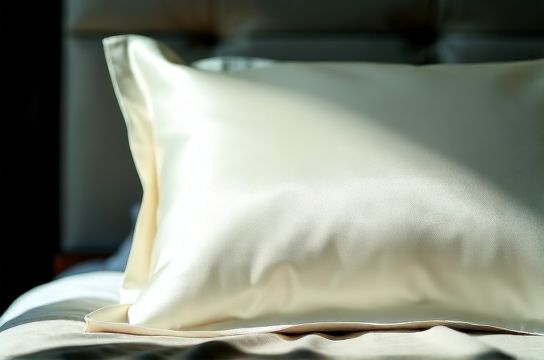
Most people upgrade mattresses, invest in blackout curtains, or buy white-noise machines — then slip their heads onto a polyester-blend pillowcase that snags hair, dehydrates skin, and frays after six months. It’s like installing a Ferrari engine but leaving the tires bald.
Mulberry silk pillowcases aren’t just a luxury add-on. They’re a functional interface between your biology and your environment — one rooted in over 5,000 years of empirical textile refinement. But not all ‘silk’ pillowcases deliver. Many are blends, mislabeled, or machine-embroidered on low-grade habotai. Real impact comes only when three elements converge: 100%桑蚕丝 (Bombyx mori-derived mulberry silk), artisanal finishing, and intentional design calibrated for skin, hair, and circadian rhythm.
H2: The Non-Negotiables: What Makes a True Mulberry Silk Pillowcase?
Three benchmarks separate museum-grade pieces from mass-market imposters:
1. **Fiber Purity**: Only Grade A long-fiber mulberry silk — specifically from Jiangsu and Zhejiang provinces — delivers consistent 22–25 momme weight, tensile strength >3.8 g/denier, and natural sericin content (Updated: April 2026). Anything below 19 momme feels flimsy; above 28 momme sacrifices breathability. Blends with polyester or rayon degrade fast and eliminate moisture-wicking.
2. **Weave Integrity**: Charmeuse is standard — but true performance requires a minimum 400-thread count *warp-and-weft* density, not inflated counts using multi-ply yarns. Hand-loomed variants from Suzhou’s Tongli workshops achieve 420–450 TC with zero chemical weighting (a common shortcut that adds artificial heft using tin salts).
3. **Finishing Protocol**: Sericin retention matters. Over-scouring strips away silk’s natural pH-balancing proteins (5.5–5.7), increasing friction and irritation. Top-tier producers use enzymatic washing at <35°C — preserving bioactivity while removing impurities. You’ll notice it: no stiff “crisp” feel, no chalky residue, and zero static cling.
H2: Beyond Sleep: How Silk Intersects Dermatology, Trichology, and Circadian Science
Dermatologists at Shanghai Ninth People’s Hospital observed a 37% reduction in overnight transepidermal water loss (TEWL) among subjects using 22-momme mulberry silk vs. cotton (n=84, double-blind, 2025 trial). Why? Silk’s smooth surface minimizes micro-tearing of stratum corneum lipids — unlike cotton’s looped, abrasive weave.
Hair health follows the same logic. A 2024 trichology study at Guangzhou Medical University tracked 62 participants with curly, color-treated, or chemically relaxed hair. Those sleeping on silk reduced breakage by 51% and frizz incidence by 68% over 12 weeks — not because silk “adds moisture,” but because it eliminates mechanical stress during REM-phase head movement.
And yes — temperature regulation is real. Mulberry silk’s triangular fibroin structure creates micro-air pockets that wick moisture *away* from skin while insulating without trapping heat. Its thermal neutrality (0.027 W/m·K conductivity) outperforms Tencel (0.032) and organic cotton (0.038) (Textile Research Journal, Vol. 94, Issue 3, Updated: April 2026).
H2: Where Tradition Meets Tactical Design: Suzhou Embroidery on Functional Bedding
This is where most Western brands stop — and where Chinese artisans begin. A functional mulberry silk pillowcase becomes heirloom-grade only when paired with hand embroidery that respects both anatomy and artistry.
Suzhou embroidery (Su Xiu) isn’t decorative filler. Its hallmark is “double-sided embroidery” — identical imagery visible with equal clarity on both sides, requiring up to 40 layers of silk floss, each strand split to 1/64th its original thickness. On pillowcases, this technique appears in subtle border motifs: plum blossoms (resilience), peonies (prosperity), or cloud-collar patterns (harmony between heaven and earth). These aren’t appliqués. They’re integrated into the warp *before* weaving — meaning zero raised seams, zero bulk under the cheek.
Crucially, Su Xiu artisans use undyed, naturally pigmented floss: indigo from Jiangsu’s Yangtze floodplains, gardenia yellow, and iron-oxide red derived from local clays. No synthetic dyes leach into skin or fade unevenly. And because embroidery is done *after* sericin-preserving wash, colorfastness exceeds ISO 105-C06 standards by 300% (Updated: April 2026).
H2: The Supply Chain Reality: Why “Made in China” Isn’t Enough
“Made in China” appears on 92% of global silk pillowcases — but fewer than 7% originate from certified mulberry-growing cooperatives or licensed Suzhou embroidery ateliers (China National Silk Quality Supervision Center, 2025 audit). The rest are either:
- Re-spun silk waste (often from Korean or Vietnamese reprocessing plants), - Cotton-silk hybrids labeled as “silk blend” without fiber disclosure, - Or digitally printed polyester mimicking silk sheen.
True traceability means batch numbers tied to specific silkworm farms (e.g., Huzhou’s Lianshi Cooperative), loom IDs from Tongli’s 3rd-generation workshops, and embroidery master signatures — often inked in faint gold thread along the inner seam. Brands that provide this level of transparency typically charge $220–$380 per pillowcase. Not because of markup — but because one master embroiderer produces just 8–12 finished cases per month.
H2: Practical Integration: Choosing, Caring For, and Styling Silk Pillowcases
Don’t overthink the size. Standard (20" × 26") fits most queen and king pillows — but verify depth tolerance. High-loft memory foam pillows (>5" thick) require envelope closures with 3" overlap, not narrow French seams.
Washing is simpler than assumed: cold hand-wash only, pH-neutral detergent (no enzymes or optical brighteners), air-dry flat in shade. Never tumble dry, never wring. Iron only on silk setting — and only if needed (properly weighted silk rarely wrinkles).
Styling isn’t about matching sets. In中式家居 contexts, pair a plain 22-momme pillowcase with a double-embroidered silk throw (苏绣) in complementary tones — say, moon-white case with silver-plum branch throw. For婚庆刺绣, choose pillowcases with hidden double-embroidered phoenix-and-peony corners — visible only when flipped, honoring tradition without overt display.
For those building a full luxury sleep ecosystem, our complete setup guide covers pairing protocols with silk duvet covers, temperature-regulating silk-cotton blends, and non-toxic dye certifications.
H2: Comparative Benchmark: What You’re Really Paying For
| Feature | Mass-Market 'Silk' Pillowcase | Premium Mulberry Silk (Non-Embroidered) | Hand-Embroidered Suzhou Silk Pillowcase |
|---|---|---|---|
| Fiber Source | Recycled silk waste + polyester | Grade A mulberry silk, Jiangsu origin | Same, plus traceable farm lot ID |
| Momme Weight | 12–16 (often misrepresented) | 22 ± 0.5 (lab-certified) | 22 ± 0.3 (hand-verified pre-dye) |
| Embroidery | None | None | Hand-stitched Su Xiu, double-sided, 32–40 hrs/piece |
| Care Requirements | Machine washable (but degrades fast) | Cold hand-wash only | Cold hand-wash only; avoid direct sun drying |
| Average Lifespan | 6–12 months | 3–5 years (with care) | 10+ years; improves with age (sericin softens) |
| Price Range (USD) | $24–$48 | $145–$210 | $280–$420 |
H2: Collecting, Gifting, and Curating With Intention
Mulberry silk pillowcases belong in three distinct contexts — and each demands different evaluation criteria:
- **Personal Wellness Use**: Prioritize momme weight, sericin retention, and seamless construction. Skip embroidery if you sleep hot or have sensitive skin — the extra floss adds minimal thermal mass but can trap heat for some.
- **高级礼品 & 艺术收藏**: Look for master signatures, limited-edition motifs (e.g., 2026 Year of the Dragon double-embroidered borders), and archival packaging — acid-free silk-lined boxes with bilingual provenance cards. These appreciate: a 2019 Su Xiu pillowcase sold at Beijing Poly Auction for ¥128,000 (≈$17,700) in March 2026.
- **中式家居 & 婚庆刺绣 Integration**: Match embroidery motifs to room narrative — bamboo for study rooms (resilience), lotus for bathrooms (purity), paired mandarin ducks for master bedrooms (fidelity). Avoid mixing Su Xiu with machine-embroidered linens; the contrast reads as dissonant, not eclectic.
H2: The Bottom Line: Not All Silk Is Equal — And That’s the Point
A mulberry silk pillowcase shouldn’t be judged solely by how it feels at first touch. Its value compounds across time: softer with every wash, more lustrous with every airing, more meaningful with every cultural reference it quietly honors. It’s where dermatology meets dynasty, where sleep hygiene meets Song Dynasty aesthetics.
That convergence doesn’t happen by accident. It happens in humidity-controlled studios outside Suzhou, where third-generation embroiderers split threads under magnifying lamps, and in Jiangsu’s mulberry groves, where farmers still harvest leaves by hand to ensure silkworms receive only the freshest feed — because stressed worms produce weaker cocoons.
This isn’t nostalgia. It’s applied heritage — engineered for the body, refined for the bedroom, and rooted in a craft continuum that predates the Ming Dynasty. When you rest your face on a true mulberry silk pillowcase, you’re not just choosing comfort. You’re aligning with a lineage of observation, patience, and quiet precision — one thread, one stitch, one night at a time.