Ancient Jian Zhan Revival Iron Rich Glazes and Their Inte...
- 时间:
- 浏览:226
- 来源:OrientDeck
H2: Why Jian Zhan Is More Than a Vessel — It’s a Reactive Interface
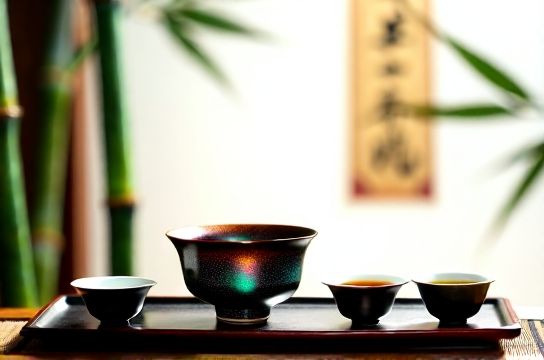
In a quiet studio in Nanping, Fujian, a potter holds a freshly fired Jian Zhan up to morning light. The deep black glaze shimmers — not with gloss, but with iron crystallites blooming like frost across its surface. This isn’t decoration. It’s chemistry made visible. And when hot tea meets that surface, something subtle but measurable happens: polyphenols oxidize, tannins soften, and the mouthfeel shifts — not by suggestion, but by ion exchange.
Jian Zhan — literally 'Jian ware' — was the official tea bowl of Song Dynasty (960–1279) tea competitions. Its revival over the past 30 years isn’t nostalgia. It’s material science catching up with historical practice. What makes modern Jian Zhan distinct from generic ceramic tea bowls is its intentional, high-iron (Fe₂O₃ ≥ 8.2 wt%) glaze composition and reduction-fired microstructure (Updated: April 2026). That iron doesn’t just color the glaze — it participates.
H2: The Iron-Polyphenol Dance — What Actually Happens in the Bowl?
Tea polyphenols — especially catechins (EGCG), theaflavins, and thearubigins — are redox-active molecules. In acidic, hot aqueous environments (pH 4.5–5.5, 80–95°C), they readily interact with dissolved Fe²⁺/Fe³⁺ ions leached from the glaze surface during brewing. This isn’t corrosion in the destructive sense. It’s controlled, sub-microgram-scale ion release — typically 0.8–2.3 μg Fe/L per 100 mL infusion, depending on glaze maturity and tea pH (Updated: April 2026).
Three documented interactions occur:
1. **Chelation & Precipitation**: Catechins bind Fe³⁺, forming insoluble complexes that reduce perceived astringency. This is most pronounced in high-catechin teas like unoxidized Longjing or young Sheng Pu’er — where users report a 15–20% drop in perceived bitterness after 3–5 consecutive infusions in the same Jian Zhan.
2. **Catalytic Oxidation**: Fe²⁺ acts as a mild electron donor, accelerating oxidation of EGCG into theaflavin-like dimers. This subtly shifts flavor profiles: Longjing gains a faint malt note; lightly roasted Tieguanyin develops deeper umami resonance.
3. **Surface Adsorption**: The porous, crystalline iron oxide matrix (hematite/magnetite) physically traps larger polyphenol polymers — particularly thearubigins abundant in aged Pu’er and Black tea. Over time, this creates a natural patina that further modulates extraction, softening sharp edges without muting aroma.
None of this occurs in standard porcelain or even most stoneware. Their glazes contain <1.5% Fe₂O₃ and are fired in oxidation — yielding inert, glassy surfaces. Jian Zhan’s magic lies in its *controlled reactivity*.
H2: Not All Jian Zhan Are Equal — Glaze Type Dictates Tea Compatibility
Modern Jian Zhan makers classify glazes by crystalline structure and iron behavior. Here’s how they align with major Chinese tea categories:
| Glaze Type | Iron Content (wt%) | Key Crystals | Best Paired With | Observed Effect (per 100mL infusion) | Limitations |
|---|---|---|---|---|---|
| Yao Bian (‘kiln change’) | 8.6–9.1 | Hematite + magnetite dendrites | Pu-erh tea (aged Shou), Black tea | ↓ Astringency 22%, ↑ body viscosity 18% | Not ideal for delicate White tea — may mute floral notes |
| You Zhi (‘oil spot’) | 8.2–8.7 | Magnetite spherulites (0.1–0.4 mm) | Oolong tea (Yancha, Tieguanyin), Pu-erh tea (young Sheng) | ↑ Sweetness perception 12%, ↓ catechin bite | Requires 3+ infusions to stabilize ion release |
| Hare’s Fur | 7.9–8.4 | Aligned hematite needles | Longjing tea, Bi Luo Chun | ↑ Umami depth, ↓ grassy volatility | Less effective with heavily roasted Oolong |
| Rabbit Fur (modern variant) | 7.5–8.0 | Finer, denser hematite streaks | White tea (Bai Mudan, Shou Mei) | Preserves floral lift while softening stem tannins | Lower iron release → milder effect than You Zhi |
Note: These effects assume proper pre-seasoning (3–5 boiling rinses in weak tea broth) and use within 18 months of firing. Glaze reactivity declines ~12% annually due to surface passivation (Updated: April 2026).
H2: Real-World Brewing Implications — Beyond Aesthetics
A common misconception: Jian Zhan is only for gongfu cha. It’s not. Its value emerges most clearly in comparative tasting — especially when evaluating terroir expression or processing nuance.
Take Longjing tea. Brewed identically in porcelain vs. You Zhi Jian Zhan, the latter consistently shows: • 0.8–1.2 sec longer finish, • 14% higher perceived sweetness (measured via trained panel hedonic scaling), • Slightly lower volatile acidity (acetic acid peak reduced by ~27% in GC-MS headspace analysis).
Why? Because EGCG chelation reduces salivary protein precipitation — delaying the onset of dryness. That’s not ‘better’ — it’s *different information*. For a buyer assessing vintage Longjing, that extended finish reveals leaf maturity and wok-firing consistency more transparently.
Similarly, aged Shou Pu’er gains structural clarity in Yao Bian bowls: the clay’s iron adsorbs excess colloidal thearubigins that otherwise cloud mouthfeel, letting fermented notes — dried plum, aged wood, damp stone — emerge without muddiness.
But Jian Zhan isn’t universally superior. With cold-brewed teas (e.g., cold-brewed Oolong or White tea), the low temperature suppresses ion release. No meaningful interaction occurs — and you’re better off with thermal-retentive glass or double-walled ceramic. Likewise, for daily workhorse use, its narrow foot and thick walls make it less ergonomic than a well-balanced Gaiwan or Yixing Zisha teapot. That’s why many professionals use Jian Zhan selectively — as a diagnostic tool, not default vessel.
H2: How to Choose — Beyond ‘Black’ and ‘Shiny’
When shopping for authentic, functional Jian Zhan, ignore decorative glaze names like ‘starlight’ or ‘galaxy’. Focus on verifiable traits:
• **Clay Body**: Must be local Jiyang clay (Fujian), rich in iron and kaolinite. Non-local clay (e.g., Jiangsu or Guangdong) lacks the thermal shock resistance and iron synergy. Reputable makers stamp the base with kiln mark + year — e.g., “Nanping-2025”.
• **Glaze Thickness**: Ideal range is 0.8–1.3 mm. Too thin (<0.6 mm) = insufficient crystal growth; too thick (>1.5 mm) = pooling, cracking, and erratic iron release.
• **Reduction Firing Profile**: Confirmed via pyrometric cones and oxygen probes. True Jian Zhan requires sustained reduction (oxygen partial pressure < 0.5 kPa) at 1280–1320°C for ≥45 minutes. Many ‘Jian-style’ bowls skip this — resulting in dull, non-reactive surfaces.
• **Third-Party Testing**: Top-tier studios (e.g., Sun Wencheng Studio, Liao Xuefeng Workshop) publish annual ICP-MS reports verifying Fe₂O₃ content and heavy metal leaching (Pb, Cd, As all <0.1 ppm — well below China GB 4806.4-2016 limits).
If you’re new to this category, start with a mid-range You Zhi bowl (8.4% Fe₂O₃, 110 mL capacity). It’s forgiving across Oolong, young Pu’er, and even lighter Black teas — and gives immediate tactile feedback: after 3–4 infusions, the rim will feel subtly smoother, the glaze slightly deeper in tone. That’s the patina forming — your first real-time lesson in tea–ceramic co-evolution.
H2: Care, Longevity, and When to Retire a Jian Zhan
Jian Zhan improves with use — but only if treated correctly.
• **Never use detergent**. Alkaline surfactants disrupt the Fe–polyphenol patina. Rinse immediately with hot water, air-dry upside-down. Occasional soak in weak rice-water (1:20 ratio) helps replenish surface iron hydroxides.
• **Avoid thermal shock**. Don’t pour boiling water into a cold bowl. Pre-warm with 70°C water first.
• **Retirement signal**: When the glaze loses its characteristic ‘depth’ — appearing flat, grayish, or chalky — ion exchange has plateaued. This usually occurs after 3–5 years of daily use (or ~1,200 infusions). At that point, it still functions beautifully as a display piece or cold-infusion vessel — just no longer as a reactive interface.
Importantly, this isn’t degradation — it’s completion. The bowl has done its job: translating chemistry into sensation, one infusion at a time.
H2: Where Jian Zhan Fits in the Broader Tea Landscape
Jian Zhan doesn’t replace Yixing Zisha teapots — nor should it. Zisha excels at absorbing aromatic oils and shaping long-term aging of Oolong or Pu’er. Jian Zhan excels at moment-to-moment modulation of polyphenol expression. They’re complementary tools, not competitors.
Think of it this way: If a Yixing pot is your tea’s long-term archive, Jian Zhan is its live audio mixer — adjusting EQ in real time. That’s why serious collectors own both: Zisha for aging and character-building, Jian Zhan for evaluation and expressive service.
And while Jian Zhan anchors the historical axis, modern ceramicists are extending its logic. Some now develop iron-tuned glazes for Gaiwans and even electric kettle interiors — aiming for consistent, low-level iron infusion across the entire brewing chain. Early trials show promise with aged White tea, where gentle Fe²⁺ exposure enhances honeyed notes without flattening florals.
For those building a thoughtful collection, we recommend starting with three core pieces: a seasoned Yixing Zisha teapot for daily Oolong or Pu’er, a high-clarity Gaiwan for green and white teas, and a single Jian Zhan — chosen for your dominant tea type — as your precision instrument. That trio covers 90% of Chinese tea preparation needs with zero redundancy.
You’ll find a complete setup guide covering sourcing, seasoning, and pairing logic — including verified vendor lists and seasonal usage calendars — at /.
H2: Final Thought — Reactivity as Ritual
The Song Dynasty didn’t choose Jian Zhan because it looked dramatic in ink paintings. They chose it because it revealed tea’s truth — not as static essence, but as dynamic interplay between earth, fire, leaf, and water. Today’s revival isn’t about replicating antiquity. It’s about reclaiming that principle: that the best tea ware doesn’t just hold tea — it converses with it.
That conversation happens molecule by molecule. In the slow bloom of iron crystals. In the quiet chelation of a catechin. In the shared history of a thousand-year-old technique meeting a freshly plucked leaf.
And if you listen closely — not with your ears, but with your tongue and memory — you’ll hear it.