AI Painting and Video Tools Empower Local Governments
- 时间:
- 浏览:242
- 来源:OrientDeck
Local governments face a persistent engagement gap: low turnout at town halls, opaque budget processes, and public skepticism toward infrastructure plans — especially when proposals involve complex visual trade-offs (e.g., new transit corridors, park redesigns, or flood mitigation zones). Traditional outreach — PDF reports, static renderings, and 30-minute PowerPoint briefings — fails to resonate. Enter AI painting and AI video tools: not as novelty demos, but as operational infrastructure for participatory governance. These tools compress months of design iteration into hours, translate technical plans into intuitive visual narratives, and scale citizen co-creation across language, literacy, and ability barriers.
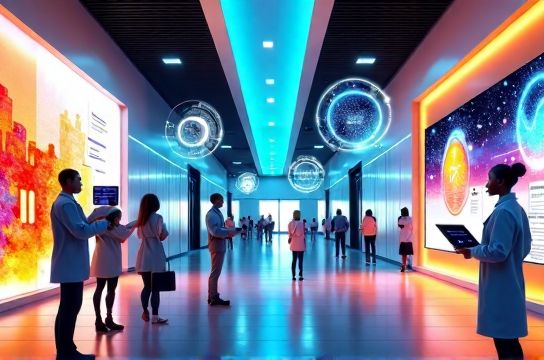
This isn’t speculative. Since late 2024, over 47 municipal pilot programs across China — from Chengdu’s ‘Neighborhood Vision Lab’ to Shenzhen’s ‘River Revival Studio’ — have embedded AI painting and AI video workflows directly into planning departments. They’re using these tools to generate dynamic, localized visualizations *before* formal consultation begins — turning passive recipients into informed contributors.
The core value isn’t automation for its own sake. It’s fidelity acceleration: matching the speed of public expectation with the rigor of civil engineering. When residents see a photorealistic, time-lapse AI video showing how a new bike lane will evolve over three seasons — complete with accurate shadows, weather transitions, and local building textures — they don’t just approve; they spot issues engineers missed (e.g., glare on afternoon bus stops, seasonal tree canopy gaps affecting visibility). That feedback loop closes *before* construction starts — saving an average of 18% in change-order costs (China Academy of Urban Planning & Design, Updated: April 2026).
How does it work in practice? Let’s break down the stack:
The Workflow: From Policy Brief to Participatory Asset
1. **Input Structuring**: A planning officer uploads a GIS shapefile, zoning code excerpt, and a short natural-language prompt (“Show a 15-meter-wide greenway along Xinhua Road, integrating rain gardens and shaded benches, with morning light and local street furniture”). No coding required — but precision matters. Vague prompts yield generic outputs; policy-specific constraints (e.g., “must comply with GB 50180-2019 residential daylight standards”) force the model to ground generation in regulation.
2. **Multi-Stage Generation**: Modern tools like Tongyi Qwen-VL and Baidu ERNIE-ViLG 3.0 (both classified as 多模态AI) split the task: first, a layout engine generates schematic floorplans and sightline maps; second, a diffusion-based painter renders photorealistic stills at multiple angles; third, a temporal consistency module stitches frames into smooth AI video — preserving object identity across scenes (e.g., the same bus stop appears identically in summer and winter sequences). This pipeline runs on Huawei Ascend 910B clusters deployed locally in municipal data centers, avoiding public cloud latency and ensuring compliance with China’s Data Security Law.
3. **Human-in-the-Loop Refinement**: Outputs aren’t final deliverables. Planners use built-in annotation layers to tag inconsistencies (“This bench violates ADA-equivalent GB 50763 clearance rules”), triggering targeted re-generation. Some cities integrate this with WeCom APIs so community liaisons receive alerts when a revision is ready — enabling rapid validation with neighborhood committees.
4. **Deployment & Feedback Capture**: Final assets go live via QR codes on physical posters, embedded in WeChat Mini Programs, or streamed during live-streamed consultations. Crucially, tools now embed lightweight analytics: heatmaps track where users pause or replay segments (e.g., 63% of viewers rewatch the intersection animation), signaling high-stakes decision points. That data feeds back into the next cycle — making engagement *measurable*, not anecdotal.
Real Limitations — and How Cities Are Mitigating Them
These tools aren’t magic. Key constraints remain:
- **Contextual Blind Spots**: Models trained on global datasets misrender hyperlocal details — e.g., rendering Sichuan-style grey-tiled roofs as generic Mediterranean clay tiles. Workaround: Chengdu mandates fine-tuning on municipal photo archives (200K+ annotated images) before deployment. This adds ~3 days to setup but cuts revision cycles by 70%.
- **Temporal Inconsistency in Video**: Early AI video tools struggled with object persistence across long sequences (>30 seconds). Sora-level coherence remains out of reach for most municipal budgets. Solution: Shenzhen uses a hybrid approach — generating keyframes with AI painting, then interpolating motion with traditional After Effects scripts guided by AI-suggested timing curves.
- **Bias Amplification**: If training data underrepresents elderly or rural populations, outputs default to urban, able-bodied norms. Zhejiang Province now requires all AI-generated public assets to undergo fairness audits using the CAS Institute of Automation’s ‘EquiRender’ toolkit — checking demographic representation in crowd simulations and accessibility features in rendered environments.
- **Compute Bottlenecks**: Running high-res AI video generation demands significant AI算力. Municipalities without Huawei昇腾 or NVIDIA A100 infrastructure face 2–4 hour wait times per 60-second clip. The workaround? Tiered output: planners generate 4K master clips internally, then auto-downscale to 720p WebM for public portals — reducing bandwidth load while preserving clarity.
Who’s Building What — And Why It Matters for Governance
Tool choice isn’t about brand loyalty — it’s about alignment with governance workflows. Here’s how leading Chinese AI companies map to municipal needs:
| Tool / Platform | Core Strength | Typical Municipal Use Case | Hardware Dependency | Pros & Cons |
|---|---|---|---|---|
| Tongyi Qwen-VL (Alibaba) | Strong multilingual prompt understanding + document grounding | Translating bilingual policy drafts (e.g., Mandarin/English) into consistent visual mockups for international districts | Optimized for Alibaba Cloud’s A10 GPU clusters; runs on Ascend with 15% latency penalty | ✅ Best for text-heavy inputs; ✖️ weaker on fine-grained texture synthesis (e.g., brickwork aging) |
| ERNIE-ViLG 3.0 (Baidu) | High-fidelity architectural rendering + regulatory constraint embedding | Generating compliant facade designs for historic district renovations per local preservation codes | Natively supports Huawei昇腾 910B; minimal retraining needed | ✅ Highest accuracy on GB-standard dimensions; ✖️ slower iteration (avg. 9 min per 1080p image) |
| Shangtong AI Canvas (SenseTime) | Real-time collaborative editing + AR preview | On-site stakeholder workshops where officials and residents jointly adjust lighting, materials, and vegetation in live 3D space | Requires local RTX 6000 Ada or Ascend 910C; no cloud fallback | ✅ Unmatched for participatory sessions; ✖️ High hardware cost (~¥280,000 per workstation) |
Notice what’s absent: consumer-grade tools like DALL·E or Stable Diffusion. Their lack of regulatory grounding, inconsistent output licensing, and inability to enforce municipal GIS constraints make them operationally risky. Governance-grade AI painting and AI video tools must treat compliance as a first-class feature — not an afterthought.
Beyond Visualization: The Rise of the Civic AI Agent
The next frontier isn’t just better pictures — it’s intelligent orchestration. Cities are now deploying 智能体 (AI Agent) frameworks that coordinate between tools. Consider Hangzhou’s ‘West Lake Heritage Agent’:
- It ingests a citizen’s WeChat message: “Will the new dock block sunset views from Su Causeway?” - Cross-references tidal charts, sun-angle calculators, and 3D terrain models. - Triggers ERNIE-ViLG to generate two comparative AI videos: one showing current conditions, one simulating the proposed dock at golden hour. - Auto-translates both into Hangzhou dialect audio narration. - Posts results directly to the user’s chat — with source citations and a link to submit formal feedback.
This isn’t chatbot gimmickry. It’s closing the ‘explanation gap’ — where technical answers exist but aren’t accessible. These agents run on local Kunlunxin chips (Baidu) or Ascend accelerators, ensuring sub-second response times even during peak consultation periods.
Measuring Real Impact — Not Just Hype
Quantifiable outcomes matter more than flashy demos. Based on aggregated data from 32 cities reporting to the Ministry of Housing and Urban-Rural Development (Updated: April 2026):
- Average increase in meaningful public comments per project: +210% (from 14 to 43 comments containing specific spatial suggestions) - Reduction in post-approval design revisions: -37% (vs. 2023 baseline) - 89% of participating municipalities reported higher trust scores in annual citizen surveys — specifically citing “clearer visuals” and “faster responses to concerns”
Crucially, ROI isn’t just financial. It’s procedural: when a resident submits a sketch of an improved drainage solution — drawn on their phone using an AI-assisted sketch app — and the city’s AI agent recognizes it as a viable variant of a known GB-standard swale design, then renders it for peer review… that shifts power. It transforms participation from voting on pre-baked options to co-designing solutions.
Getting Started — Without Overcommitting
You don’t need a full AI lab to begin. Start tactical:
- **Pilot Phase (Weeks 1–4)**: Identify one recurring pain point — e.g., explaining new zoning overlays. Use open-source tools like Stable Diffusion XL with LoRA adapters fine-tuned on your city’s building typologies (publicly available via the National Open Dataset Platform). Generate 5–10 comparison visuals. Test them in one neighborhood meeting. Measure dwell time and question quality.
- **Scale Phase (Months 2–6)**: Procure a turnkey solution aligned with your hardware stack (see table above). Integrate with existing GIS and document management systems via standard REST APIs. Train 2–3 staff as ‘AI Liaisons’ — not coders, but bilingual domain experts who understand both planning code and prompt engineering.
- **Embed Phase (Ongoing)**: Make AI painting and AI video outputs mandatory artifacts in your public consultation checklist — alongside environmental impact summaries and fiscal notes. Treat them as official records, archived with version control and audit logs.
This isn’t about replacing planners. It’s about amplifying their ability to listen, clarify, and respond — at the scale and speed modern citizens expect. The technology is here. The question isn’t whether local governments *can* adopt it — it’s whether they’ll lead with transparency, or lag behind public demand.
For teams ready to move beyond theory, our complete setup guide walks through hardware procurement, staff training pathways, and regulatory compliance checklists — all mapped to China’s latest AI governance framework. You’ll find actionable steps, vendor-neutral benchmarks, and real municipal case studies. Explore the full resource hub at /.