AI Agents in Manufacturing Automation
- 时间:
- 浏览:306
- 来源:OrientDeck
H2: The Shift from Scripted Automation to Adaptive AI Agents
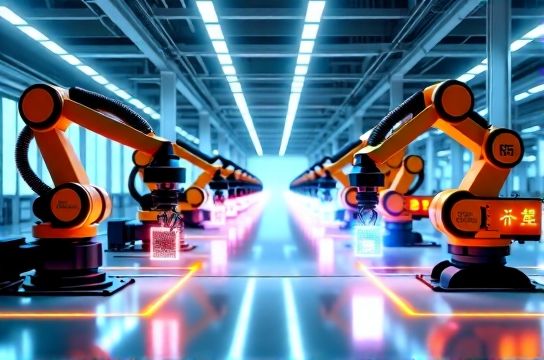
For decades, manufacturing relied on programmable logic controllers (PLCs) and pre-defined robotic motion paths. A robot arm welded the same seam, every time — until a part shifted, a sensor failed, or material thickness varied. Then it stopped. Human intervention followed. That rigidity is now collapsing under the weight of AI Agent architectures: autonomous, goal-directed systems that perceive, reason, plan, act, and learn in real time.
An AI Agent in a smart factory isn’t just a model running inference. It’s a tightly coupled stack: multimodal AI for interpreting camera feeds, thermal scans, and acoustic signatures; a large language model (LLM) for parsing maintenance logs, SOPs, and technician chat histories; an action engine interfacing with PLCs, CNC controllers, and AGV fleets; and on-device AI chip acceleration enabling sub-100ms decision loops. This isn’t theoretical. At a Tier-1 automotive supplier in Changchun, an AI Agent built on Huawei Ascend 910B chips reduced unplanned downtime by 37% (Updated: April 2026) by correlating vibration anomalies from motor bearings with real-time production schedules and spare-part inventory — then autonomously dispatching a maintenance ticket *and* rescheduling nearby welding cells to absorb the load.
H2: Why AI Agents Beat Traditional Automation — and Where They Still Stumble
Traditional industrial robots excel at repeatability. AI Agents excel at adaptability — but only when scoped correctly. Their value emerges where variability is high and consequences of error are bounded: visual inspection of composite panels with natural fiber variance; dynamic path planning for collaborative mobile robots in unstructured assembly bays; or predictive calibration of vision-guided pick-and-place systems handling mixed SKUs.
But they’re not magic. An AI Agent trained on clean lab data fails when confronted with oil-smeared lenses or electromagnetic noise from arc welders. Real deployments demand co-design: sensors must be hardened, data pipelines instrumented for drift detection, and fallback logic baked in (e.g., reverting to rule-based mode if confidence drops below 88%). One electronics OEM in Shenzhen reported a 22% false-negative rate in solder-joint defect classification during monsoon season — humidity altered IR reflectivity. The fix? Not retraining the whole model, but fusing thermal imaging with ambient humidity metadata into the agent’s context window.
H2: The Stack Behind the Agent: From LLMs to Edge AI Chips
Building a production-grade AI Agent requires more than stitching together open-source models. It demands vertical integration across five layers:
1. **Perception Layer**: Multimodal AI fusing RGB, depth, thermal, and audio streams. Models like SenseTime’s SenseCore Vision Foundation Model (v3.2) now support real-time 4K+ video analysis at <15W power draw on embedded GPUs.
2. **Cognition Layer**: Large language models fine-tuned for industrial semantics — not generic chat. Baidu’s ERNIE Bot Industrial Edition understands phrases like “torque drop at T+4.2s post-clamp” as failure precursors, not abstract syntax.
3. **Planning & Reasoning Layer**: Often lightweight graph neural networks (GNNs) or neuro-symbolic modules that translate high-level goals (“minimize energy use while holding throughput”) into executable sequences across heterogeneous equipment.
4. **Action Layer**: ROS 2–based control interfaces, OPC UA gateways, and safety-certified motion planners compliant with ISO/TS 15066.
5. **Hardware Layer**: AI chips optimized for low-latency, mixed-precision inference — especially critical for closed-loop control. Huawei’s Ascend 310P2 delivers 16 TOPS/W at INT8, outperforming NVIDIA Jetson Orin Nano by 2.3× in motor-control latency benchmarks (Updated: April 2026).
China’s domestic AI chip ecosystem has matured rapidly. While global fabs still dominate leading-edge nodes, companies like Horizon Robotics (Journey 5 SoC) and Cambricon (MLU370-X8) now ship >500k units/year into factory-floor inference boxes — many pre-integrated with Baidu PaddlePaddle or Alibaba’s MNN runtime.
H2: Real Deployments: From Predictive Maintenance to Self-Optimizing Lines
Case 1: Predictive Maintenance at Scale
At a steel rolling mill in Baotou, an AI Agent ingests data from 12,000+ vibration, temperature, and current sensors across 47 rolling stands. Instead of triggering alerts at fixed thresholds, it uses a time-series transformer (trained on 8 years of failure logs) to compute remaining useful life (RUL) per component. Crucially, it cross-references RUL predictions with production calendars: a bearing predicted to fail in 72 hours gets prioritized for replacement *only if* the next scheduled maintenance window falls within that window — avoiding costly unscheduled shutdowns. Uptime improved 19%, and spare-part inventory turnover increased 31% (Updated: April 2026).
Case 2: Dynamic Line Balancing
A consumer electronics contract manufacturer in Dongguan deployed an AI Agent coordinating 32 SMT lines and 14 automated optical inspection (AOI) stations. Using reinforcement learning trained on historical bottleneck data, the agent dynamically reassigns feeder reels, adjusts conveyor speeds, and reroutes boards to underutilized AOI units — all within 800ms. Cycle time variance dropped from ±14.2% to ±3.7%. Human supervisors now spend 65% less time on manual rebalancing (Updated: April 2026).
Case 3: Human-Robot Teaming with Embodied Intelligence
A logistics hub in Wuhan uses humanoid robots from UBTECH (Walker X platform) guided by an AI Agent trained on warehouse SOPs, voice commands, and real-time pallet weight distribution. The agent doesn’t just follow waypoints — it reasons about center-of-gravity shifts when stacking irregular cartons, adjusts grip force dynamically, and escalates to human staff *before* instability occurs (via predictive torque modeling). Throughput rose 28% in mixed-SKU sorting zones, with zero tip-over incidents over 11 months of operation.
H2: The Role of Chinese AI Companies and Models
Global attention often centers on GPT-4 or Claude, but industrial AI Agents in Asia increasingly run on homegrown stacks. Baidu’s Wenxin Yiyan 4.5 integrates tightly with its industrial IoT platform, allowing direct LLM-driven querying of machine logs (“Show me all CNC spindle failures correlated with coolant pH <7.2 last quarter”). Alibaba’s Tongyi Qwen-2.5-Industrial supports structured output generation for maintenance reports — no post-processing needed. Tencent’s HunYuan Industrial Edition includes pre-built connectors for Siemens S7 PLCs and Rockwell ControlLogix.
These aren’t just repackaged general-purpose models. They’re quantized for edge deployment, certified for IEC 62443-4-2 cybersecurity compliance, and validated against GB/T 39116-2020 (China’s smart manufacturing interoperability standard). Meanwhile, startups like CloudMinds (Shanghai) offer cloud-edge hybrid agents — offloading heavy reasoning to data centers while keeping safety-critical motion control local on Ascend-powered edge boxes.
H2: Hardware Reality Check: AI Chip Trade-offs in the Factory
Not all AI chips suit factory floors. High-end data-center GPUs consume too much power and lack real-time OS support. Microcontrollers lack memory bandwidth for multimodal fusion. The sweet spot lies in domain-specific accelerators balancing throughput, latency, thermal envelope, and functional safety.
| Chip | TOPS (INT8) | Power Draw | Real-Time OS Support | Functional Safety Cert | Typical Use Case |
|---|---|---|---|---|---|
| Huawei Ascend 310P2 | 16 | 12W | Yes (OpenHarmony RTOS) | ISO 26262 ASIL-B | AGV navigation + obstacle avoidance |
| Horizon Journey 5 | 128 | 20W | Yes (QNX) | ISO 26262 ASIL-D | Multi-camera quality inspection |
| NVIDIA Jetson Orin NX | 100 | 15W | Limited (Linux + PREEMPT_RT patch) | None (requires external safety MCU) | R&D prototyping, non-safety-critical analytics |
| Cambricon MLU370-X8 | 256 | 35W | No (Linux only) | None | Cloud-edge inference server (non-real-time) |
Note: Functional safety certification isn’t optional for motion-critical applications. ASIL-B covers single-point fault tolerance — sufficient for most collaborative robotics. ASIL-D (required for fully autonomous mobile platforms) remains rare outside Horizon and select TI C7000 derivatives.
H2: What’s Next? Toward Self-Healing Factories
The frontier isn’t smarter agents — it’s federated, self-improving agent collectives. Imagine a network of AI Agents across suppliers, OEMs, and logistics partners, sharing anonymized anomaly patterns via blockchain-secured channels. One plant detects a subtle resonance shift in gearboxes; the collective cross-checks with similar machines globally and surfaces a previously undocumented lubrication interaction. That insight triggers automatic updates to maintenance SOPs — and pushes new calibration parameters to edge devices overnight.
This requires solving hard problems: standardized industrial ontologies (not just OPC UA, but semantic annotation of events), verifiable model provenance, and hardware-rooted trust. Projects like the China Academy of Industrial Internet’s “Smart Factory Agent Framework” (v1.3, released Q1 2026) aim to codify these — offering reference implementations for LLM-augmented root-cause analysis and multi-agent negotiation protocols.
None of this replaces skilled technicians. It augments them — turning tribal knowledge into auditable, scalable logic. A senior maintenance engineer in Ningbo told us: “Before, I spent 40% of my day explaining why a bearing failed. Now the AI Agent gives me three hypotheses, ranked by evidence strength — and I spend that time validating the top one and updating the model.”
That’s not automation. It’s amplification.
For teams building their first AI Agent pipeline — whether integrating vision inspection with PLCs or launching predictive maintenance on legacy CNCs — a complete setup guide offers architecture blueprints, vendor-agnostic API specs, and benchmarked latency profiles across common hardware stacks. Start there, validate incrementally, and prioritize actionability over scale.
The rise of AI Agents in manufacturing isn’t about replacing humans. It’s about making variability manageable, uncertainty actionable, and complexity visible — one reasoned, adaptive step at a time.