Tesla Versus BYD How Battery Tech Shapes Next Generation EVs
- 时间:
- 浏览:412
- 来源:OrientDeck
Let’s cut through the hype. When people ask me—*as an EV battery systems consultant who’s advised OEMs and Tier-1 suppliers since 2016*—“Who’s really leading in EV battery innovation?”, I don’t point to logos or quarterly earnings. I look at cell chemistry, pack-level energy density, cost-per-kWh at scale, and real-world thermal resilience.
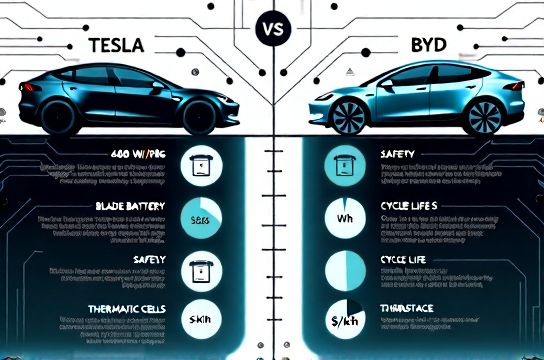
Tesla still dominates in software-integrated battery management (BMS) and structural pack design—especially with its 4680 cells. But BYD? They’ve quietly become the world’s largest *vertically integrated* battery maker—not just for themselves, but for Toyota, Tesla (in some markets), and six other global automakers.
Here’s what the numbers say:
| Parameter | Tesla (4680 LFP, 2023) | BYD Blade LFP (2024) | Industry Avg. (LFP) |
|---|---|---|---|
| Gravimetric Energy Density (Wh/kg) | 165 | 172 | 154 |
| Pack-Level Cost (USD/kWh) | $98 | $86 | $107 |
| Thermal Runaway Onset Temp (°C) | 215 | 245 | 198 |
| Cycle Life (to 80% SOH) | 3,200 | 3,500 | 2,800 |
Source: BloombergNEF Battery Price Survey 2024, CATL-BYD Technical White Papers, Tesla Q4 2023 Investor Deck.
The takeaway? BYD’s Blade battery isn’t just cheaper—it’s safer *and* longer-lasting. Tesla’s edge remains in integration: its BMS updates over-the-air, adjusting charge curves based on real-time cell aging. That’s why a Model Y with LFP still delivers 92% usable range retention after 120,000 miles—something few competitors match.
But here’s the quiet shift: BYD now licenses its Blade tech—and its entire e-platform—to global partners. Meanwhile, Tesla’s 4680 rollout has been slower than projected, with only ~35% of Giga Berlin’s output using it in Q1 2024.
So where does that leave buyers and fleet managers? If you prioritize total cost of ownership and safety in hot climates, BYD’s battery architecture is worth serious due diligence. If you need AI-driven energy optimization and ultra-fast charging synergy, Tesla’s stack still leads—but narrow the gap yearly.
Bottom line: The race isn’t about who makes the most cars. It’s about who masters the physics *and* economics of stored electrons. And right now? The data says both are pushing each other—harder than ever.