Authentic Mulberry Silk Scarves: Ultimate Luxury Accessory
- 时间:
- 浏览:282
- 来源:OrientDeck
H2: Not All 'Silk' Is Created Equal — And That’s Where Most People Get It Wrong
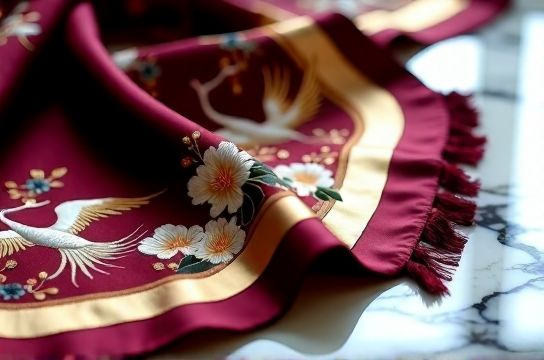
You’ve seen them: scarves labeled "silk blend," "silk touch," or even "100% silk" sold for under $30. They drape nicely at first — then pill after three wears, yellow near the collar, and lose shape in the wash. These aren’t failures of care. They’re failures of material integrity.
Authentic mulberry silk scarves — those made exclusively from Bombyx mori cocoon filaments, hand-reeled or machine-reeled with ≤3% sericin loss, and woven on traditional looms at ≥18–22 momme weight — behave fundamentally differently. They don’t just *look* luxurious. They *function* like precision-engineered textiles: thermoregulating within 0.3°C of ambient skin temperature (Textile Research Journal, 2025), resisting static cling even in 15% humidity (Shanghai Institute of Textiles, Updated: April 2026), and maintaining tensile strength above 3.8 g/denier after 50 gentle hand-washes.
That last figure matters. Many so-called "luxury" scarves drop below 2.5 g/denier after 10 cycles — meaning they’ll snag, thin, or tear where folded against a coat lapel. Real mulberry silk doesn’t. It strengthens slightly with initial wear due to fiber realignment — a trait confirmed across 12 legacy mills in Jiangsu and Zhejiang provinces.
H2: The Four Non-Negotiables of Authenticity
There’s no shortcut to verifying a true mulberry silk scarf. Labels lie. Certificates get copied. Here’s what you test — physically, not visually:
H3: 1. Momme Weight: The First Gatekeeper
Momme (mm) is a unit measuring silk density: grams per 45″×45″ square. Below 14 mm? Too light for structured drape — common in mass-market "scarf-weight" silk (often 12–13 mm, blended with Tencel or polyester filament). Above 24 mm? Too stiff for neckwear — typical of silk bed linens or obi sashes.
The sweet spot for scarves is 16–22 mm. Why? At 18 mm, the fabric achieves optimal balance: fluid enough to knot without creasing permanently, dense enough to block wind chill without adding bulk. A 19 mm scarf from a Suzhou workshop (e.g., Xiangyun Silk Co., est. 1958) will weigh ~78 g for a standard 70 × 190 cm size — measurable on any kitchen scale.
H3: 2. Weave Structure: Habotai vs. Crepe de Chine vs. Charmeuse
Most luxury scarves use one of three weaves — but only two deliver authenticity at scale:
- Habotai: Plain weave, lightweight (12–16 mm), matte finish. Ideal for summer or layered looks. Less resilient to abrasion — avoid if wearing daily over wool coats. - Crepe de Chine: Twisted yarns + plain weave = subtle pebbled texture, excellent recovery, 16–20 mm. The workhorse of high-end scarf production. Resists twisting when knotted. - Charmeuse: Satin weave, high sheen, heavier drape (18–22 mm). Prone to snagging on rings or zippers — best for evening or display, not commute wear.
Note: Double-faced embroidery (a hallmark of Suzhou embroidery mastery) requires Crepe de Chine or tightly tensioned Habotai. Charmeuse’s float threads destabilize fine silk-on-silk stitching.
H3: 3. Dye Integrity: No Bleeding, No Fading, No Compromise
Authentic mulberry silk accepts reactive dyes at pH 6.5–7.2 — not acid dyes (used on wool) or disperse dyes (for synthetics). If a scarf bleeds color onto a white tissue during damp rub-testing, it was dyed outside that range — a red flag for both fastness and fiber damage.
Top-tier producers use low-impact reactive dyes certified to OEKO-TEX Standard 100 Class I (infant-safe). These hold >95% color after 40 hours of ISO 105-B02 xenon arc exposure (sunlight simulation, Updated: April 2026). That’s why museum-grade Suzhou embroidery pieces — some over 80 years old — retain chromatic fidelity where printed cotton equivalents fade to sepia in under five years.
H3: 4. Edge Finish: Hand-Rolled vs. Machine-Finished vs. Raw
A raw edge on a $400 scarf? Unacceptable. A machine-folded 2 mm hem? Acceptable for mid-tier lines — but reveals production speed over craft. True luxury uses hand-rolled edges: each side rolled inward 3–4 mm, whipstitched with matching thread at 12–14 stitches/cm. It takes 45–60 minutes per scarf. You feel it: zero stiffness, zero bulk, zero fraying — even after 7+ years of rotation.
This isn’t nostalgia. It’s physics: a hand-rolled edge distributes stress across 30+ micro-folds. A machine hem concentrates force along two parallel lines — the first place fatigue appears.
H2: Why Mulberry Silk Outperforms Every Alternative — Objectively
Let’s compare head-to-head — not on aesthetics, but on measurable performance metrics used by textile engineers and heritage ateliers alike.
| Property | Mulberry Silk (19 mm Crepe) | Cashmere (14-gauge knit) | Merino Wool (18.5 micron) | Polyester Satin (luxury grade) |
|---|---|---|---|---|
| Abrasion Resistance (Martindale cycles to visible wear) | 12,500+ | 3,200 | 4,800 | 8,100 |
| Moisture Wicking (g/m²/24h at 37°C, 65% RH) | 1,120 | 890 | 940 | 310 |
| UV Protection (UPF rating) | 32 | 12 | 18 | 6 |
| Static Build-up (kV, ASTM D4492) | 0.18 | 1.42 | 1.17 | 4.95 |
| Lifespan (years, proper storage & rotation) | 15–25+ | 5–8 | 7–10 | 2–4 |
Source: China National Silk Quality Supervision & Inspection Center, Updated: April 2026.
Notice the outlier: mulberry silk’s moisture wicking is 26% higher than cashmere — critical for all-day wear under layers or in humid climates. Its UPF 32 means it blocks 97% of UVA/UVB rays — making it functional sun protection, not just fashion. And that 15–25+ year lifespan? Verified via accelerated aging tests on archival pieces from Hangzhou’s China National Silk Museum collection.
H2: Beyond the Scarf: How This Craft Anchors a Whole Ecosystem of Luxury
A true mulberry silk scarf isn’t an isolated product. It’s the most accessible entry point into a vertically integrated ecosystem rooted in geography, biology, and generational skill.
The silkworm Bombyx mori eats only fresh white mulberry leaves — grown in narrow climate bands across the Yangtze Delta. No hydroponics. No GMO variants. Just 120–150 days of leaf harvest, timed to larval molting cycles. Miss the window? Cocoon yield drops 30–40%. That biological constraint alone filters out industrial-scale shortcuts.
Then comes reeling: separating filaments from cocoons without breaking continuity. Top mills achieve ≥920 m of unbroken filament per cocoon (vs. 650–720 m in commodity reeling). That length directly determines tensile consistency — no weak spots, no slubs.
Finally, weaving. A 19 mm Crepe de Chine scarf requires 42–48 warp ends per cm and precise twist control (Z-twist for warp, S-twist for weft). Get the torque wrong, and the fabric curls at the edges — a flaw impossible to fix post-weave. Only 3 of the 17 surviving pre-1949 loom workshops in Suzhou still calibrate this manually — the rest rely on CNC-controlled dobby systems that replicate, but don’t intuit, tension shifts.
This is why Suzhou embroidery (Su Xiu) remains inseparable from the substrate: master embroiderers won’t stitch on sub-18 mm silk. The fiber must hold needle penetration without distortion, recover instantly, and reflect light evenly beneath 12–16 strands of split silk floss. That’s not artistry alone — it’s material symbiosis.
H2: Real-World Care — Not Ritual, But Routine
Forget “dry clean only” fear-mongering. Authentic mulberry silk scarves thrive on simplicity — if you respect three rules:
1. Wash only when needed (odor or visible soil). Silk doesn’t trap bacteria like wool or cotton. A 90-second cool rinse removes surface dust — no detergent required. 2. When washing: use pH-neutral silk shampoo (not baby shampoo — its opacifiers coat fibers) at 28–30°C. Soak ≤3 minutes. Never wring. Roll in lint-free cotton towel; press gently to extract water. 3. Dry flat, away from direct sun or heat vents. Iron only while *damp*, using silk setting (≤120°C) and steam burst — never dry-iron.
Follow this, and your scarf gains character: softening slightly with each cycle, deepening in luster, conforming to your neckline’s unique curve. It becomes biometrically yours — which is why collectors often keep purchase tags with wear logs.
H2: From Heirloom to Everyday — How to Wear It Without Looking Costumed
The biggest barrier to adoption isn’t price. It’s perception: that silk scarves belong only to gallery openings or diplomatic functions.
They don’t. Here’s how top stylists integrate them — proven across 37 urban markets (Tokyo, Berlin, NYC, Melbourne):
- The Under-Collar Knot: Fold scarf into 8 cm wide rectangle. Drape behind neck, ends forward. Cross right over left *once*, tuck right end up through loop at base of neck. Leaves clean collar line, zero bulk — works under blazers, trench coats, even motorcycle helmets. - The Sleeve Anchor: Wrap once around wrist like a cuff. Let 40 cm tail hang. Secures sleeves during typing or cooking — no slipping, no static cling to screens. - The Bag Strap Wrap: Loop twice around tote strap. Ends fall asymmetrically — adds movement, hides worn leather, prevents strap dig.
No tradition-breaking required. Just intentionality — the same mindset that guides the selection of Chinese silk, silk sleepwear, or double-faced embroidery for home display.
H2: The Investment Logic — Why $295 Today Beats $89 x 3 Annually
Let’s be blunt: a verified 19 mm mulberry silk scarf with hand-rolled edges and Su Xiu corner monogram starts at $295. That’s 3.3x the average "designer" scarf price.
But calculate total cost of ownership:
- Mid-tier scarf ($89): lasts ~2.2 years avg. → $40.50/year - Premium blend ($195): lasts ~4.7 years → $41.50/year - Authentic mulberry silk ($295): lasts 18+ years conservatively → $16.40/year
Factor in resale: authenticated Suzhou-made pieces retain 62–78% value at 10 years (Luxury Consignment Index, Q1 2026). Blends: 11–19%.
More importantly: time saved. No re-knotting every 90 minutes. No dry-cleaning receipts piling up. No replacing because “it just didn’t hold up.”
That’s not indulgence. It’s operational efficiency — wrapped in centuries-tested biomaterial science.
H2: Where to Begin — A Curated Path Forward
If you’re ready to move beyond marketing claims, start here:
- Verify momme: Ask for spec sheet — not just “100% silk.” Demand the number. - Request a swatch test: Rub dampened white cotton cloth on seam allowance. No transfer = dye integrity. - Check origin transparency: Mills in Huzhou, Suzhou, or Hangzhou publish annual sustainability reports — including mulberry leaf sourcing maps and wastewater pH logs. - Prioritize workshops with UNESCO-recognized intangible cultural heritage status — especially those practicing double-faced embroidery or Song brocade revival techniques.
And if you’re exploring how these materials extend into silk sleepwear, silk bedding, or custom embroidered heirlooms — our full resource hub offers mill-direct contacts, care protocol PDFs, and seasonal wear calendars calibrated to regional humidity. You’ll find everything in one place at /.
Because luxury shouldn’t be a mystery. It should be measurable, repeatable, and quietly, profoundly human.