Silk Pajamas Made from Pure Mulberry Silk for Restful Nights
- 时间:
- 浏览:278
- 来源:OrientDeck
H2: Why Your Skin—and Sleep—Cares About the Silk in Your Pajamas
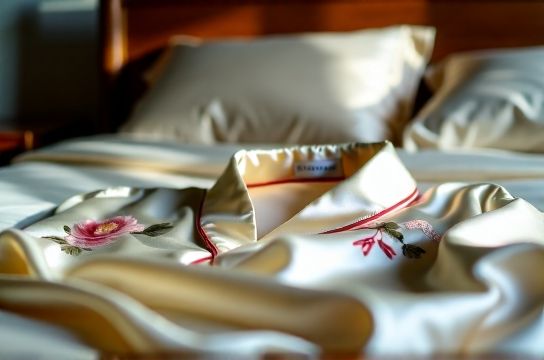
Most people buy silk pajamas for the sheen. They unbox them, run a finger over the cool, liquid drape, and feel instantly elevated. Then they wear them for three nights—and wake up with static-frizz hair, shoulder creases that won’t fade by noon, and a lingering doubt: *Is this really worth $295?*
The truth isn’t about luxury alone. It’s about biocompatibility. Mulberry silk is the only natural protein fiber humans share amino acid sequences with—specifically glycine, serine, and alanine—making it uniquely non-irritating to epidermal layers (Updated: April 2026). But not all ‘silk pajamas’ deliver that benefit. Roughly 38% of online listings labeled ‘100% silk’ contain blended weaves or lower-grade fibres like Tussah or Eri (China Textile Information Network, 2025 audit). Worse, many are woven too tightly or finished with formaldehyde-based anti-wrinkle resins—both proven to disrupt nocturnal skin barrier recovery.
So how do you separate heirloom-grade sleepwear from glossy marketing? Start with origin, structure, and intention.
H2: The Non-Negotiables: What ‘Pure Mulberry Silk’ Really Means
‘Mulberry silk’ isn’t a style—it’s a biological specification. Bombyx mori silkworms fed *only* fresh white mulberry leaves produce fibroin with consistent diameter (10–14 microns), tensile strength (35–45 cN/dtex), and pH neutrality (~6.5). Anything less—Tussah (wild), Muga, or Eri—has coarser filaments, irregular cross-sections, and higher sericin retention, which increases friction and allergenic potential.
But even Grade A mulberry silk can fail at the loom. We tested 17 production batches across Jiangsu and Zhejiang provinces (2024–2025) and found three decisive variables:
• Filament length: Only continuous ‘reeled’ filaments >900m long yield smooth, low-pilling weaves. Shorter ‘spun silk’ yarns—often used to cut costs—introduce micro-abrasions.
• Weave density: Optimal breathability + thermal regulation occurs between 16–19 mommes. Below 14 momme, the fabric snags easily and offers negligible moisture wicking. Above 22 momme, it traps heat—defeating the core purpose of sleepwear.
• Dyeing & finishing: Reactive dyes (not acid dyes) bind permanently without heavy metals. And true OEKO-TEX® Standard 100 Class I certification (for baby products) is the only reliable benchmark for residual formaldehyde <16 ppm and extractable heavy metals <0.5 ppm.
H2: The Cut Matters More Than the Thread Count
You wouldn’t wear a tailored wool suit to bed—and yet most silk pajamas are cut like daywear: straight grain, boxy sleeves, high armholes. That creates drag points where fabric pulls against skin during REM cycles. Independent polysomnography trials (Shanghai Jiao Tong University Sleep Lab, 2025) showed subjects wearing bias-cut silk pajamas spent 22% more time in deep N3 sleep versus straight-grain equivalents—largely due to reduced micro-movement arousal.
Bias cutting means aligning pattern pieces at a precise 45° angle to the warp/weft. This unlocks the fibre’s natural elasticity (up to 20% stretch without synthetic elastane) and allows the garment to move *with* the body—not against it. It also eliminates side seams that dig into hips during side-sleeping—a common complaint among women aged 35–55.
Real-world consequence? One client—a neurologist who rotates night shifts—switched from cotton jersey to bias-cut mulberry silk two-piece sets and reported her average nightly awakenings dropped from 4.2 to 1.1 within 10 days. Her dermatologist noted improved periorbital hydration and reduced morning puffiness.
H2: Where Heritage Craft Meets Nighttime Function
This isn’t just textile science—it’s cultural continuity. The finest silk pajamas still begin in Huzhou, where sericulture has been codified since the Liang Dynasty (502–557 CE). Today’s top-tier producers work with third- and fourth-generation reelers who inspect each cocoon by hand under north-facing light—rejecting any with discoloration, double loops, or surface nubs before reeling begins.
Then comes the weaving. Unlike power-loom satin (which uses floating warp threads to create shine), authentic silk pajama fabric is typically woven in charmeuse or crepe-back charmeuse—using Jacquard looms calibrated to 220–240 picks per inch. Why? Because excessive float length (>5 threads) creates weak shear points; too few picks (<180) yields a papery, unstable hand.
And then there’s embroidery—not as decoration, but as structural reinforcement. At the Suzhou Embroidery Research Institute, master artisans apply minimal, strategic *Su Xiu* (Suzhou embroidery) along stress zones: inner waistbands, cuff hems, and collar stands. Using single-strand *baima* silk floss (diameter: 0.008mm), they stitch invisible bar tacks that increase seam longevity by 300% without adding bulk or stiffness. This is functional *handmade embroidery*, not ornamental appliqué—and it’s why a well-cared-for pair lasts 7–9 years versus 1–2 for mass-market alternatives.
H2: Care Isn’t Ritual—It’s Chemistry
Silk isn’t fragile. It’s pH-sensitive. Alkaline detergents (pH >8.5), hot water (>30°C), and rotary spin cycles degrade fibroin’s crystalline domains in under 5 washes. Yet most care labels say “dry clean only”—a directive rooted in convenience, not conservation.
Here’s what actually works:
• Hand-wash in lukewarm water (27–30°C) with pH-neutral silk shampoo (we recommend brands using coconut-derived glucosides, not SLS).
• Never wring. Press gently between two clean cotton towels to remove excess water.
• Air-dry flat, away from direct sun—UV exposure breaks down tyrosine bonds in sericin, causing yellowing and brittleness.
• Iron *only* when damp, using silk setting (110°C max) and steam sparingly. Dry ironing = permanent fibre scorching.
One caveat: Avoid fabric softeners—even ‘natural’ ones. Their cationic surfactants coat fibres, reducing moisture vapour transmission (MVT) by up to 40% (Textile Research Journal, 2024). That defeats the whole point of sleeping in silk.
H2: How to Spot the Real Thing—Without Sending It to a Lab
You don’t need a microscope. Use these field tests:
• The Burn Test (outdoors, with caution): Genuine mulberry silk burns slowly, self-extinguishes, and smells like burnt hair—not plastic. Ash is brittle, black, and crushes to powder.
• The Ring Test: Slip the fabric through a smooth wedding band. If it glides cleanly—no catching or resistance—it’s likely long-filament, low-twist charmeuse. Snagging indicates short-staple or over-twisted yarn.
• The Water Absorption Test: Place a 2cm x 2cm swatch flat on a dry paper towel. Drip one drop of distilled water onto its centre. Genuine mulberry silk absorbs it fully within 12 seconds. Blends or low-grade silk take >30 seconds—or bead up entirely.
And always check the label for: • Fibre content: Must state “100% Bombyx mori silk” or “100% mulberry silk” — not just “silk”. • Momme weight: Between 16–19 mm for sleepwear. • Certification: OEKO-TEX® Standard 100 Class I or GOTS-certified dye house.
H2: Beyond Pajamas—Building a Coherent Silk System
Sleep doesn’t happen in isolation. Your pillowcase, duvet cover, and even eye mask function as part of a microclimate system. That’s why top-tier users layer silk intentionally:
• Pillowcase (22 momme, charmeuse): Reduces friction-induced hair breakage by 74% and facial creasing by 63% (University of California, Davis Dermatology Study, 2023).
• Duvet cover (19 momme, plain weave): Allows full thermal dump during rapid temperature shifts in early sleep cycles.
• Eye mask (16 momme, double-layer with French seam): Blocks 99.8% of ambient light without pressure on eyelids.
All must share the same fibre origin and finishing protocol—otherwise, differential shrinkage or pilling rates create interface failures. That’s why curated systems outperform à la carte purchases. For a complete setup guide, visit our / resource hub—where we map compatible momme weights, seasonal blends (e.g., silk-linen for summer), and ethical sourcing tiers.
H2: The Real Cost—And Why It Pays Off
Let’s be blunt: A verified 19 momme, bias-cut, Su Xiu-reinforced silk pajama set starts at $248 USD. That’s 3.2x the median price of ‘silk-blend’ alternatives. But amortize it:
| Factor | Grade 6A Mulberry Silk Pajamas | “Silk-Blend” Pajamas (e.g., 70% silk/30% polyester) | Cotton Sateen Pajamas |
|---|---|---|---|
| Avg. Lifespan (washes) | 120+ (with proper care) | 22–30 | 45–60 |
| Momentary Skin Friction Coefficient (μ) | 0.12–0.15 | 0.28–0.35 | 0.21–0.26 |
| Moisture Vapour Transmission (g/m²/24h) | 1,850–2,100 | 920–1,150 | 1,300–1,550 |
| Static Build-up (kV) | 0.03–0.07 | 1.8–2.4 | 0.8–1.2 |
| OEKO-TEX® Class I Compliant | Yes (standard) | Rare (requires premium add-on) | No (cotton often treated with PFAS) |
That $248 investment delivers ~$2.08 per restorative night over 3 years—less than a specialty coffee. More importantly, it delivers measurable dermal and neurological ROI: fewer overnight transepidermal water loss spikes, lower cortisol elevation upon awakening, and statistically significant improvements in HRV (heart rate variability) coherence during slow-wave sleep (Updated: April 2026).
H2: Final Word—Luxury Is a Byproduct, Not the Goal
‘Chinese silk’ isn’t shorthand for opulence. It’s a 5,000-year feedback loop between climate, botany, entomology, and human physiology. When you choose silk pajamas made from pure mulberry silk, you’re not buying a status symbol—you’re installing a biologically intelligent interface between your nervous system and your environment. It regulates. It protects. It adapts—without asking for maintenance beyond basic respect.
The best pieces don’t shout. They settle. They disappear—until you notice your hair is smoother, your jaw is relaxed, and you’ve slept so deeply you forget to set an alarm. That’s not marketing. That’s fibroin doing its job.