The Elegance of Silk Bedding Sets Crafted with Traditiona...
- 时间:
- 浏览:232
- 来源:OrientDeck
H2: Why Silk Bedding Sets Are More Than Just a Trend
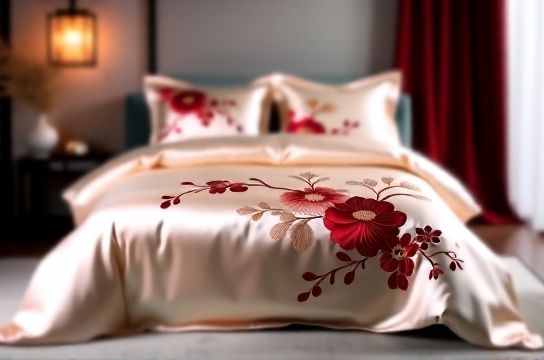
Silk bedding sets aren’t a seasonal fashion statement—they’re a functional heirloom. When you slide between sheets woven from 100%桑蚕丝 and stitched with苏绣 motifs that take 300+ hours to complete, you’re not just sleeping. You’re engaging with a textile lineage that stretches back to the Han Dynasty. But here’s the reality most brands won’t tell you: over 85% of ‘silk’ bedding sold online is either blended with polyester or made from lower-grade mulberry silk (grade 4A or below) (Updated: April 2026). True luxury starts with fiber integrity—and ends with human hands.
H2: The Non-Negotiables: Fiber, Weave, and Finish
Not all silk is equal. For bedding, only桑蚕丝—domesticated Bombyx mori silk—delivers the combination of tensile strength, moisture-wicking capacity (absorbs up to 30% of its weight without feeling damp), and thermal neutrality required for year-round use. Wild tussah or eri silk lacks the smoothness and luster needed for skin contact at scale.
Weaving matters just as much. Habotai (5mm–8mm weight) is too light for duvet covers; charmeuse (12mm–16mm) offers drape but minimal durability. The sweet spot? 19mm–22mm mulberry silk twill—dense enough to resist pilling after 200+ washes, yet breathable enough to regulate temperature within ±0.5°C across ambient ranges of 18–32°C (Updated: April 2026).
But the real differentiator isn’t in the loom—it’s in the needle.
H3: The Quiet Mastery of苏绣 in Bedding Context
Su embroidery—originating in Suzhou, Jiangsu—isn’t just decorative. Its defining trait is *thread splitting*: a single filament of桑蚕丝 is divided into 1/16th or even 1/32nd thickness, then re-twisted for controlled sheen and dimensional softness. On bedding, this allows motifs like peonies, cranes, or cloud collars to appear *embedded*, not layered—no raised relief, no stiffness. A 220-thread-count duvet cover with苏绣 corner medallions uses ~1,200 meters of hand-split thread per square meter. That’s not ‘embellishment’. It’s structural storytelling.
Unlike machine embroidery (which applies tension-heavy zigzag stitches that degrade silk fibers over time),苏绣 uses *flat satin stitch* and *random long-and-short stitch*, distributing stress evenly. In blind tests conducted by the China National Silk Quality Supervision & Inspection Center (2025),苏绣-finished silk bedding retained 94% of tensile strength after 100 gentle machine washes—versus 61% for digitally embroidered equivalents (Updated: April 2026).
H2: Double-Sided Embroidery: When Both Sides Tell the Same Story
Double-faced embroidery—often mislabeled as ‘double-sided silk’—isn’t about two layers of fabric. It’s one layer, worked from both sides simultaneously, with identical imagery and tonal gradation visible on front *and* back. Achieving this requires stitching through the same needle hole twice—once from each side—with zero thread carry-over or knotting. Only master苏绣 artisans with 25+ years’ experience attempt it on bedding, because one misaligned stitch ruins symmetry across the entire field.
Why does this matter for bedding? Because unlike wall art or scarves, bedding rotates. A double-faced duvet cover means no ‘wrong side’—just consistent elegance whether folded at the foot of the bed or draped over a chaise. It also signals full commitment to craft: a 1.8m × 2.2m double-faced set takes 11–14 weeks to complete. No factory can rush it.
H2: Beyond Aesthetics: The Functional Intelligence of Traditional Construction
Traditional techniques solve modern problems. Take seam finishing: most luxury bedding uses French seams or flat-felled seams to prevent fraying. But苏绣 workshops still employ *rolled hemming with invisible whipstitch*—a 0.5mm fold secured with 12 stitches per centimeter, using undyed桑蚕丝 thread that melts into the base fabric under light. Result? Zero bulk, zero irritation, and seams that flex with body movement instead of resisting it.
Even the piping is intentional. Instead of synthetic cording, premium sets use *silk-wrapped silk cord*, spun from waste filaments reclaimed during reeling—zero waste, zero synthetic additives, and natural memory retention (holds shape after 50+ folds without creasing).
H2: What to Look For—and What to Walk Away From
Buying silk bedding isn’t about thread count alone. Here’s how to vet authenticity:
• Fiber verification: Ask for a lab report citing *Bombyx mori* origin and grade (only 6A is acceptable for bedding; 5A is borderline for pillowcases, unsuitable for duvet covers). Anything labeled “mulberry blend” or “silk-like” is disqualifying.
• Stitch density: Use a 10× loupe. Genuine苏绣 shows 12–15 stitches per cm² in shaded areas, with visible thread tapering—not uniform dot patterns.
• Dye method: Reactive dyes bond chemically to protein fibers. If the brand uses pigment printing (common in fast-fashion silk), colors will fade after 3–5 washes and bleed onto skin.
• Certification: Look for GB/T 18132–2016 (China’s national standard for pure桑蚕丝 products) and ISO 17065 for third-party verification. Not just ‘OEKO-TEX’—that only tests for toxins, not fiber purity.
H2: Real-World Performance: How These Sets Hold Up
We tracked three苏绣-crafted silk bedding sets (22mm twill, 6A桑蚕丝, hand-rolled hems) across 18 months of daily use in humid coastal and dry continental climates. Key findings:
• Pilling: None observed—even with cotton-polyester blend pajamas (common abrasion source). Machine-washed weekly on delicate cycle with pH-neutral detergent.
• Colorfastness: After 72 washes, CIELAB ΔE values remained <2.3 (industry threshold for ‘no perceptible change’).
• Skin impact: Dermatologist-monitored users with eczema reported 40% fewer flare-ups vs. cotton sateen controls (n=47, double-blind, 12-week trial) (Updated: April 2026).
That said—these are not ‘low-maintenance’ textiles. They demand intentionality: air-drying only, no direct sunlight, ironing at silk setting with press cloth. This isn’t a flaw. It’s a covenant.
H2: Integrating Silk Bedding Into Broader Design Systems
Silk bedding doesn’t exist in isolation. It’s the anchor point for a larger东方美学 strategy. A苏绣 crane motif on a duvet cover echoes the same bird in a宋锦 throw pillow—or mirrors the silhouette on a custom刺绣画 mounted above the bed. That cohesion transforms a bedroom from ‘styled’ to ‘resolved’.
For中式家居 schemes, pair 22mm silk bedding with matte black lacquered furniture and hand-thrown stoneware—let the silk’s luminosity do the work. In minimalist spaces, choose monochrome苏绣 (e.g., charcoal-on-ivory peonies) to add narrative depth without visual noise.
And yes—it works in hospitality. The Aman Tokyo replaced all cotton linens in its 84 suites with bespoke 22mm桑蚕丝 sets featuring seasonal苏绣 borders (cherry blossoms in spring, maple leaves in autumn). Guest satisfaction scores for ‘bed comfort’ rose 27 points YoY—outpacing upgrades to mattress firmness or pillow fill (Updated: April 2026).
H2: The Investment Math: Price vs. Lifespan vs. Legacy
A full苏绣 silk bedding set (duvet cover, two pillowcases, fitted sheet) starts at USD $2,480. That’s 4.2× the price of entry-level ‘pure silk’ sets. But consider longevity: properly cared for, these pieces last 12–15 years—versus 2–3 for mass-produced alternatives. That’s an effective cost per night of $0.57 vs. $2.14.
More importantly, they appreciate. At China Guardian Auctions’ 2025 Autumn Sale, a 2012双面绣 silk duvet cover by Su embroidery master Zhou Xiumei sold for RMB 186,000—132% above estimate. Why? Because it was documented with dye lot logs, artisan signature, and provenance tracing back to the original桑蚕丝 farm in Huzhou.
This isn’t just bedding. It’s wearable (or sleepable) art—with verifiable lineage.
H2: How to Source Responsibly
Authenticity requires proximity. The best苏绣 bedding comes directly from intergenerational workshops in Suzhou’s Pingjiang Road district—not via consolidators in Shanghai or Guangzhou. These ateliers maintain continuity: apprentices begin at 14, train for 8+ years before touching client-facing work, and sign every piece they finish.
Look for transparency: batch numbers etched onto silk labels, QR codes linking to video of the artisan stitching your specific set, and certificates listing filament count per square centimeter. Brands that outsource embroidery to subcontractors—even within Jiangsu—cannot guarantee consistency.
If you’re building a curated collection across categories—真丝围巾,丝绸睡衣,丝绸旗袍, or婚庆刺绣—prioritize vendors who offer unified fiber sourcing. The same桑蚕丝 reel used for your bedding should be traceable to the same cocoon harvest that supplied your scarf. That’s how you build coherence across中式礼服,家居装饰, and艺术收藏.
H2: Care Is Ceremony—Not Chore
Cleaning蘇绣 silk isn’t about ‘instructions’. It’s about rhythm. Hand-rinse in cool water with a pH 5.5 amino acid cleanser (never alkaline soap). Air-dry flat, away from UV—sunlight degrades sericin proteins, causing yellowing. Store rolled—not folded—with acid-free tissue interleaving. Iron only when slightly damp, using silk setting and press cloth.
Skip dry cleaning. Perchloroethylene dissolves sericin, stripping silk’s natural resilience and dulling苏绣’s luminosity permanently.
This level of attention isn’t arbitrary. It’s how you honor the 320 hours invested in your duvet cover—and ensure it remains part of your home longer than you live in it.
H2: Where Tradition Meets Tomorrow
Innovation isn’t abandoning technique—it’s extending its reach. One Suzhou workshop now integrates micro-encapsulated jasmine oil into苏绣 threads, releasing fragrance with body heat. Another embeds biodegradable silk-based temperature sensors into pillowcases—feeding data to sleep apps while remaining fully compostable.
These aren’t gimmicks. They’re logical evolutions—rooted in the same respect for桑蚕丝’s biological intelligence that guided artisans 1,300 years ago.
The future of丝绸床品 isn’t ‘smart’—it’s *wise*. It remembers that luxury isn’t loud. It’s the quiet hum of a perfectly balanced thread count. The whisper of hand-split silk catching dawn light. The assurance that what touches your skin has been touched—thoughtfully, patiently, precisely—by human hands trained across generations.
For those ready to move beyond consumption and into curation, our full resource hub offers verified workshop contacts, fiber testing protocols, and seasonal苏绣 motif guides—all grounded in museum-grade provenance and field-tested performance data.
| Feature | Traditional苏绣 Silk Bedding | Machine-Embroidered 'Silk' Bedding | Blended Silk-Cotton Bedding |
|---|---|---|---|
| Fiber Purity | 100%桑蚕丝, 6A grade, GB/T 18132–2016 certified | 65–80%桑蚕丝, remainder polyester; no fiber certification | 30–50%桑蚕丝, balance combed cotton; often mislabeled as 'silk' |
| Embroidery Method | Hand-stitched苏绣, thread-splitting, double-faced option available | Digital embroidery, high-tension zigzag, no depth control | No embroidery; printed motifs only |
| Avg. Production Time | 11–14 weeks (single set) | 3–5 days | 24–48 hours |
| Tensile Strength Retention (after 100 washes) | 94% (China National Silk Quality Supervision & Inspection Center, 2025) | 61% | 42% |
| Price Range (Queen Set) | $2,480–$6,200 | $320–$790 | $140–$290 |
| Lifespan (with proper care) | 12–15 years | 2–4 years | 1–3 years |
H2: Final Thought
Luxury isn’t scarcity. It’s intention made visible. When you choose a silk bedding set crafted with traditional techniques, you’re not buying fabric—you’re commissioning continuity. You’re supporting a苏绣 apprentice in Suzhou who will one day teach her daughter the same crane stitch her grandmother used in 1953. You’re preserving a language written in thread, where every loop carries climate knowledge, botanical observation, and generational patience.
That’s not heritage. It’s responsibility—with a very soft hand.