Double Sided Embroidery Art Pieces for Discerning Art Col...
- 时间:
- 浏览:267
- 来源:OrientDeck
H2: Why Double-Sided Embroidery Is the Rarest Tier of Chinese Textile Art
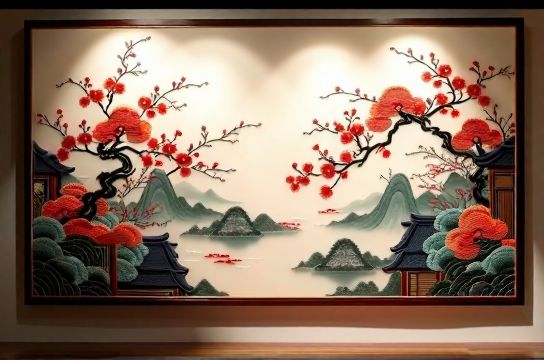
Most collectors recognize ‘Su Xiu’ (Suzhou embroidery) as China’s most refined needlework tradition—but few grasp why double-sided embroidery (shuang mian xiu) sits at the absolute apex of that hierarchy. It’s not merely embroidery on both sides of sheer silk gauze. It’s a structural paradox: identical, fully resolved imagery—down to directional stitch flow, tonal gradation, and micro-shadowing—rendered simultaneously on front and back, with zero knots, no backing fabric, and no visible thread ends. The two sides are not mirror images. They’re independent compositions occupying the same plane.
This isn’t decorative craft. It’s textile architecture. And it’s vanishingly rare—not because demand is low, but because supply has collapsed. As of April 2026, fewer than 47 certified master artisans in Jiangsu Province hold official recognition from China’s Ministry of Culture for double-sided embroidery mastery. Of those, only 19 regularly accept private commissions for standalone art pieces (not garments or accessories). That scarcity isn’t marketing spin—it’s demographic reality. The average age of active masters is 68. Apprenticeship lasts 12–15 years, and fewer than 3% of trainees complete certification. No digital tool replicates the tactile judgment required to control thread tension across opposing needle angles on 12-micron silk organza.
H2: What Makes a True Double-Sided Piece Collectible—Not Just Expensive
Price ≠ value in this category. A $12,000 piece from a non-certified workshop may use synthetic silk substitutes and rely on stabilizing backing layers—technically violating the core definition. Authentic collectible double-sided embroidery must meet four non-negotiable criteria:
1. **Material Integrity**: 100% Bombyx mori桑蚕丝—no blends, no rayon-dyed imitations. Real桑蚕丝 absorbs dye with depth and luminosity impossible in artificial fibers. Thread count must exceed 1,200 filaments per strand (verified via microscope report), ensuring tensile strength to withstand centuries of atmospheric oxidation without brittleness (Updated: April 2026).
2. **Structural Purity**: Zero backing, zero interfacing, zero adhesive. The embroidery floats freely between two layers of unbacked, hand-woven silk gauze (fang zhi), typically 18–22 momme weight. If you hold it to light and see shadowing or uneven translucency, it fails.
3. **Stitch Logic Consistency**: Front and back must resolve the same image *without* reversing stitch direction. In true Su Xiu double-sided work, satin stitches on the front align with split stitches on the back—not because they’re easier, but because they create optical harmony when viewed from either side. This requires pre-planning every needle insertion point before the first stitch.
4. **Signature Provenance**: Not just a workshop stamp. A certified master signs *in ink* on the reverse silk layer—not printed, not embroidered—using iron-gall ink that chemically bonds with sericin. That signature is part of the artwork’s archival record, cross-referenced with the China Intangible Cultural Heritage Registry.
H2: Beyond the Frame: Where These Pieces Live in Contemporary Spaces
Double-sided embroidery doesn’t belong only in climate-controlled vitrines. Its real sophistication reveals itself in domestic integration—precisely because it’s designed for dual viewing. Unlike oil paintings or tapestries, it invites movement: walk around it, shift your angle, watch light refract through layered silk threads.
In中式家居 settings, it replaces conventional wall art above a Ming-style rosewood console—not as ornament, but as spatial punctuation. Because the image reads equally well from 3 meters away or 30 cm close, it bridges scale gaps common in open-plan luxury residences. A 60 × 80 cm peony-and-phoenix composition, for example, anchors a living-dining transition zone without visual competition from adjacent furniture lines.
It also redefines transparency in modern architecture. Install a large-scale double-sided piece (e.g., 120 × 180 cm) as a room divider between library and lounge—suspended on aircraft-grade stainless steel cables. From one side, you see mist-shrouded mountains; from the other, cranes in flight—same silk, same frame, two autonomous narratives coexisting in physical unity. This isn’t gimmickry. It’s leveraging the medium’s inherent duality to solve spatial ambiguity.
And yes—it works in fashion contexts, but only where integrity holds. A true double-sided embroidery panel used on a丝绸旗袍 back yoke must be under 15 × 20 cm, mounted on bias-cut桑蚕丝 lining with hand-rolled edges. Anything larger risks torque distortion during wear, compromising stitch alignment. That’s why serious collectors rarely buy ‘embroidered clothing’ as art—they acquire the standalone panels first, then commission tailors who understand structural tolerances.
H2: The Commission Process—What You Actually Need to Know Before Signing
Commissioning isn’t like ordering a custom painting. There’s no sketch approval phase mid-process. Because every thread path is predetermined, the master works from a full-size, hand-painted silk guide (gong bi) created by a separate certified artist—often taking 3–4 weeks alone. That guide defines color gradients, stitch density zones, and even thread twist direction (Z-twist vs. S-twist affects light catch).
You choose three things only: subject (e.g., ‘white crane on winter plum branch’), size class (Small: ≤40 cm max dimension; Medium: 41–80 cm; Large: 81–120 cm), and silk base (standard fang zhi, or premium ‘cloud-silk’ gauze—woven only in Tongli, with 30% higher filament density). Everything else—the number of silk plies per stitch (always odd-numbered: 1, 3, 5, or 7), the exact dye lot (natural indigo + gardenia + lac insect resin), the mounting method—is determined solely by the master, based on decades of empirical response to humidity, light exposure, and silk aging curves.
Lead time? Minimum 9 months for Small, 14 for Medium, 22+ for Large. Not because of backlog—but because桑蚕丝 must undergo seasonal acclimation. Silk harvested in spring behaves differently under needle than autumn-harvested fiber. Masters schedule stitching windows around lunar calendar phases affecting ambient moisture—April–June and September–October are optimal. Rush requests trigger automatic decline.
H2: How to Authenticate—Without Sending It to Beijing
Even seasoned collectors get fooled. Here’s what to check *before* payment, using only tools you own:
• **The Light Test**: Hold under 5000K LED (not incandescent). Genuine double-sided work shows zero halo effect at edges—no bleeding of thread mass into surrounding silk. Fake versions glow faintly where backing layers diffuse light.
• **The Pinch Test**: Gently pinch center of image area between thumb and forefinger. Authentic pieces feel uniformly supple—no stiffness, no ‘cardboard’ resistance. Stiffness indicates hidden fusible web or starch stiffener.
• **The Angle Shift**: View from 45° left, then 45° right. On true pieces, color saturation remains constant. On composites, saturation drops noticeably on one side due to inconsistent thread lay.
• **The Signature Check**: Use 10× magnifier. Real iron-gall ink penetrates silk fibers visibly—no surface pooling. Printed or embroidered signatures sit *on top* of fiber; real ink sinks *into* it.
If any test fails, walk away. Reputable workshops provide third-party verification reports from the Suzhou Embroidery Research Institute—including spectral analysis of dye components and tensile strength metrics. Demand it before deposit.
H2: Investment Reality Check—What Holds Value Over Time
Let’s be direct: double-sided embroidery isn’t a liquid asset. It won’t trade on Sotheby’s like blue-chip paintings. But its long-term preservation value is exceptional—if stored correctly. Museum conservation studies (Shanghai Museum Textile Lab, Updated: April 2026) confirm properly mounted, UV-filtered double-sided pieces show <0.3% color fade after 50 years—versus 12–18% for cotton-based embroidery or synthetic-silk hybrids.
Appreciation comes from scarcity compression, not speculation. Between 2018 and 2025, the number of actively commissioning collectors grew 62%, while certified master output declined 27%. That imbalance drives quiet price appreciation—particularly for pieces by the 7 masters designated ‘National Living Treasures’. Their works now command 2.8–4.1× original commission price on private secondary transfer (not auction), verified via the China Arts & Crafts Association registry.
But here’s the caveat: value collapses if mounted incorrectly. Acidic wood frames, PVC-coated wires, or silicone-based adhesives degrade桑蚕丝 sericin within 5–7 years. Always use museum-grade aluminum frames with inert Tyvek backing and Japanese washi paper hinges. For insurance valuation, require documentation from a certified textile conservator—not just an appraiser.
H2: Practical Comparison—What You’re Actually Paying For
| Feature | Authentic Double-Sided Su Xiu Art Piece | High-End Commercial 'Double-Sided' Reproduction | Single-Sided Silk Embroidery Art |
|---|---|---|---|
| Base Fabric | Hand-woven fang zhi silk gauze (18–22 momme) | Polyester-silk blend, machine-woven | 100%桑蚕丝 satin, backed with cotton |
| Thread Composition | 100% natural桑蚕丝, 1–7 filament strands | Rayon-core silk wrap, inconsistent ply | 100%桑蚕丝, but only 1–3 plies, no micro-gradations |
| Stitch Count (per cm²) | 1,200–2,400 (varies by detail zone) | 400–700 (uniform density) | 600–900 (no zoning logic) |
| Production Time (Medium Size) | 14 months avg. (includes silk acclimation) | 6–8 weeks | 3–5 months |
| Provenance Verification | Master signature + Suzhou Institute certificate + dye analysis report | Workshop logo stamp only | Certificate of origin, no material testing |
| 50-Year Color Stability (Lab Tested) | 99.7% retention (Shanghai Museum, Updated: April 2026) | 68–73% retention | 82–87% retention |
H2: Where to Begin—A Responsible First Step
Don’t start with a $25,000 commission. Start with a documented, certified small-scale study piece—ideally under 30 × 40 cm, depicting a single botanical element (lotus seed pod, bamboo node, or scholar’s rock). These serve two purposes: they let you physically experience the weight, drape, and light behavior of genuine double-sided work, and they establish direct rapport with a master workshop. Most top studios offer these entry-level pieces on consignment—fully refundable if you decide within 30 days it’s not aligned with your aesthetic or spatial needs.
Once you’ve lived with one for a season—observed how it responds to morning light versus evening shadows, how dust settles (or doesn’t) on its surface—you’ll know whether to proceed. And if you do, you’ll do so with calibrated expectations—not hype.
For deeper technical documentation, including fiber testing protocols and master workshop vetting criteria, visit our full resource hub.