Tea Education for Families: Fun Activities & Cultural Sto...
- 时间:
- 浏览:200
- 来源:OrientDeck
H2: Why Tea Education Belongs at the Family Table
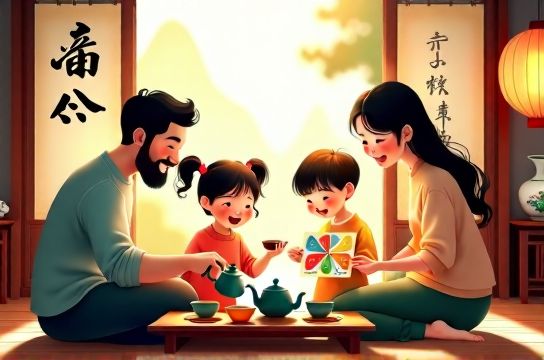
Tea isn’t just a beverage—it’s a tactile, sensory, intergenerational language. In homes where screen time dominates, shared tea rituals offer rare pockets of slowness, curiosity, and presence. But let’s be honest: handing a six-year-old a gaiwan and saying “let’s practice gongfu cha” rarely ends well. The magic lies not in replicating formal tea ceremonies—but in designing accessible, repeatable, joyful entry points rooted in real tea culture.
This isn’t about turning kids into certified tea sommeliers. It’s about building neural pathways through smell, touch, memory, and story—so that decades later, the scent of roasted oolong or the weight of a Yixing zisha teapot triggers warmth, connection, and quiet confidence in their own palate.
H2: Tasting Games That Build Real Sensory Literacy
Tasting isn’t passive. It’s comparative, contextual, and cumulative. Below are three low-prep, high-engagement games tested across urban homeschool co-ops, museum family programs, and intergenerational tea circles in Hangzhou and Kunming (Updated: April 2026).
H3: The Color-Scent-Mood Trio
Use five teas with strong visual and aromatic signatures: Dragon Well (green, vegetal, chestnut), Keemun Black (amber, fruity, malty), Silver Needle White (pale gold, delicate, honeyed), Shou Pu’er (deep brown, earthy, woody), and Tieguanyin Oolong (golden-yellow, floral, orchid-like). Brew each at standard parameters (85°C for greens/whites, 95°C for oolongs/blacks, 100°C for ripe pu’er; 3g per 150ml, 2-minute steep). Serve in clear glass cups—not porcelain—to highlight color differences.
Ask participants to assign one word for color, one for scent, one for mood (e.g., “moss-green / steamed bok choy / calm”). No right answers—only observation. Record responses on a shared board. Over 3–4 sessions, patterns emerge: children consistently link darker infusions with “cozy” or “grandpa’s study”; lighter ones with “sunlight” or “morning.” This builds associative literacy—the foundation for later nuance.
H3: Temperature Detective
Cold-brewed jasmine green tea and hot-brewed Dianhong black tea can taste startlingly similar in sweetness and body—but only if you skip temperature context. So we reverse it: blind-taste two identical-looking infusions—one chilled (cold-brewed Longjing, 12h at room temp), one hot (same leaf, 80°C, 2 min). Ask: “Which feels more like a summer afternoon? Which feels like a winter morning?” Then reveal temperature. Discuss how heat unlocks volatile aromatics (linalool in jasmine) while cold extraction favors amino acids (theanine in Longjing)—why one tastes brighter, the other rounder. This introduces chemistry without jargon.
H3: The Leaf Life Cycle Sorting Game
Lay out dried leaves, infused leaves (rinsed and spread on parchment), and photos of the plant (e.g., Camellia sinensis var. sinensis for Longjing vs. var. assamica for Pu’er). Add cards: “plucked in spring,” “shaded for 20 days,” “fermented 72 hours,” “compressed into tuo cha,” “aged 8 years.” Let kids physically sort steps into chronological order. Mistakes spark discussion: “Why is white tea *less* processed than green tea—even though it looks ‘drier’?” Answer: minimal handling, no kill-green step—just withering and drying. This grounds abstract terms like “oxidation” and “fermentation” in tangible cause-and-effect.
H2: Cultural Storytelling That Sticks (Without Lecturing)
Facts fade. Stories linger. The key is anchoring tea history in human-scale moments—not dynasties or dates, but choices, constraints, and quirks.
H3: The Accidental Invention of Pu’er
Tell it like this: “In the 1400s, tea merchants carried compressed tea cakes from Yunnan to Tibet on horseback. The journey took months. Rain, sweat, dust, and body heat soaked into the cakes. When they opened them in Lhasa, the tea tasted *different*—richer, smoother, less astringent. They didn’t throw it away. They drank it. And liked it. That ‘spoilage’ was microbial fermentation—now prized as shou pu’er. The lesson? Some of China’s most beloved teas began as happy accidents—and patience transformed flaws into tradition.”
Pair this with a side-by-side tasting: raw (sheng) pu’er (grassy, vibrant, tannic) vs. ripe (shou) pu’er (earthy, mellow, velvety). Let kids decide which ‘accident’ they prefer.
H3: Lu Yu’s Runaway Teacup
Lu Yu, author of the 8th-century *Classic of Tea*, wasn’t born a sage—he was an orphan raised by Zen monks who made him wash *hundreds* of teabowls daily. One day, he dropped a Jian Zhan (a dark-glazed Song-dynasty bowl) and watched the glaze pool and crackle like oil on water. He sketched it. Later, he wrote that “the best tea vessel reveals the tea—not itself.” That’s why Jian Zhan bowls—made in Fujian’s Jianyang kilns—have thick walls (to retain heat), iron-rich glaze (for subtle mineral notes), and unpredictable hare’s-fur or oil-spot patterns (each unique, like fingerprints). Today, modern Jian Zhan artisans still fire in wood-fired kilns for up to 40 hours. Their work appears in our complete setup guide, alongside sourcing tips for ethical small-batch makers.
H2: Hands-On Tea Ware Exploration (No Collecting Required)
You don’t need a $2,000 Yixing zisha teapot to explore clay’s impact. Start with what you have—and add one intentional piece per quarter.
H3: Clay vs. Ceramic: A 10-Minute Experiment
Brew the same batch of Tieguanyin oolong in three vessels: - A thin-walled porcelain gaiwan (neutral, bright) - A thick-walled stoneware mug (earthy, muted) - A small unglazed Yixing-style clay cup (even if mass-produced—look for “zisha-inspired,” not “authentic Yixing,” which requires seasoning)
Note differences in mouthfeel: does the clay soften astringency? Does porcelain lift floral notes? This isn’t about “best”—it’s about *material intention*. Just as a violinist chooses gut vs. steel strings for tone, tea drinkers choose vessels for effect.
H3: Build-Your-Own Tea Tray (Ages 8+)
A tea tray isn’t decorative—it’s functional hydrology. Kids measure absorption rates: pour 50ml water onto bamboo, slate, and ceramic trays. Time how long until surface puddles vanish. Bamboo wicks fast (good for quick service); slate holds moisture (ideal for slow, contemplative sessions); ceramic sits in between. Then design a tray layout: reservoir placement, drainage slope, space for waste water. This merges engineering, aesthetics, and practicality—core tenets of Chinese tea ware philosophy.
H2: Practical Integration: Scheduling, Sourcing, and Sustainability
Real families need realism—not ideals. Here’s what works: - **Time**: 15 minutes, twice weekly. Not daily. Consistency > duration. - **Cost**: Start under $40. A $12 ceramic tea set (lead-free, dishwasher-safe), $15 of sample-size teas (Longjing, Dianhong, Bai Mudan), and $8 for a bamboo tea tray covers basics. - **Storage**: Use amber glass jars with airtight seals—no plastic. Store white and green teas in the fridge (4°C); oolongs and blacks in cool, dark cabinets; pu’er at stable 20–25°C with 60–70% RH (Updated: April 2026). Avoid direct sunlight—UV degrades catechins in under 48 hours.
H2: What *Not* to Do (And Why)
- Don’t force “proper” posture. Slouching while sipping Longjing is fine. Presence matters more than poise. - Don’t gatekeep vocabulary. “Grassy” is as valid as “umami.” Let definitions emerge from experience—not flashcards. - Don’t buy “starter kits” with generic “Chinese tea blends.” These obscure origin, cultivar, and processing. Instead, source single-origin samples: Fujian Zhenghe Bai Mudan (white), Anxi Tieguanyin (oolong), Yunnan Menghai Shou Pu’er (black/fermented), Zhejiang Xihu Longjing (green), Fujian Qimen Dianhong (black). Reputable vendors include Jing Tea, Yunnan Sourcing, and Seven Cups—each offers transparent harvest dates and farmer partnerships.
H2: Measuring Progress Beyond Tests
There’s no exam. Progress shows up subtly: - A teen starts noticing bitterness in over-steeped tea—and adjusts time without prompting. - A child asks, “Why does this oolong smell like peaches but taste like toast?” - Grandparents share stories about tea rationing during the 1960s—or how their mother packed jasmine pearls in cloth pouches for weddings.
That’s the real metric: tea becomes a bridge, not a subject.
H2: Comparative Guide: Family-Friendly Tea Ware Options
| Item | Best For | Key Specs | Pros | Cons | Starting Price (USD) |
|---|---|---|---|---|---|
| Ceramic Tea Set (3-cup) | Families new to brewing; easy cleanup | Lead-free glaze, dishwasher-safe, 120ml capacity per cup | Durable, neutral flavor profile, wide availability | Less heat retention than clay or cast iron | $18 |
| Bamboo Tea Tray | First-time tray users; small spaces | 12" x 8", grooved surface, integrated reservoir | Lightweight, sustainable, absorbs spills quickly | Requires oiling every 3 months to prevent cracking | $22 |
| Yixing Zisha-Inspired Cup | Ages 10+; exploring clay’s effect on taste | Unglazed, hand-thrown, 80ml, fired at 1180°C | Softens astringency, develops patina over time, authentic texture | Not dishwasher-safe; must be dedicated to one tea type | $34 |
| Jian Zhan Reproduction | Story-driven tasting; visual engagement | Iron-rich glaze, 100ml, wood-fired (modern electric kiln version) | Highlights tea’s body and texture, dramatic visual patterns | Fragile; heavy; higher price point | $68 |
H2: Final Thought: Tea as Living Curriculum
Tea education for families succeeds when it mirrors how humans actually learn: through repetition, variation, and emotional resonance. A child who sorts tea leaves learns botany. One who sketches Jian Zhan glaze patterns engages with materials science and art history. A teen who compares cold-brewed Longjing to hot-brewed explores thermodynamics—and discovers their own preferences without judgment.
None of this requires perfection. It requires showing up—with curiosity, a kettle, and willingness to let the tea lead. Because in the end, Chinese tea isn’t preserved in museums. It lives in steaming cups, shared laughter, and the quiet pride of a nine-year-old who says, “This Longjing tastes like fresh peas—and I know why.”